ISO 27001 is the international standard that answers this demand. It gives enterprise buyers, insurance carriers, and regulated partners an objective signal that your organization manages information security systematically, not reactively. The problem is that most SMB owners don't know where to start, what it actually costs, or how long it takes.
This guide covers all of it: what ISO 27001 requires, how the certification process works step by step, realistic cost considerations, common mistakes that derail SMBs, and what to look for in a compliance partner, written specifically for organizations without a dedicated security team.
Key Takeaways
- ISO 27001 is an internationally recognized standard for building and maintaining an Information Security Management System (ISMS), including SMBs.
- Certification isn't legally mandatory in most US contexts, but enterprise clients, government contractors, and regulated industries increasingly require it.
- The process typically takes 3–9 months for SMBs, depending on company size and security maturity.
- Costs include internal labor, consulting fees, and certification body audit fees; budget accordingly before scoping the project.
- ROI comes from avoided breach costs, won enterprise contracts, and lower cyber insurance premiums.
- Maintaining compliance post-certification requires continuous monitoring, not a one-time effort.
What Is ISO 27001 and Why Does It Matter for SMBs?
If you run a small or mid-sized business and assume ISO 27001 is something only large enterprises worry about, that assumption is costing you deals. ISO 27001 is the international standard published by ISO/IEC for establishing and maintaining an Information Security Management System, and it applies to organizations of any size or industry.
The standard is built around three core principles, commonly called the CIA triad:
- Confidentiality: ensuring information is accessible only to authorized parties
- Integrity: protecting data from unauthorized modification
- Availability: ensuring systems and data are accessible when needed
These map directly to what enterprise clients, procurement teams, and regulators evaluate when they assess a vendor's security posture. Fail on any one of them, and you lose the contract.
The "It's Only for Large Companies" Myth
Many SMBs assume ISO 27001 is out of scope for their size. According to the SBA, approximately 43% of cyberattacks target small businesses, and smaller organizations are attractive targets precisely because their defenses tend to be less mature than those at large enterprises.
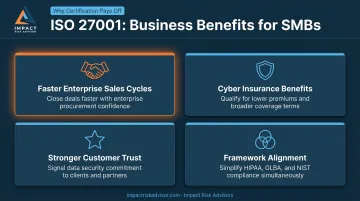
The business case extends beyond defense. ISO 27001 delivers four concrete outcomes for SMBs:
- Faster enterprise sales cycles: certification satisfies vendor security questionnaires and procurement requirements without lengthy back-and-forth
- Cyber insurance benefits: demonstrated risk management maturity is increasingly factored into underwriting decisions
- Stronger customer trust: particularly in regulated sectors like healthcare and financial services, where clients scrutinize vendor security rigorously
- Framework alignment: ISO 27001 overlaps significantly with HIPAA, GLBA Safeguards Rule, and NIST 800-53, meaning controls you build for certification carry over across your compliance obligations
The 2022 Update: What Changed
Understanding those business benefits is one thing; knowing which version of the standard you're working toward is another. The current version is ISO/IEC 27001:2022, replacing the 2013 revision. If you're starting certification today, this is the target.
Key changes relevant to SMBs:
- Annex A was reorganized from 14 domains with 114 controls into 4 categories with 93 controls
- 11 new controls were added, including Threat Intelligence (A.5.7), Information Security for Use of Cloud Services (A.5.23), and Data Leakage Prevention (A.8.12)
- The new structure better reflects modern operating environments: cloud infrastructure, remote work, and software supply chains
If you were previously working toward the 2013 version, the controls, categories, and scope have all shifted; starting from the current version avoids rework later.
What ISO 27001 Certification Actually Requires
ISO 27001 has two parts: the main body (Clauses 4–10), which are mandatory, and Annex A, which provides 93 reference controls.
The Mandatory Clauses (4–10)
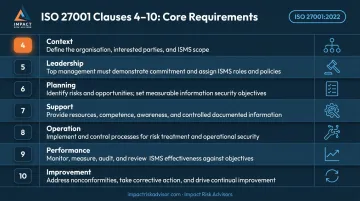
Each clause demands something specific from your organization:
| Clause | What It Requires |
|---|---|
| 4: Context | Define your ISMS scope, identify internal/external issues, map interested parties |
| 5: Leadership | Assign accountability at the executive level; document an Information Security Policy |
| 6: Planning | Conduct a formal risk assessment; set security objectives |
| 7: Support | Allocate resources, build competence, create required documentation |
| 8: Operation | Implement your risk treatment plan and security controls |
| 9: Performance | Conduct internal audits and management reviews |
| 10: Improvement | Address nonconformities; commit to continual improvement |
Annex A Controls by Category
Not every control is required; your Statement of Applicability (SoA) documents which controls you've selected and why, based on your risk assessment. Here's a breakdown of the 2022 categories with representative SMB examples:
| Category | Controls | SMB Examples |
|---|---|---|
| Organizational (A.5) | 37 | Information security policies, cloud service management, supplier security |
| People (A.6) | 8 | Security awareness training, remote working policies, NDAs |
| Physical (A.7) | 14 | Physical access controls, security monitoring, media handling |
| Technological (A.8) | 34 | Secure authentication, configuration management, encryption, DLP |
The Documentation Burden
This is where most SMBs underestimate the effort. Mandatory documented information includes:
- ISMS scope document
- Information Security Policy
- Risk assessment and risk treatment methodology
- Statement of Applicability
- Risk treatment plan
- Internal audit results and program
- Management review records
- Evidence of competence and security awareness
Creating this documentation from scratch, while also implementing the underlying controls, is the most resource-intensive phase of certification.
Compliance vs. Certification
An SMB can self-declare compliance with ISO 27001 at any time. Formal certification, however, requires a two-stage audit by an accredited third-party certification body. Only certification provides externally verified proof, which is what enterprise clients, insurance carriers, and regulated partners require. In practice, self-declaration carries no weight in enterprise procurement reviews or insurance underwriting.
The ISO 27001 Certification Process: Step by Step
Step 1: Gap Assessment
Start by benchmarking your current security practices against ISO 27001 requirements. For most SMBs with no formal ISMS, the gap is significant. This assessment produces your implementation roadmap and gives you a realistic timeline. Skipping or rushing this step leads to scope creep and rework later.
Step 2: ISMS Design and Risk Assessment
Define your ISMS scope, inventory your information assets, and conduct a formal risk assessment, identifying threats, vulnerabilities, and the likelihood and impact of each risk. From this, you select the Annex A controls that address your specific risk profile and document your decisions in the SoA.
Auditors scrutinize risk-based decision-making above nearly everything else. If your SoA can't justify why each control was selected or excluded, expect findings.
Step 3: Documentation, Policy Building, and Control Implementation
Create your required documentation, build your policies and procedures, implement the selected controls, and train staff on new processes. For SMBs without a dedicated security team, this phase is where timelines most commonly slip, typically due to policy drafting backlogs and the effort required to document processes that have never been formally written down.
Step 4: Internal Audit and Management Review
Before the external audit, you must:
- Conduct an internal audit to verify the ISMS is functioning as documented
- Hold a management review to confirm leadership is engaged and objectives are being met
Neither is optional. Auditors will request records of both. An internal audit that exists only on paper, with no real testing of controls, is a common source of major nonconformities.
Step 5: Stage 1 and Stage 2 Certification Audit
The external audit has two stages:
- Stage 1 (Documentation Review): The auditor assesses whether your ISMS is adequately designed and documented.
- Stage 2 (On-Site Audit): The auditor verifies that controls are actually implemented and operating effectively. This is where paper-only programs fail.
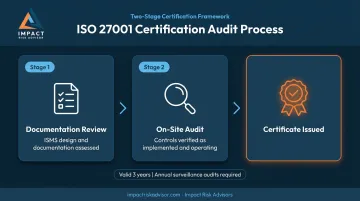
If the auditor identifies nonconformities, you address them before a certificate is issued. According to ISMS.online, most organizations achieve certification within 3 to 14 months, depending on size and maturity.
Your certificate is valid for 3 years, with annual surveillance audits required to maintain it. Those surveillance audits aren't a formality; they're how ISO 27001 stays a living program rather than a one-time project.
How Much Does ISO 27001 Compliance Cost for an SMB?
ISO 27001 costs vary too much by scope, company size, and control complexity for any single number to be reliable. What is consistent is the cost structure, and understanding it helps you budget accurately before a single scoping conversation. Three components drive the total:
Cost Components
- Internal labor: Staff time for documentation, risk assessment, evidence collection, and training. This is frequently the largest hidden cost, especially when it pulls team members away from revenue-generating work.
- External consulting fees: Readiness support, gap assessment, implementation guidance, and audit prep. Fees scale with company size, ISMS scope, and the complexity of your control environment.
- Certification body fees: Stage 1 and Stage 2 audit fees, typically calculated based on in-scope employee headcount. These are separate from consulting costs and paid directly to the accredited certification body.
Controlling Costs
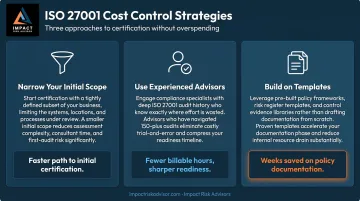
Three strategies meaningfully reduce total investment:
- Narrow your initial scope: Certify the business unit or product line that faces the most client scrutiny first, then expand. Fewer in-scope systems means fewer controls, less documentation, and lower audit fees.
- Use experienced advisors: Consultants who know the standard catch problems before an auditor does. An advisor who has guided 50 SMBs through Stage 2 audits reduces rework that generic template distribution never will.
- Build on templates, not from scratch: Proven policy templates cut documentation time substantially, provided they're adapted to your actual environment rather than used as-is.
The ROI Frame
Once you understand what cost control looks like, the investment calculus becomes clearer. IBM's research found that organizations with fewer than 500 employees averaged $2.98M in breach costs in 2021, a number that has trended upward every year since.
A single prevented breach, or one enterprise contract won because your security posture cleared procurement, typically exceeds the full cost of certification. That's the comparison worth making.
Common SMB Mistakes That Delay ISO 27001 Certification
Mistake 1: Treating It as a Documentation Project
The most common certification failure mode: SMBs create policies and procedures that exist on paper but aren't embedded in actual operations. Auditors test whether controls work, not whether documents exist. If your access control policy says you conduct quarterly access reviews but you've never run one, that's a nonconformity, regardless of how polished the policy looks.
Mistake 2: Underestimating Internal Resource Commitment
Many SMBs assume an external consultant or compliance software will handle everything. They won't. Someone inside your organization must own the process, and that means covering:
- Risk assessment ownership and ongoing updates
- Evidence collection and documentation maintenance
- Management review coordination
- Primary ISMS point of contact for auditors
Without that internal accountability, projects stall, documentation goes out of date, and the Stage 2 audit exposes every gap.
Mistake 3: Neglecting Ongoing Compliance Post-Certification
ISO 27001 is not a one-time achievement. Organizations that treat certification as a finish line, rather than the start of an operational program, routinely struggle at surveillance audits. Continuous monitoring, timely internal audits, and active risk management aren't optional maintenance items. Miss enough of them, and you're looking at a major nonconformity, or losing the certificate entirely.
Avoiding these mistakes comes down to one thing: treating ISO 27001 as an operational commitment from day one, not a project with a finish line.

How to Choose the Right ISO 27001 Compliance Partner
The difference between a genuine compliance partner and a point-in-time consultant comes down to what happens after certification. A consultant delivers documentation and moves on. A partner stays involved: managing surveillance audits, adapting controls as your business evolves, and maintaining the ISMS alongside you long-term.
For resource-constrained SMBs without a CISO, the embedded model is more effective. You get continuity, institutional knowledge, and someone who already understands your risk environment when the annual surveillance audit arrives.
What to Evaluate in a Partner
- Prioritize firms with SMB experience in your sector (financial services, healthcare, SaaS, or government contracting). They'll understand adjacent frameworks, regulatory context, and what enterprise clients expect from your controls.
- Verify the approach is risk-based, not templated. Generic control application produces generic ISMSs. Your partner should explain why specific controls fit your specific risk profile.
- Look for practitioners, not project managers. You want advisors who have sat in audit rooms, fielded auditor questions, and helped clients remediate nonconformities under real deadline pressure.
- Ask directly about post-certification involvement: what does their role look like in months 13–36?
Impact Risk Advisors works with SMBs in regulated industries using this model. With 150+ compliance audits supported and a vCISO leadership structure, the firm guides clients through the full ISMS lifecycle, from initial scoping through ongoing surveillance audit preparation and continuous monitoring.
Questions to Ask Any Prospective Partner
- How do you tailor ISMS scope for a business our size?
- Can you provide references from clients in our industry who passed their Stage 2 audit?
- What does your involvement look like in months 13–36, after we receive our certificate?
Frequently Asked Questions
How much does ISO 27001 cost?
Costs cover internal labor, consulting fees, and certification body audit fees, the last of which scales with in-scope employee headcount. A 20-person SaaS company with a narrow scope will spend considerably less than a 150-person organization certifying its full environment.
What is required for ISO 27001 certification?
Certification requires implementing an ISMS that satisfies mandatory clauses (4–10) and passing a two-stage audit by an accredited certification body. That means completing a risk assessment, selecting Annex A controls, producing required documentation, and conducting an internal audit before the external review.
How long does it take to implement ISO 27001?
Most organizations complete certification within 3–14 months, according to ISMS.online. SMBs with a narrow scope and some prior security documentation in place can move faster; those starting from scratch should plan for the longer end.
Is ISO 27001 certification mandatory?
Not legally, in most US contexts. However, enterprise buyers across finance, healthcare, and government contracting increasingly require it as a vendor prerequisite, making it functionally mandatory for SMBs pursuing those markets.
Is ISO 27001 difficult to implement?
It demands genuine commitment, particularly around documentation, risk assessment, and operational adoption. With the right scoping, an experienced compliance partner, and clear internal ownership, SMBs routinely achieve certification on their first attempt.
What companies require ISO 27001?
Enterprise technology firms, financial institutions, healthcare organizations, and US government agencies are the most frequent buyers requiring ISO 27001 from vendors, especially those managing sensitive data or operating within regulated supply chains.