Introduction
Cybercrime is projected to cost the world $10.5 trillion annually in 2025, climbing to $12.2 trillion by 2031. Boards are responding by pushing security leadership out of the IT basement and into the boardroom.
The problem for most mid-market companies? A full-time CISO costs between $415K (small/midmarket) and $880K+ in total compensation annually. That's before benefits, equity, and onboarding costs.
The alternative, operating without executive-level security guidance, carries its own costs. Compliance gaps accumulate, audits fail, and cyber insurance premiums spike when underwriters can't see a mature risk management program behind the application.
This guide covers what a virtual CISO (vCISO) service actually delivers, why demand is accelerating in 2026, and which providers best serve organizations in regulated industries: Financial Services, Healthcare, SaaS, and Government Contracting.
Key Takeaways
- A vCISO delivers C-suite-level cybersecurity leadership on a fractional or retainer basis for a fraction of the cost of a full-time hire
- The best providers embed into your leadership team and own compliance programs (SOC 2, HIPAA, NIST, ISO 27001), not just advise on them
- Top companies in 2026: Impact Risk Advisors, Fractional CISO, Point Solutions Security, DeepSeas, and Vistrada
- Choose based on: embedded vs. advisory-only model, compliance framework depth, industry specialization, and vendor independence
- Organizations in Financial Services, Healthcare, SaaS, and Government Contracting have the most to gain
What Is a Virtual CISO Service (and Why Is Demand Surging in 2026)?
A virtual CISO, also called a fractional CISO, is an outsourced senior security executive who provides strategic cybersecurity leadership, governance, risk management, and compliance oversight on a part-time or retainer basis. The two terms are used interchangeably across the industry.
Unlike a project-based consultant who delivers a report and moves on, a vCISO maintains ongoing accountability, a critical difference for organizations managing continuous compliance obligations.
Why 2026 Is a Turning Point
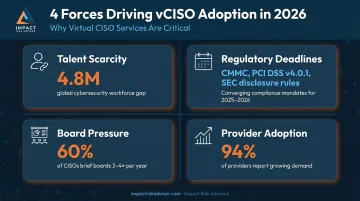
Several forces are converging to make vCISO services a necessity rather than a convenience:
- Talent scarcity: ISC2 reports a global cybersecurity workforce gap of 4.8 million; organizations simply cannot hire their way out of the security leadership shortage
- Regulatory deadlines: CMMC Phase 1 is active November 2025–November 2026 for defense contractors, PCI DSS v4.0.1 requirements took effect March 2025, and SEC cyber disclosure rules now require material incident reporting within four business days
- Board pressure: 60% of CISOs discuss security posture with the board 3–4 times per year, per the WEF Global Cybersecurity Outlook; boards are asking harder questions and expect coherent answers
- Provider adoption: Cynomi's 2024 State of the vCISO report found 94% of service providers recognize growing demand, and 98% of MSPs/MSSPs not yet offering vCISO services plan to add it
The five companies profiled below were selected for their embedded support models, compliance track records, and demonstrated ability to serve organizations in regulated industries, not just their marketing presence.
Best Virtual CISO Services: Top Companies in 2026
The companies below were evaluated on engagement model, compliance framework depth, industry specialization, vendor independence, and evidence of measurable client outcomes.
Impact Risk Advisors
Impact Risk Advisors is a US-based cybersecurity compliance firm specializing in vCISO leadership, penetration testing, and risk assessments for Financial Services, Healthcare, SaaS, and Government Contracting organizations. With 150+ compliance audits supported and 18+ years of experience, the firm brings a practitioner-led approach built around continuous compliance, not one-time engagements.
What separates Impact Risk Advisors from advisory-only providers is their model: vCISOs embed directly into client organizations, owning the security roadmap, managing the compliance calendar, and communicating risk to the board. From day one, every engagement covers:
- Security program development and governance
- Multi-framework compliance roadmap ownership
- Vendor risk management
- Board-level reporting
- Incident response planning with tabletop exercises
Their approach is explicitly risk-based rather than checklist-driven. Controls are right-sized to each client's actual threat landscape and regulatory exposure based on actual exposure, not copied from a generic framework. Clients consistently report reduced cyber insurance premiums, stronger enterprise sales velocity as security reviews stop blocking deals, and clean audit results without last-minute scrambles.
| Category | Details |
|---|---|
| Key Industries Served | Financial Services & Fintech, Healthcare & Health Tech, SaaS & Cloud Technology, Government Contractors |
| Core vCISO Offerings | Cybersecurity compliance programs, virtual CISO leadership, penetration testing, risk assessments |
| Engagement Model | Embedded, continuous support, not point-in-time consulting |

Fractional CISO
Fractional CISO (fractionalciso.com) serves compliance-heavy organizations in tech and SaaS environments where SOC 2 and ISO 27001 are gating factors for growth. Their team-based model pairs each client with a senior vCISO and a dedicated cybersecurity analyst, providing both strategic leadership and execution capacity.
A formal "zero conflict of interest" policy sets them apart: they do not accept referral fees or commissions from vendors they recommend. For leadership teams wary of biased tool or platform guidance, this matters.
| Category | Details |
|---|---|
| Key Industries Served | SaaS, Tech Startups, Regulated Vendor Environments |
| Core vCISO Offerings | Compliance services (SOC 2, ISO 27001, PCI DSS), risk assessments, policy development, security program management |
| Engagement Model | Team-based (paired vCISO + analyst); vendor-independent advisory |
Point Solutions Security
Point Solutions Security provides fractional and virtual CISO services for organizations that need security leadership integrated into operations, not delivered from a distance. Their vCISOs work directly alongside internal IT teams and MSPs to implement security strategy, not just recommend it.
They have particular depth in defense, aerospace, and government environments, making them relevant for organizations where security is tied to procurement requirements or federal funding eligibility.
| Category | Details |
|---|---|
| Key Industries Served | Defense, Aerospace, Government, SaaS, Manufacturing |
| Core vCISO Offerings | Risk gap analysis, compliance readiness (SOC 2, HIPAA), incident response planning, policy and governance development |
| Engagement Model | Embedded, hands-on, works alongside internal IT and MSP teams |
DeepSeas
DeepSeas integrates AI-powered threat intelligence with traditional governance frameworks, positioning them well for organizations deploying AI technologies or operating in high-threat environments. They serve organizations of all sizes with flexible retainer models that scale with project complexity.
Integration is the core of their model: DeepSeas vCISOs draw on in-house red team capabilities and continuous AI-driven risk analysis. Governance frameworks are built to produce defensive resilience, not just documentation.
| Category | Details |
|---|---|
| Key Industries Served | Mid-market and enterprise organizations; technology-forward sectors |
| Core vCISO Offerings | AI-augmented risk analysis, compliance support (SOC 2, ISO 27001, NIST CSF, GDPR), executive reporting, red team validation |
| Engagement Model | Flexible retainer; scalable from monthly advisory to intensive project support |
Vistrada
Vistrada provides fractional CISO services with a strong emphasis on vendor-independent, objective advisory. Their flexibility makes them useful across a range of scenarios, from bridging leadership transitions to providing long-term part-time CISO oversight for scaling companies.
Vistrada vCISOs operate free of vendor partnerships and internal politics, a meaningful advantage when boards and exec teams need guidance they can trust on security investment decisions.
| Category | Details |
|---|---|
| Key Industries Served | Growing companies, startups, mid-sized businesses in regulated sectors |
| Core vCISO Offerings | Cybersecurity strategy, compliance (SOC 2, ISO 27001), business continuity planning, vendor risk assessments, incident response coordination |
| Engagement Model | Flexible part-time and interim engagements; neutral advisory model |
What Do the Best vCISO Services Include?
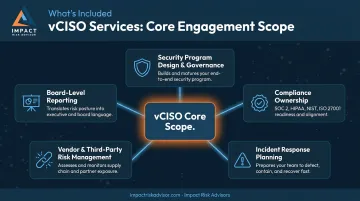
A quality vCISO engagement should deliver more than a compliance checklist. The core scope includes:
- Security program design and governance: policies, risk registers, control frameworks aligned to NIST CSF 2.0, ISO 27001, or SOC 2 Trust Services Criteria
- Compliance ownership: SOC 2, HIPAA, ISO 27001, NIST, PCI-DSS, or CMMC, depending on the client's industry
- Executive and board-level reporting: translating technical risk into business language for directors, investors, and auditors
- Vendor and third-party risk management: SecurityScorecard found 35.5% of 2024 breaches were linked to third-party access, and enterprise clients and cyber insurers increasingly require documented third-party oversight programs
What Separates Strong Providers from Weak Ones
Two areas reveal the gap between credible vCISO providers and those just selling compliance paperwork:
Strong providers develop tested incident response playbooks and run tabletop exercises that expose real gaps before a breach does. A written plan that's never been stress-tested isn't a plan; it's a liability.
The other differentiator is engagement model. A provider who delivers a report and exits can't help you respond to next year's enterprise security review or brief your board when a new regulatory requirement lands. Embedded vCISO support builds institutional security maturity over time, which is why organizations in regulated industries consistently get better outcomes from ongoing partnerships than one-time assessments.
How We Chose the Best Virtual CISO Services
The five companies above were assessed against a specific framework, not just service breadth or brand recognition.
Evaluation criteria:
- Does the vCISO participate in board and executive discussions, or just deliver reports?
- Can the provider show outcomes (audits passed, insurance premiums reduced, enterprise deals unblocked) rather than just processes?
- Guidance must be vendor-agnostic, with no undisclosed referral relationships skewing recommendations.
- Does the engagement model match the operational realities of mid-market and regulated-industry organizations?
Common buyer mistakes to avoid:
- Selecting a provider based on brand name without confirming their engagement model
- Choosing a generalist security advisor when your industry has specific regulatory requirements (HIPAA, CMMC, GLBA)
- Confusing advisory-only services with embedded vCISO programs
Each company listed serves the US market and has demonstrated hands-on experience with at least two of the following frameworks: SOC 2, HIPAA, ISO 27001, NIST CSF, PCI-DSS, or CMMC. If your organization operates in Financial Services, Healthcare, SaaS, or Government Contracting, verify that your shortlisted provider can cite specific audit outcomes, not just framework familiarity, in your sector.
Conclusion
The vCISO model has moved from a cost-saving workaround to a practical standard for organizations that need senior security leadership without the overhead of a full-time executive hire. The right provider isn't a compliance vendor; they're an embedded partner who can define your risk exposure, prioritize the controls that matter, and show you what progress looks like in 30, 60, and 90 days.
When evaluating providers, focus on operational fit: Will this partner embed into your team or stay at arm's length? Ask whether they understand the regulatory pressures specific to your sector:
- HIPAA enforcement trends and breach notification obligations
- CMMC Phase 1 requirements for defense contractors
- SEC cybersecurity disclosure rules for public companies
And before signing anything, ask them to define what the first 90 days of engagement will look like.
For organizations in Financial Services, Healthcare, SaaS, or Government Contracting looking for an embedded, practitioner-led vCISO partner with a track record across 150+ compliance audits, Impact Risk Advisors is built for exactly this kind of work. Contact Impact Risk Advisors for a free, confidential consultation, with a response commitment within one business day.
Frequently Asked Questions
What are the responsibilities of a vCISO?
A vCISO owns security program design and governance, risk assessments, compliance framework management (SOC 2, HIPAA, NIST, ISO 27001), incident response planning, vendor risk oversight, and board-level reporting. Responsibilities are scoped to the organization's industry, regulatory requirements, and security maturity.
What is the difference between a CISO and a virtual CISO?
A full-time CISO is an in-house executive with total compensation ranging from $415K (midmarket) to $880K+ (broad US market). A vCISO delivers equivalent strategic security leadership on a fractional or retainer basis, at a fraction of the cost. For most mid-market and SMB organizations, the vCISO model is how they access executive-level security without the full-time overhead.
How much does a virtual CISO service cost?
According to the MSSP Alert 2024 Pricing Benchmark Report (via ChannelE2E), the average vCISO retainer runs approximately $2,697/month. Scope, engagement depth, and industry complexity can push retainers higher, but the cost is still significantly lower than a full-time CISO hire at any experience level.
How much does a vCISO charge per hour?
Hourly vCISO rates can reach up to $450/hour after retainer hours are consumed, per the MSSP Alert 2024 Pricing Benchmark Report. For ongoing engagements, retainer pricing is generally more cost-effective than hourly billing and provides more predictable access to your vCISO.
What is the difference between a vCIO and a vCISO?
A vCIO (Virtual Chief Information Officer) focuses on IT strategy, infrastructure, and technology alignment with business goals. A vCISO focuses specifically on cybersecurity strategy, risk management, and compliance. Some organizations engage both, but they serve distinct and non-overlapping functions.
What's important to the CISO in 2026?
Top CISO priorities in 2026 include managing AI-related security risks, meeting tightening regulatory requirements (SEC disclosure rules, CMMC Phase 1, updated PCI DSS), and demonstrating measurable ROI on security investments to boards. Cyber resilience, not just compliance, is the dominant leadership frame, and the talent gap is accelerating adoption of fractional and managed security models.