Two budgeting mistakes derail most first-time SOC 2 projects. The first is treating the audit invoice as the total cost. The second is failing to account for internal team time, which is often the largest single line item on the budget. Both lead to the same outcome: sticker shock mid-process.
This guide breaks down realistic cost ranges for Type 1 and Type 2 audits, the specific line items that drive total spend, and the decisions that push costs up or down before you ever engage an auditor.
Key Takeaways
- Total first-year SOC 2 cost ranges from $20,000–$30,000 for lean startups to $150,000+ for larger organizations
- Audit fees run $7,000–$15,000 for Type 1 and $12,000–$20,000 for Type 2 at market rates, with partner pricing available at $5,000 and $7,000 respectively
- Audit fees are often the smallest line item; readiness, tools, legal, and internal time add significantly to total spend
- Key cost drivers: company size, Trust Services Criteria in scope, auditor tier, and control maturity at engagement start
- Narrowing scope, investing in readiness early, and choosing the right auditor for your actual needs are the three most effective cost-reduction moves
How Much Does SOC 2 Certification Cost?
There is no single fixed answer. "SOC 2 certification cost" is really a bundle of costs: audit fee, readiness preparation, security tooling, internal labor, legal review, and ongoing maintenance. Each variable shifts based on your organization.
According to Secureframe's 2025 guidance, most companies spend between $80,000 and $350,000 for a full SOC 2 investment, though many smaller companies complete the process for $10,000–$80,000+ depending on complexity. Vanta's current guidance pegs audit fees alone at $10,000–$50,000, separate from total program cost.
Confusing the audit fee with total program cost is the most common planning mistake, and it's why budgets fall short. The sections below break down each number.
SOC 2 Type 1 Cost
Type 1 evaluates whether your controls are designed correctly at a single point in time. It is faster and cheaper than Type 2, and it is the right first milestone for companies under sales pressure or those validating their control environment before committing to a longer observation window.
Typical Type 1 audit fees:
| Auditor Tier | Estimated Fee Range |
|---|---|
| Boutique / Specialist firm | $5,000–$20,000 |
| Mid-tier regional firm | $15,000–$40,000 |
| Big 4 | $40,000–$60,000+ |
The audit fee covers the auditor's professional time and the final report. Readiness preparation, security tools, and internal team hours are separate costs. Type 1 can typically be completed in 1–4 months once controls are in place.
Type 1 is the right fit for:
- Companies facing an imminent customer requirement or sales deadline
- Teams validating control design before committing to a full Type 2 observation period
- Early-stage startups still building out their security program
SOC 2 Type 2 Cost
Type 2 evaluates whether your controls operate effectively over a 3–12 month observation period. That longer window means more auditor hours, more evidence collection, and more internal effort, which is why 1Password's 2024 guidance cites a typical premium of 30%–50% over Type 1 costs.
Typical Type 2 audit fees:
| Source | Estimated Fee Range |
|---|---|
| Secureframe (2025) | $7,000–$150,000 (larger companies often exceed $100,000 all-in) |
| Thoropass | $15,000–$100,000+ for most engagements |
Type 2 is the standard for companies selling into enterprise accounts, financial services, healthcare, or government contracting, sectors where a point-in-time report no longer satisfies procurement or security reviews.
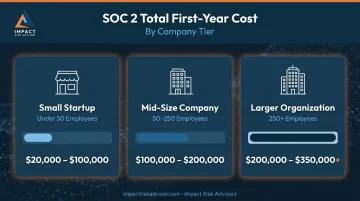
Total First-Year Cost by Company Size
These are all-in estimates, not audit fees alone:
| Product | Price | Notes |
|---|---|---|
| SOC 2 Full Consulting (with pen test & risk assessment) | $25,000 | Billed monthly subscription |
| Gap Assessment | $3,000 | Included free if going for full service |
| Type 1 Security Attestation (Audit) | $5,000 (partner price) | Market range $7k–$15k |
| Type 2 Security Attestation (Audit) | $7,000 (partner price) | Market range $12k–$20k |
| GRC Tool | Extra | Priced separately |
| CPA Audit / Attestation | Extra | Priced separately |
Key Factors That Affect SOC 2 Certification Cost
SOC 2 pricing reflects the scope of work an auditor must perform. Knowing what drives that scope lets you make smarter decisions before the engagement begins.
Audit Scope and Trust Services Criteria (TSCs)
The Security criterion is mandatory and forms the baseline for every SOC 2 report. Each additional TSC adds auditor testing hours, more evidence requirements, and ongoing maintenance burden.
Approximate cost impact per additional TSC, based on current guidance:
- Availability or Confidentiality: +10%–20% per criterion
- Processing Integrity or Privacy: +20%–50% per criterion
Privacy is typically the most expensive add-on due to data handling complexity. Availability is the most commonly requested by enterprise buyers after Security.
Only include TSCs your actual customers require. Adding criteria for theoretical future use inflates both audit cost and year-over-year maintenance without near-term commercial return.
Company Size and Systems Complexity
Auditor effort scales with the number of:
- Employees and user accounts in scope
- Systems, cloud platforms, and data stores reviewed
- Sub-service providers (vendors) included in the audit boundary
- Office locations or infrastructure environments
A startup running a single product on one cloud platform is structurally faster and cheaper to audit than a company with multiple product lines or layered vendor relationships. Control maturity matters too; organizations arriving with undocumented policies or informal processes require substantially more auditor time to assess.
Auditor Selection
Your choice of CPA firm is one of the most direct levers on audit cost:
- Boutique/specialist firms (SaaS and startup focus): $5,000–$40,000 for most engagements
- Mid-tier regional firms: $20,000–$60,000
- Big 4 firms: $40,000–$100,000+
Thoropass guidance notes that auditor choice alone can affect fees by 30%–100%. That range is real, but price shouldn't be the only filter. A credentialed auditor who asks hard questions produces a more defensible report, one that holds up when a sophisticated enterprise buyer reviews it closely. An auditor who accepts weak evidence to close faster creates problems downstream.
Match auditor prestige to your actual customer base. If you're selling to mid-market SaaS companies, a well-regarded boutique firm is typically sufficient and significantly more cost-effective than a Big 4 engagement.
SOC 2 Cost Breakdown: What You're Actually Paying For
The audit invoice is rarely the largest line item. Organizations that budget only for the auditor's fee are consistently surprised by what the full picture looks like.
Readiness Assessment
Type: One-time (pre-audit) Typical cost: $3,000 (included free with full SOC 2 consulting service)
A readiness assessment evaluates your current control environment against the Trust Services Criteria and identifies gaps before the formal audit begins. Skipping it tends to backfire: control gaps discovered during a live audit require remediation under time pressure, which costs significantly more than finding them early.
Impact Risk Advisors' gap assessment produces a risk register and prioritized remediation roadmap, giving teams a clear baseline before the auditor engagement begins.
CPA Audit Fee
Type: Recurring annually Typical cost: See Type 1/Type 2 ranges above
This is the formal auditor's professional fee for the engagement. SOC 2 reports are valid for 12 months, which means audit fees recur annually. Some firms offer multi-year engagement pricing, so it's worth raising during initial scoping conversations.
Security Tools and Infrastructure
Type: One-time setup + recurring licenses Typical cost: $5,000–$50,000+ annually
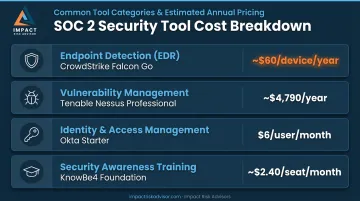
Most organizations need to purchase or upgrade tools to meet SOC 2 control requirements. Common categories include:
- Endpoint detection (EDR): CrowdStrike Falcon Go starts at ~$60/device/year
- Vulnerability management: Tenable Nessus Professional runs ~$4,790/year
- Identity and access management: Okta Starter at $6/user/month
- Security awareness training: KnowBe4 Foundation at ~$2.40/seat/month (25–50 seat tier)
Both line items are easy to overlook in early planning. Building them into the initial budget avoids scope creep later.
Hidden Costs Most Companies Don't Budget For
Even well-planned SOC 2 projects routinely run over budget. The audit fee doesn't change, but several cost categories only become visible once the project is underway.
Lost productivity rarely appears on a budget spreadsheet, but it's one of the largest real costs. The compliance project lead, engineering leads, and senior management are pulled from primary responsibilities for months. That opportunity cost doesn't come with an invoice, but it still counts.
Remediation surprises hit hardest when a readiness assessment or formal audit surfaces control gaps. Closing those gaps costs money: new software licenses, policy rewrites, configuration changes, or additional headcount. Organizations with less mature security programs can face five-figure remediation bills on top of every other line item.
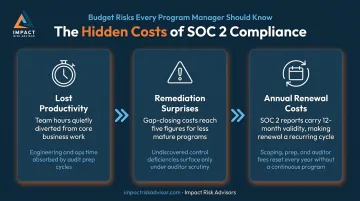
Annual renewal costs tend to catch companies off guard because SOC 2 is not a one-time certification. Re-audit fees, tool renewals, and ongoing monitoring programs create a recurring annual cost that belongs in the total cost of ownership from day one. The SOC 2 report is valid for 12 months; after that, the cycle starts over.
How to Reduce Your SOC 2 Certification Costs
Cost reduction in SOC 2 doesn't mean cutting corners. It means making smarter decisions about scope, timing, and preparation.
Narrow the scope before engaging an auditor. Limit audit scope to the product or service that actually requires the report, and include only the TSCs your target customers require. This single decision has more impact on both audit fees and internal preparation time than almost anything else.
Invest in readiness before the formal audit begins. Organizations that arrive at the audit with documented controls, organized evidence, and a functioning security program typically avoid the costly emergency remediation that inflates most budgets. A compliance advisor or vCISO partner can structure the program correctly from the start. Specifically, that means:
- Completing a gap assessment before the audit clock starts
- Documenting controls and evidence collection workflows in advance
- Establishing continuous monitoring so findings don't pile up between cycles
Impact Risk Advisors structures its advisory engagements around this approach, covering all five Trust Services Criteria from initial gap assessment through Type II report issuance, with continuous monitoring built in afterward. For most clients, that ongoing support is what turns the annual audit from a fire drill into a predictable process.
Match your auditor to your actual business goals. A boutique firm specializing in SaaS and startups typically produces a rigorous, credible report at significantly lower cost than a Big 4 engagement. Only pay for name recognition if your target customers genuinely require it.
Conclusion
SOC 2 certification cost varies significantly based on audit type, company size, scope decisions, and how well-prepared the organization is before the auditor arrives. There is no universal number, but there is a right number for each company's situation, and it is almost always higher than the audit fee alone.
Understanding the full cost picture (audit fee, readiness, tools, internal time, legal, training, and annual renewal) leads to more accurate budgeting and fewer mid-project surprises. For companies in regulated industries or targeting enterprise deals, a well-executed SOC 2 program generates returns through accelerated sales cycles, stronger customer trust, and controls that survive real audit review. Working with an experienced readiness partner, rather than going it alone, helps companies reach that outcome without costly detours. Impact Risk Advisors supports that process from gap assessment through audit day, and beyond.
Frequently Asked Questions
Frequently Asked Questions
How much does SOC 2 certification cost?
Total first-year costs range from roughly $20,000–$30,000 for a lean startup to $150,000–$350,000+ for larger organizations. The audit fee alone runs $10,000–$60,000 depending on report type, scope, and auditor tier; readiness, tooling, internal time, and legal costs typically double or triple that figure.
How much does a SOC 2 Type 1 audit cost?
Type 1 audit fees typically fall within a market range of $7,000–$15,000, with partner pricing available at $5,000. Variation depends on company size, number of Trust Services Criteria in scope, and auditor tier.
How much does a SOC 2 Type 2 audit cost?
Type 2 audit fees generally fall within a market range of $12,000–$20,000, with partner pricing available at $7,000. The higher cost relative to Type 1 reflects a 3–12 month observation period during which the auditor tests control effectiveness, requiring more evidence review and testing hours.
What is a reasonable SOC 2 audit fee?
For most mid-sized SaaS companies, a boutique firm engagement at $15,000–$30,000 hits the right balance of cost and quality. Price shouldn't be the only factor; a poorly conducted audit can produce a report that enterprise buyers reject, costing you far more in lost deals than you saved on fees.
How do I get SOC 2 certified?
The process runs in four stages: readiness assessment, control implementation, formal audit by a licensed CPA firm, and report issuance. Engaging a compliance advisor before the auditor typically cuts both timeline and cost.
How much does penetration testing cost?
Pricing depends on scope and methodology (black-box, grey-box, or white-box). Web application penetration tests typically run $5,000–$30,000 for SaaS companies; network penetration tests generally fall between $5,000–$25,000. Environment complexity is the biggest variable within those ranges.