Add CMMC, SOC 2, PCI DSS, and ISO 27001 into the mix, and most organizations are simultaneously managing overlapping frameworks with distinct control requirements. Navigating that landscape requires more than internal good intentions; it requires structured, expert-led programs.
This guide explains what cybersecurity compliance consulting firms actually do, which services and frameworks matter most for your sector, and what separates a firm that builds lasting compliance programs from one that hands you a checklist and disappears.
Key Takeaways
- Cybersecurity compliance consulting firms help businesses meet regulatory requirements and build auditable security programs across frameworks like HIPAA, SOC 2, CMMC, and PCI DSS
- Core services include risk assessments, penetration testing, virtual CISO leadership, and ongoing compliance monitoring
- Choose firms that offer continuous engagement, sector-specific experience, and practitioner-led teams, not one-time audits
- Compliance needs vary sharply by industry; healthcare, defense contractors, and SaaS companies each face different frameworks and risks
What Is a Cybersecurity Compliance Consulting Firm?
A cybersecurity compliance consulting firm is a specialized advisory partner that helps organizations identify, implement, and maintain the security controls required by applicable laws, regulations, and industry standards. That's distinct from two common alternatives:
- General IT security vendors focus on tools and technical defense: firewalls, endpoint protection, SIEM platforms
- General management consultants focus on business strategy without deep technical execution capability
Compliance consulting sits at the intersection: it requires both technical depth and regulatory fluency.
Cybersecurity vs. Cybersecurity Compliance
That intersection matters because cybersecurity and cybersecurity compliance aren't interchangeable. Cybersecurity means protecting systems from threats; compliance means demonstrating to regulators, auditors, and customers that those protections meet mandated standards.
A company can have strong security controls and still fail a compliance audit, because the evidence wasn't documented, the policies weren't formalized, or the controls weren't mapped to the right framework criteria. Compliance consulting bridges that gap.
Why Organizations Turn to External Firms
Building in-house compliance expertise is rarely feasible without outside help. ISC2's 2024 workforce study found that 90% of cybersecurity teams have skills gaps, 67% report staffing shortages, and 58% say those shortages put their organization at significant risk.
Beyond staffing, most regulated businesses must satisfy multiple overlapping frameworks simultaneously. A health tech SaaS company, for example, might need HIPAA, SOC 2, and HITRUST alignment at the same time, three distinct requirement sets, each with its own audit trail and documentation burden. Without dedicated expertise, organizations typically under-document controls, miss framework-specific evidence requirements, and walk into audits unprepared.
Core Services Offered by Cybersecurity Compliance Consulting Firms
Risk Assessments and Gap Analysis
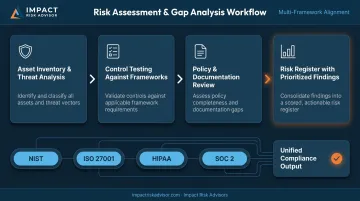
Before any compliance program can be built, a firm needs to map where the organization currently stands against required controls. A formal gap analysis involves:
- Asset inventory and threat landscape analysis
- Control testing against applicable framework criteria
- Policy review and documentation assessment
- Risk register development with scored, prioritized findings
What separates a quality gap analysis from a commodity checklist is prioritization. The output should tell you which gaps carry the highest regulatory and business risk, not just catalog everything that's missing.
AICPA's Trust Services Criteria (CC3.2) require that entities identify and analyze risks to objectives as a basis for determining how those risks should be managed. SOC 2 frameworks explicitly call for ongoing evaluations (CC4.1) to determine whether controls are present and functioning. Gap analysis, in other words, isn't a one-time event. It's a recurring process.
Impact Risk Advisors' risk assessment evaluates controls against multiple frameworks simultaneously (NIST, ISO 27001, HIPAA, and SOC 2), producing a single risk register and prioritized remediation roadmap across all applicable frameworks.
Penetration Testing
Penetration testing simulates real-world cyberattacks to validate whether security controls hold up under actual attack conditions. It's not the same as automated vulnerability scanning, which identifies potential weaknesses but doesn't confirm exploitability.
PCI DSS v4.0.1 (published June 2024) makes the distinction explicit: Requirement 11.4 mandates external and internal penetration testing with defined methodology, qualified independent resources, and remediation retesting, not vulnerability scans alone. PCI DSS v3.2.1 retired March 31, 2024, and future-dated v4.x requirements became mandatory after March 31, 2025.
Beyond PCI DSS, CMMC Level 3 goes further, incorporating selected NIST SP 800-172 enhanced requirements that include explicit penetration testing obligations.
Impact Risk Advisors uses a hybrid approach : certified ethical hackers conduct manual testing across networks, applications, APIs, and cloud environments (AWS, Azure, GCP). All findings are compliance-mapped and tied to remediation guidance; a penetration test that leaves findings disconnected from framework requirements won't satisfy auditors.
Virtual CISO (vCISO) Leadership and Continuous Compliance Programs
The vCISO model provides fractional executive-level security and compliance leadership , embedding a seasoned security leader in the organization without the cost of a full-time hire.
A vCISO in this model doesn't just consult on one project. They own the compliance calendar, manage vendor risk, lead incident response planning, and translate risk into plain business language for board-level communication. The scope is ongoing, not bounded by a single audit or assessment.
Impact Risk Advisors' vCISO service operates through a structured six-phase model:
- Discovery & Scoping
- Risk & Gap Assessment
- Program Design
- Testing & Validation
- Audit Support
- Continuous Monitoring
After certification, the program continues, maintaining policy libraries, tracking control effectiveness, and keeping documentation current year-round.
The practical result: organizations are audit-ready at any given point, rather than scrambling in the weeks before an audit.
Compliance Framework Implementation and Audit Readiness
End-to-end framework implementation covers a full range of deliverables:
- Policy creation and control mapping
- Evidence collection and staff training
- Pre-audit readiness reviews
- Direct coordination with third-party auditors
Impact Risk Advisors' engagement leads manage auditor communication and facilitate evidence requests throughout the process. Clients don't navigate that alone.
Audit readiness isn't a sprint before the audit date. It's a continuous state. Organizations that treat it otherwise tend to accumulate compliance debt between audit cycles.
Key Compliance Frameworks These Firms Help You Navigate
Different industries operate under different regulatory regimes. A qualified firm should have working knowledge of the frameworks relevant to your sector, not surface-level familiarity with all of them.
NIST CSF and NIST 800-53
NIST Cybersecurity Framework 2.0 (published February 26, 2024) provides a flexible structure organized around six functions: Identify, Protect, Detect, Respond, Recover, and Govern. It applies to organizations of all sizes and sectors as a voluntary framework.
NIST SP 800-53 Rev. 5 is different in scope and obligation: it's mandatory for federal agencies under FIPS 200, and that mandate extends to contractors and other sources operating systems on behalf of agencies. Compliance consultants map these controls to existing processes and help organizations implement appropriate baselines.
SOC 2
SOC 2 is the de facto assurance standard for SaaS and cloud technology companies, evaluated across five Trust Services Criteria: Security, Availability, Processing Integrity, Confidentiality, and Privacy. For SaaS companies, it removes friction from deals that would otherwise stall at the security review stage, and is increasingly a prerequisite in enterprise procurement, not just a security exercise.
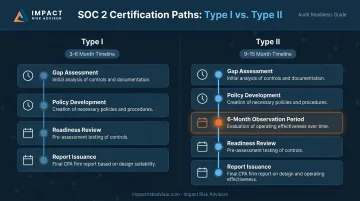
Impact Risk Advisors guides clients from initial gap assessment through SOC 2 Type II report issuance. Typical timelines:
- Type I: 3–6 months from gap assessment to report
- Type II: Minimum six-month observation period; 9–15 months total depending on readiness
HIPAA and HITRUST
HIPAA's Security Rule, Privacy Rule, and Breach Notification Rule govern how covered entities and business associates protect electronic protected health information (ePHI). The enforcement stakes are real: OCR has received 349,615 complaints and resolved 345,871 cases, with resolution agreements that can require years of corrective action reporting.
HITRUST CSF consolidates HIPAA, NIST, and other standards into a certifiable framework. For health tech companies, it demonstrates compliance maturity to healthcare enterprise buyers in a way that standalone HIPAA attestation often cannot.
Impact Risk Advisors' HIPAA services cover Security Risk Analysis (required under the Security Rule), Business Associate Agreement management, and technical safeguards designed to satisfy OCR scrutiny.
CMMC
The Cybersecurity Maturity Model Certification became effective December 16, 2024, following publication of the final rule on October 15, 2024. It applies to defense contractors handling Federal Contract Information (FCI) and Controlled Unclassified Information (CUI).
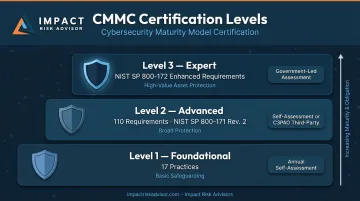
CMMC is tiered:
- Level 1: Annual self-assessment and affirmation (17 basic safeguarding practices)
- Level 2: 110 NIST SP 800-171 Rev. 2 requirements; self-assessment or third-party (C3PAO) assessment depending on sensitivity
- Level 3: Selected NIST SP 800-172 enhanced requirements; government-led assessment
CMMC compliance is implemented through contracts and can be a condition of award. For defense contractors, this isn't optional.
PCI DSS and ISO 27001
PCI DSS v4.0.1 applies to any environment where payment account data is stored, processed, or transmitted. Its scope is environment-specific: organizations must identify their cardholder data environment before determining which controls apply.
ISO 27001 provides an international standard for Information Security Management Systems (ISMS). Where PCI DSS is prescriptive and tied to a defined payment environment, ISO 27001 is certifiable and applies organization-wide. That scope makes it a stronger signal for international buyers and enterprise procurement teams evaluating a vendor's overall security posture.
How to Choose the Right Cybersecurity Compliance Consulting Firm
Choosing a cybersecurity compliance firm isn't just about passing the next audit. It's about finding a partner whose program holds up as regulations shift, threats evolve, and your business grows.
Continuous Engagement vs. Point-in-Time Consulting
Point-in-time consulting produces a snapshot, accurate the day it's delivered, increasingly stale after that. When regulations shift and security controls fall behind, that snapshot stops being useful fast. Continuous compliance programs stay current instead.
In practice, continuous engagement looks like:
- Ongoing policy and evidence maintenance (not annual updates)
- Pre-audit readiness reviews built into the program calendar
- Regulatory change management as frameworks update
- Standing advisory access through a vCISO or embedded lead
Multiple frameworks mandate this approach implicitly. PCI DSS requires recurring penetration testing and remediation. CMMC requires recurring assessments and annual affirmations. AICPA's TSC include ongoing evaluations as a control requirement. A firm that only engages before audit season is misaligned with how these frameworks actually work.
Sector-Specific Experience
A consultant experienced in HIPAA for healthcare covered entities may have limited familiarity with CMMC for defense contractors, and vice versa. These aren't the same skill set.
When evaluating firms, ask directly:
- How many audits have you supported in my specific industry?
- Which frameworks do you work with most frequently?
- Have you supported clients through the same frameworks I need, including multi-framework situations?
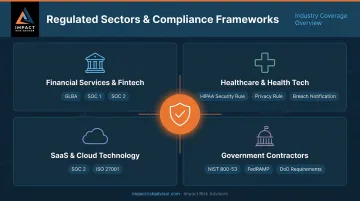
Impact Risk Advisors serves four primary regulated sectors: Financial Services & Fintech (GLBA, SOC 1, SOC 2), Healthcare & Health Tech (HIPAA Security Rule, Privacy Rule, Breach Notification), SaaS & Cloud Technology (SOC 2, ISO 27001), and Government Contractors (NIST 800-53, FedRAMP, DoD contract requirements). That sector depth changes what the work actually looks like: controls get designed for how your industry operates, not just mapped to framework requirements.
Practitioner-Led vs. Generalist Teams
Firms staffed by former auditors, operating CISOs, and offensive security specialists approach compliance differently than generalist consultants working from framework templates. The gap shows up in every client engagement.
Practitioner-led teams understand how real threats manifest and how actual auditors evaluate evidence. They make risk-based recommendations rather than defaulting to the most conservative interpretation of every control requirement. Impact Risk Advisors brings together practitioners from security leadership, audit, and offensive testing backgrounds, people who understand both sides of the assessment process.
Measurable Outcomes and Business Value
Compliance consulting produces measurable outcomes across multiple dimensions; it's not just a cost of doing business:
- Risk reduction: Vulnerabilities identified and remediated before they're exploited
- Audit efficiency: Clean audit results, fewer findings, no last-minute scrambles
- Revenue enablement: SOC 2 and HIPAA compliance removes friction from enterprise sales cycles
- Insurance positioning: Demonstrated risk management maturity supports cyber insurance negotiations
- Executive confidence: Board-level visibility into risk in language leadership can act on
The enforcement numbers reinforce this. HIPAA alone accounts for 152 settlements totaling nearly $145 million. Proactive compliance investment consistently costs less than reactive remediation, across every regulated sector.
Frequently Asked Questions
What is a compliance consultancy?
A compliance consultancy is a specialized advisory firm that helps organizations understand, implement, and maintain the regulatory and industry security standards applicable to their business. It acts as both assessor and implementation partner, not just identifying gaps but building the programs to close them.
What are the 5 key areas of compliance?
The five commonly recognized areas are:
- Data protection and privacy
- Access control and identity management
- Risk assessment and management
- Incident response and reporting
- Audit readiness and documentation
Frameworks like NIST CSF, HIPAA, and SOC 2 address all five, though control requirements differ by framework.
What are the top cybersecurity consulting firms?
Top firms range from global advisors like Deloitte, PwC, and Accenture to specialized boutiques with deep framework expertise. For organizations in regulated industries (healthcare, SaaS, fintech, government contracting), specialized firms with embedded engagement models and sector-specific experience typically deliver more targeted value than generalist consultancies.
How much does a cybersecurity consultant charge?
Pricing varies significantly by scope, firm size, and engagement model. Project-based or hourly engagements suit discrete needs like a single risk assessment. For ongoing compliance programs, subscription or retainer models are typically more cost-effective, particularly when continuous monitoring, vCISO leadership, and audit support are bundled together.
How long does it take to achieve cybersecurity compliance?
It depends on the framework and your starting point. SOC 2 Type I typically takes 3–6 months; SOC 2 Type II requires a minimum six-month observation period, with total timelines of 9–15 months. CMMC Level 2 timelines vary based on organizational readiness and assessment scheduling.