Introduction
Information security risk assessment is the engine behind ISO 27001. Without it, security controls become guesswork: a generic checklist with no justification for why those controls were chosen over others.
ISO 27001 risk assessment and treatment is the process through which an organization identifies threats to its information assets, evaluates how severe each risk is, and selects controls to bring them down to an acceptable level. It's mandatory under the standard, and the foundation every other control decision depends on.
For compliance officers, IT managers, CISOs, and security leads in regulated industries, the stakes are concrete. IBM's 2024 research puts the average healthcare data breach at $9.77M and financial services at $6.08M.
Beyond breach costs, ISO 27001 certification has become a prerequisite for enterprise contracts, cyber insurance underwriting, and supply chain participation. Getting the risk assessment right is what makes the certification defensible.
This guide explains exactly what ISO 27001 requires, how the process works in practice, what the four treatment options mean, and where organizations most commonly go wrong.
Key Takeaways
- ISO 27001 Clauses 6.1.2 and 8.2 mandate a documented, repeatable risk assessment process covering confidentiality, integrity, and availability
- Risk treatment requires choosing one of four options (reduce, avoid, transfer, or accept) for every unacceptable risk
- Reassessment is required at planned intervals and after significant organizational or technical changes, not a one-time exercise
- The three critical audit outputs are: Risk Assessment Report, Statement of Applicability, and Risk Treatment Plan
- Most programs fail due to missing methodology documentation, an IT-only scope, or risk owners who lack real decision-making authority
What Is ISO 27001 Risk Assessment & Treatment?
Risk assessment is the systematic process of identifying threats and vulnerabilities to information assets, then analyzing the likelihood and impact of each risk to produce a prioritized list.
Risk treatment is what happens next: deciding how to respond to each unacceptable risk and selecting appropriate controls to address it.
Together, they produce a risk-based security program where every implemented control traces back to a documented, specific risk. This is what separates ISO 27001 from a generic security checklist: every control exists because the assessment showed it was necessary, tied to a specific, documented risk.
How This Differs from Related Processes
These three processes are often confused during initial scoping, but each serves a distinct purpose:
| Process | What It Does | When It Happens |
|---|---|---|
| Risk Assessment | Identifies what could go wrong operationally | Before controls are fully implemented |
| Gap Analysis | Checks compliance against ISO 27001 requirements | During initial scoping or readiness review |
| Internal Audit | Verifies whether implemented controls are working | After controls are in place |
Risk assessment anchors the entire process; gap analysis and audits only make sense once you know what you're protecting against.
Why ISO 27001 Requires a Formal Risk Assessment Process
ISO 27001 is deliberately light on prescribing specific controls. That's intentional. Information security threats vary dramatically by organization, industry, and operational context; what's a critical risk for a healthcare SaaS company looks nothing like the risk profile of a government contractor.
The standard's solution: require each organization to justify its control choices through a formal, documented risk assessment. Ad hoc security practices can't provide that justification. A formal process can.
What Formal Assessment Enables
Informal security programs share a common weakness: they can't produce the documented, consistent, accountable outputs that auditors and leadership both require. Formal assessment delivers:
- Consistent prioritization: the same methodology applied across all systems produces comparable, defensible results
- Documented justification: every control decision links to a specific risk, which is exactly what auditors and customers want to see
- Leadership accountability: residual risks are formally accepted by named owners, not quietly ignored
The Commercial and Regulatory Reality
Those internal benefits matter, but they only tell part of the story. External pressure to formalize risk assessment has intensified across every regulated sector. Verizon's 2025 DBIR analyzed 22,052 security incidents and 12,195 confirmed breaches, with third-party involvement appearing in 30% of cases. Healthcare alone accounted for 1,542 confirmed breaches in that dataset.
Regulated sectors face compounding pressure from:
- Enterprise customers requiring ISO 27001 certification before signing contracts
- Cyber insurers factoring security program maturity into underwriting and premiums
- Supply chain requirements embedding security assurance into procurement processes
Without a defensible risk program, that exposure lands directly on the bottom line: breach costs, regulatory penalties, and deals that never close.
How the ISO 27001 Risk Assessment & Treatment Process Works
The process follows a defined sequence: establish methodology, identify risks, analyze and evaluate, select treatment, and document outputs. ISO 27001 doesn't prescribe a specific methodology, but it requires one that is defined, documented, and applied consistently, so results are comparable across the organization.
Step 1: Define Scope, Methodology, and Risk Acceptance Criteria
Before identifying a single risk, the organization must document its rules of engagement. Skipping this step is where many programs run into trouble: risk identification without a foundation produces results that can't be compared, defended, or repeated.
The methodology document must establish:
- ISMS scope: which systems, locations, and processes are included
- Risk identification approach: asset-based, process-based, or scenario-based
- Scoring scales: how impact and likelihood will be measured (e.g., 1–5 qualitative scales)
- Risk calculation method: whether scores are added or multiplied
- Acceptance threshold: the score above which a risk is unacceptable and requires treatment
Without this document in place first, everything downstream is harder to audit and easier to challenge.
Step 2: Identify, Analyze, and Evaluate Risks
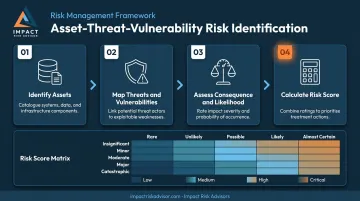
The asset-threat-vulnerability approach is the most widely used method. For each information asset (data, systems, people, processes) the team identifies:
- Relevant threats (ransomware, unauthorized access, hardware failure, human error)
- Vulnerabilities those threats could exploit (unpatched systems, weak access controls, no backup process)
- The consequence if the threat exploited the vulnerability
- The likelihood of that occurring
Multiplying or adding consequence and likelihood scores produces a risk score for each combination. Scores above the acceptance threshold proceed to treatment; scores below may be accepted without further action.
One point that gets overlooked: this process must involve department heads, not just IT. Business process owners understand their own operational risks better than any security team working in isolation.
Step 3: Select Treatment Options and Document Outputs
For each unacceptable risk, the organization selects a treatment option (detailed in the next section), identifies specific controls, assigns a responsible owner, and sets an implementation timeline.
This feeds three required documents:
| Document | Purpose |
|---|---|
| Risk Assessment & Treatment Report | Records all identified risks, scores, and decisions |
| Statement of Applicability (SoA) | Lists all Annex A controls with justification for inclusion or exclusion |
| Risk Treatment Plan | The action plan for implementing selected controls |
Organizations in regulated industries (financial services, healthcare, government contracting) often engage practitioners like Impact Risk Advisors to build this methodology from the ground up, so the approach holds up under Stage 1 and Stage 2 audit scrutiny rather than being patched together afterward.
Key Clause Requirements: What 6.1.2 and 8.2 Actually Demand
Clause 6.1.2: Planning the Process
Clause 6.1.2 is the planning-level requirement. It defines five specific elements the risk assessment methodology must address:
- How to identify risks affecting confidentiality, integrity, and availability within the ISMS scope
- How to identify risk owners: the person with authority and knowledge to act
- How to assess consequences and likelihood of each identified risk
- How to calculate risk levels by combining those assessments
- How to define risk acceptance criteria: the threshold above which risks require treatment
ISO 27001 gives organizations freedom in methodology design but requires all five elements to be documented and applied consistently. Documented information about the risk assessment process is explicitly required.
Clause 8.2: Executing the Process
Clause 8.2 is the operational counterpart. Where 6.1.2 defines how assessments will be conducted, 8.2 requires organizations to actually do it, at planned intervals and whenever significant changes occur, and to retain documented results.
Auditors don't just want to see a methodology document. They want to see a current, dated risk register showing the assessment was actually conducted. Without evidence of execution, the methodology alone won't pass a Stage 2 audit.
Mandatory Documentation Auditors Will Review
These are the documents a certification auditor will specifically look for:
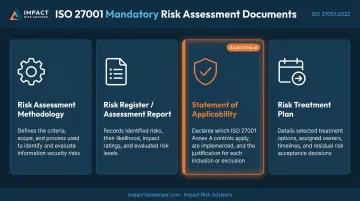
- Risk Assessment Methodology: defines the process, scoring scales, and acceptance criteria
- Risk Register / Risk Assessment Report: lists identified risks with scores, owners, and treatment decisions
- Statement of Applicability (SoA): maps assessed risks to selected controls; auditors frequently use this to anchor the entire Stage 2 review
- Risk Treatment Plan: outlines how and when selected controls will be implemented
Of these four, the SoA carries the most weight. It bridges assessed risks and selected controls, and auditors will scrutinize whether it reflects actual decisions made, not controls you plan to implement someday.
The Four Risk Treatment Options Explained
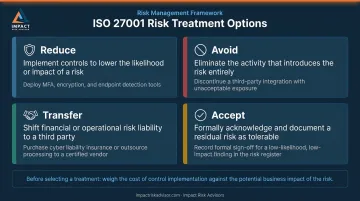
For every risk that exceeds the acceptance threshold, the organization must select one of four treatment approaches. The choice should be based on cost-benefit judgment: does the cost of mitigation justify the potential damage if the risk materializes?
Reduce (Modify) the Risk
Implement controls to lower the likelihood of the risk, reduce the impact if it occurs, or both. This is the most common option and the primary mechanism for applying ISO 27001 Annex A controls.
Example: Implementing multi-factor authentication to reduce the risk of unauthorized account access.
After controls are applied, assess the residual risk to confirm it falls below the acceptance threshold. Clause 6.1.3 requires risk owners to formally approve residual risk acceptance.
Avoid the Risk
Stop performing the activity that creates the risk entirely. This eliminates the risk rather than managing it.
Example: Deciding not to store a category of sensitive personal data removes the associated breach risk completely.
Avoidance makes sense when:
- No practical control can reduce the risk to an acceptable level
- The business activity generating the risk isn't worth its exposure
Transfer (Share) the Risk
Shift the financial consequence of the risk to a third party, most commonly through cyber insurance or contractual liability provisions with vendors.
Transfer doesn't eliminate the operational risk, though. A breach still happens. Transfer is most effective when combined with reduction, not used as a substitute for it.
Accept the Risk
Accept the risk when the cost of mitigation exceeds the potential loss, or when the risk already falls within the organization's defined tolerance.
ISO 27001 requires accepted risks to be formally documented and approved by the risk owner. Passive acceptance (not addressing a risk without recording why) does not satisfy the standard.
Organizations without a dedicated CISO often default to accepting risks they should be treating, simply because they lack the internal context to evaluate treatment options. A virtual CISO can close that gap, providing the security leadership needed to ensure treatment decisions are grounded in full risk context rather than resource constraints.
Common Mistakes in ISO 27001 Risk Management
Most ISO 27001 programs don't fail because of missing controls; they fail because of avoidable process mistakes. These are the ones that appear most often.
Misconceptions That Set Programs Back
- ISO 27001 doesn't prescribe a specific methodology, but it does require five documented elements. Organizations that skip the methodology document often produce scores that don't hold up under audit scrutiny.
- Risk assessment isn't an IT exercise. It must involve business process owners across all departments; operational risks, supplier risks, and process failures rarely originate in IT systems alone.
- A single assessment isn't enough. The standard requires repeated assessments at planned intervals and after significant changes. Treating it as a project deliverable rather than an ongoing program conflicts directly with what ISO 27001 requires.
Common Process Errors
- Starting risk identification without a methodology document; the resulting scores can't be compared or defended in an audit
- Assigning risk owners in name only, without giving them authority or resources to act
- Confusing the SoA with the Risk Treatment Plan: the SoA justifies control selection; the Risk Treatment Plan covers implementation. Both are required, and they serve different purposes
The Over-Engineering Trap
Many organizations attempt to identify hundreds of risks in exhaustive detail on their first cycle. This stalls the program. A practical approach: start with the most significant assets and risks, complete the first full cycle, and add depth through continual improvement iterations. ISO 27001 favors a repeatable, defensible process over an exhaustive but unusable one.
Frequently Asked Questions
What are the requirements for ISO 27001 risk assessment?
Clause 6.1.2 requires a documented methodology covering five elements: risk identification criteria (tied to CIA), risk owner identification, consequence and likelihood scales, a risk calculation method, and risk acceptance criteria. The methodology must produce consistent, comparable results across the organization.
What is Clause 6.1.2 information security risk assessment?
Clause 6.1.2 is the planning-level requirement that defines what must be established before conducting a risk assessment: the rules, scales, and criteria governing how risks are identified, scored, owned, and accepted. It is distinct from Clause 8.2, which requires organizations to operationally execute the assessment at planned intervals.
What are the mandatory documents for ISO 27001?
For risk assessment and treatment, the four mandatory documents are: the Risk Assessment Methodology, Risk Assessment Report (or Risk Register), Statement of Applicability, and Risk Treatment Plan. These serve as the primary audit evidence for certification, alongside the Information Security Policy and scope definition.
How do you ensure audit readiness?
Audit readiness means current, dated documentation covering four things: proof the assessment was performed, treatment decisions with named owners for each unacceptable risk, an SoA reflecting real control choices, and a Risk Treatment Plan showing implementation progress. If it isn't documented, auditors treat it as if it didn't happen.
What is ISO 31000 vs NIST SP 800-37?
ISO 31000 is a generic risk management framework covering all organizational risk types and is referenced but not mandated by ISO 27001. NIST SP 800-37 is a US government framework for federal information system authorization. US government contractors may align their methodology with NIST guidance while still satisfying ISO 27001 requirements, provided Clause 6.1.2's five elements are addressed.
What is the ISO standard for IT risk management?
ISO/IEC 27001 is the primary standard for information security management. ISO/IEC 27005 provides detailed methodology guidance that directly supports Clause 6.1.2 implementation, while ISO 31000 covers broader risk principles across all domains. Organizations can use any of these frameworks and remain ISO 27001 compliant, provided all five Clause 6.1.2 requirements are met.