A SOC 2 readiness assessment is the critical bridge between deciding to pursue SOC 2 and actually starting the formal examination. This guide covers what a readiness assessment is, why it matters, how to work through it step by step, and which pitfalls most commonly derail organizations before they even get to the audit.
Key Takeaways
- A SOC 2 readiness assessment is a pre-audit gap analysis that evaluates your controls against the AICPA's Trust Services Criteria before the formal examination begins
- Skipping it raises the risk of audit exceptions and qualified opinions. 54.9% of SOC 2 reports in CBIZ's 2024 benchmark contained control exceptions
- The assessment covers five Trust Services Criteria; Security is mandatory, the rest depend on your service commitments
- Expect several weeks for the assessment itself, plus additional weeks or months for remediation
- The output is a gap report and remediation roadmap your team uses to close issues before the formal audit begins; it is not an auditor opinion
What Is a SOC 2 Readiness Assessment?
A SOC 2 readiness assessment is a pre-audit evaluation, performed by an internal team or an external assessor, that measures how well your existing controls and documentation align with the AICPA's Trust Services Criteria (TSCs). It identifies gaps and produces a remediation roadmap for closing them before the formal audit begins.
The key distinction: a readiness assessment produces no auditor opinion. Unlike a Type 1 or Type 2 report, it carries no external assurance value for customers and cannot substitute for a formal SOC 2 report in a vendor security review. This is actually its value. You see the same gaps an auditor would find, before they find them during live fieldwork, where remediation options shrink and timelines compress.
Understanding what auditors evaluate helps you scope the assessment correctly. The AICPA organizes SOC 2 around five Trust Services Criteria:
The Five Trust Services Criteria
| Criterion | Status | Notes |
|---|---|---|
| Security | Mandatory | Required for every SOC 2 audit |
| Availability | Optional | Include if your services have uptime commitments |
| Processing Integrity | Optional | Relevant for transaction processing systems |
| Confidentiality | Optional | CBIZ found this appeared in 64.4% of 2024 reports |
| Privacy | Optional | Include when handling personal information under privacy commitments |
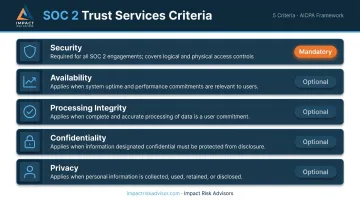
Scope to what your actual service commitments and customer contracts require, not every optional category.
SOC 2 Type 1 vs. Type 2
- Type 1 evaluates whether controls are suitably designed at a single point in time
- Type 2 evaluates whether those controls operated effectively over a defined period, typically 3–12 months
Schellman describes Type 2 as the "gold standard" because it tests operating effectiveness over time, not just design intent. For organizations new to SOC 2, the recommended path is: readiness assessment → Type 1 report → Type 2 report.
Why SOC 2 Audit Readiness Is Critical
In enterprise B2B sales, SOC 2 has become a baseline expectation, especially for SaaS, fintech, healthcare tech, and government contracting. It's not a legal requirement. But an absent or unclean report can disqualify an organization from a contract before a conversation even starts.
Drata's 2023 Compliance Trends survey of 300 established and enterprise technology organizations found 41% reported slower sales cycles from low compliance maturity, and 33% reported loss of business relationships. Those aren't edge cases. They're deals lost and partnerships ended over compliance gaps.
The Cost-Benefit Case for Readiness
Readiness assessments typically cost between $5,000 and $25,000 depending on scope and provider. Discovering gaps during live audit fieldwork is far more expensive: it creates rework, retesting cycles, and potential for a qualified opinion. CBIZ's 2024 SOC benchmark found 10.9% of reports received qualified opinions, up from 8% the prior year.
A failed or delayed audit compounds quickly. Additional audit cycles, remediation under deadline pressure, and stalled customer contracts add costs that are hard to predict and harder to absorb.
Business Outcomes a Clean SOC 2 Process Supports
- Removes security review bottlenecks that stall enterprise deals
- Builds customer trust through a demonstrated, audited security posture
- Supports cyber insurance underwriting; Marsh cites mature access controls as a key factor in favorable decisions
- Strengthens competitive position on contracts requiring third-party assurance
How a SOC 2 Readiness Assessment Works – Step by Step
Most gaps in SOC 2 readiness don't come from missing controls. They come from controls that exist but lack standardized execution and audit-ready evidence. The steps below address both.
Step 1 – Define Scope
Identify which systems, services, and data flows are in scope. Determine which Trust Services Criteria apply based on your product commitments and customer base. Document scope decisions formally; scope creep is a leading cause of audit delays and budget overruns.
The right scope question: which systems process customer data, and what commitments appear in your customer contracts and terms of service?
Step 2 – Map Existing Controls to TSC
With scope defined, the next step is understanding what you already have. Work through the following:
- Inventory current policies, procedures, and technical controls
- Map each to the relevant TSC criteria (for example, identity and access management maps to Security criteria CC6)
- Classify each criterion as: no mapped control, partial coverage, or fully addressed
Step 3 – Perform Gap Analysis
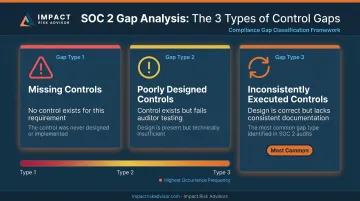
Compare your mapped controls against what each TSC criterion requires. Gaps fall into three types:
- Missing controls: no control exists for the criterion
- Poorly designed controls: the control exists but won't satisfy auditor testing
- Inconsistently executed controls: the control exists and is designed correctly, but lacks consistent documentation or evidence
Document gaps in a structured register with severity classification. Type 3 gaps are the most common and the most underestimated.
Step 4 – Build and Remediate Controls
Develop remediation plans for each identified gap. Auditors evaluate whether controls operate consistently throughout the observation period, so build them into daily operations rather than treating them as one-time audit preparations.
For each gap, assign:
- A specific owner accountable for remediation
- A realistic timeline with milestone checkpoints
- Clear deliverables that satisfy the relevant TSC criterion
- Priority ranking based on risk severity and implementation effort
Step 5 – Prepare Evidence and Documentation
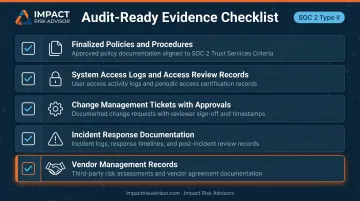
Build a systematic evidence collection process. Key evidence categories include:
- Finalized policies and procedures
- System access logs and access review records
- Change management tickets with approvals
- Incident response documentation
- Vendor management records
For Type 2 readiness, evidence must demonstrate continuous operation over the full reporting period, not just a point-in-time snapshot.
Step 6 – Validate Readiness and Brief Your Team
Before fieldwork begins, conduct internal walkthroughs with stakeholders. Confirm all gaps from the gap register are closed or have documented mitigation plans. Brief every team member who will interact with auditors: what evidence they own, where it lives, and how to walk an auditor through it clearly. Teams that rehearse this step avoid the most common audit-day delays.
Common SOC 2 Readiness Pitfalls That Derail Audits
Performing Controls Without Standardization
Organizations often execute the right activities but never build a repeatable, documented process around them, and that gap costs them at audit time.
A quarterly access review that was completed but not consistently approved in a traceable system is a common scenario. The underlying work happened. The auditor still flags an exception because there's no evidence trail demonstrating the control operated as designed. CBIZ's 2024 benchmark found business approvals and reviews accounted for 17.4% of exceptions, and user access reviews for another 15.1%.
Scoping Too Broadly or Too Narrowly
Broad scope creates unnecessary audit surface and inflates remediation work. Narrow scope risks omitting systems that auditors will test regardless. Base scope on what systems actually process customer data and what commitments appear in contracts and terms of service.
Starting Remediation Too Late
Controls need operating history. A control implemented in month three of a twelve-month Type 2 observation period will only be testable for the remaining nine months; auditors will note the gap in coverage. Start remediation before the observation period begins, not during it.
Treating Readiness as a One-Time Project
SOC 2 compliance is an ongoing operational discipline, not a pre-audit sprint. Organizations that embed these activities into regular workflows carry far less burden into each renewal cycle:
- Access reviews completed and approved on schedule
- Change management documented at the point of change
- Incident response testing run at defined intervals
- Vendor reviews tracked and evidenced throughout the year
How Impact Risk Advisors Can Help
Impact Risk Advisors works as an embedded compliance partner, not a point-in-time consultant, throughout the readiness and remediation process. With 150+ compliance audits supported across SOC 2, SOC 1, HIPAA, ISO 27001, and other frameworks, their team brings hands-on experience spanning security leadership, audit knowledge, and offensive testing.
For SOC 2 readiness specifically, Impact Risk Advisors provides:
- Gap analysis against your chosen Trust Services Criteria, producing a risk register and prioritized remediation roadmap
- Program design that builds or hardens controls, policies, and evidence management systems for auditors
- Policy and procedure development aligned to the applicable TSC requirements
- Virtual CISO (vCISO) services covering security program governance, board-level risk reporting, vendor risk management, and incident response planning between audit cycles
- Penetration testing to validate the security of in-scope systems before the formal audit begins, reducing the risk of examiner findings tied to technical vulnerabilities
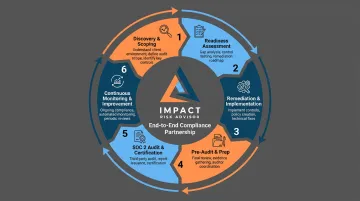
These services follow a structured six-phase engagement model:
- Discovery and scoping
- Risk and gap assessment
- Program design
- Testing and validation
- Audit support
- Continuous monitoring post-certification
SOC 2 Type 1 typically takes 3–6 months from engagement start to report issuance. Type 2 requires a minimum six-month observation period and runs 9–15 months in total.
For SaaS companies, fintech platforms, healthcare technology firms, and government contractors, a managed readiness process typically means fewer audit findings, faster report issuance, and less internal strain on engineering and security teams.
Conclusion
A SOC 2 audit is a snapshot, but the control environment behind it has to function every day. Organizations that invest in a proper readiness assessment before the formal examination consistently achieve cleaner reports with fewer exceptions, because the evidence is already there when auditors ask for it.
The discipline required for a clean SOC 2 report, documented controls, consistent execution, evidence collected at the point of action, doesn't switch off after the audit closes. Each renewal cycle is an opportunity to tighten gaps found in the previous period, not just to repeat the same process.
Working with a partner who stays engaged between audits, not just in the weeks before fieldwork, is what separates organizations that respond to auditor findings from those that anticipate them.
Frequently Asked Questions
What is a SOC 2 readiness assessment?
A SOC 2 readiness assessment is a pre-audit gap analysis that evaluates whether your controls align with the AICPA's Trust Services Criteria. It identifies deficiencies and produces a remediation roadmap, but does not result in an auditor opinion or provide external assurance to customers.
How do you prepare for a SOC 2 Type 2 audit?
Start with a readiness assessment, define scope around systems that process customer data, and remediate gaps before your observation period begins. Collect evidence of control operation continuously throughout that period, not just when the auditor arrives.
How long does a SOC 2 readiness assessment take?
The assessment itself typically runs several weeks, covering planning, walkthroughs, evidence collection, and reporting. Remediation adds weeks or months on top of that, depending on the number and severity of gaps found.
What's the difference between SOC 2 Type 1 and Type 2?
Type 1 evaluates whether controls are suitably designed at a specific point in time. Type 2 evaluates whether those controls operated effectively over a defined period, typically 3–12 months. Type 2 is what enterprise vendor questionnaires and procurement teams specifically ask for; a point-in-time Type 1 report rarely satisfies that requirement on its own.
What does a SOC 2 Type 2 compliance checklist cover?
A SOC 2 Type 2 checklist covers scoping decisions, control mapping against all applicable Trust Services Criteria, evidence collection for the full observation period, finalized policies and procedures, and documentation of consistent control execution, not just one-time activities.
How often is a SOC 2 audit required?
SOC 2 is not legally mandated, but organizations pursuing enterprise contracts typically renew their Type 2 report annually. Enterprise contracts and vendor management programs typically require a current report dated within the past 12 months to maintain active vendor status.