Introduction
Picture this: your SaaS team has spent months nurturing an enterprise deal. Security questionnaires cleared, demos done, pricing agreed. Then procurement sends over a vendor assessment request, and asks for your SOC 2 Type 2 report. You don't have one. Or the one you have expired eight months ago. Or it's riddled with exceptions around access reviews. The deal stalls.
This scenario isn't rare. According to a 2025 Vanta survey of 2,500 IT and business leaders, 65% say customers, investors, and suppliers increasingly require proof of compliance before agreeing to share data or sign contracts.
SOC 2 Type 2 has become the de facto security credential for SaaS companies selling to enterprise buyers. It's not legally required, but it proves your controls work over time rather than just on paper. That distinction makes it significantly harder to achieve than most SaaS teams anticipate.
This article breaks down the specific challenges SaaS companies run into: evidence gaps, scope creep, access control failures, and the operational burden of sustaining compliance between audits.
Key Takeaways
- SOC 2 Type 2 tests whether controls operated effectively over 3–12 months, not just whether they existed on audit day
- Fast product iteration, fragmented tooling, and lean teams make SaaS environments harder to audit than most teams expect
- 54.9% of SOC reports reviewed by CBIZ contained control exceptions: access reviews are the leading cause of qualified opinions
- 89.6% of service providers use sub-processors: vendor gaps count as your findings, and most SaaS teams underestimate this exposure
- Continuous compliance programs consistently produce cleaner reports; annual scrambles rarely do
What Makes SOC 2 Type 2 Uniquely Challenging for SaaS Companies
Type 1 vs. Type 2: A Different Game
SOC 2 Type 1 is a point-in-time snapshot. An auditor reviews whether your controls are designed and in place as of a specific date. Type 2 is different in a meaningful way: it evaluates whether those controls actually operated as intended across an observation period, typically 3 to 12 months.
CBIZ's 2024 SOC Benchmark Report found that 75.6% of reviewed SOC reports covered a full 12-month period. That's 12 months of evidence, not a single screenshot.
This changes everything about how you prepare. A policy document that worked for Type 1 means nothing in a Type 2 audit if you can't prove the control ran consistently every month. For SaaS companies, that proof is harder to produce than it sounds.
Why SaaS Environments Create Structural Audit Complexity
Traditional software companies have relatively stable environments. SaaS companies don't. Several structural realities compound the challenge:
- Continuous deployment means code ships daily or weekly; system configurations change throughout the observation window, creating a moving target for auditors
- Multi-tenant architecture means a single control gap can affect all customers at once, which expands the scope of what auditors expect to see evidenced
- Engineers and product managers frequently own compliance tasks alongside their primary roles, with no dedicated security staff to absorb the audit workload
- BetterCloud's 2025 State of SaaS Report found organizations use an average of 106 SaaS applications, each one a potential source of control evidence that must be located, extracted, and formatted for auditors
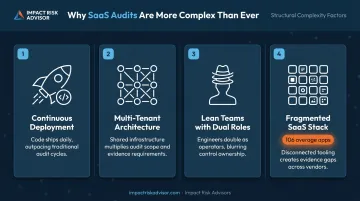
The Trust Services Criteria (Security, Availability, Processing Integrity, Confidentiality, and Privacy) must map to live, functioning controls, not documented intentions. In a SaaS environment where deployments, configurations, and integrations shift week to week, proving that consistency over 12 months is where most audits run into trouble.
Challenge 1: Defining and Maintaining Audit Scope in a Fast-Moving Environment
Scope Creep and Mid-Audit Pivots
For most SaaS companies, the audit scope conversation feels manageable at the start. Then reality hits: a new payment integration launches in month four, a cloud migration kicks off in month seven, and a new enterprise customer segment triggers additional data handling requirements.
Any system that touches customer data and is introduced, or substantially modified, during the observation window may require additional evidence, revised control mappings, or a restarted observation period.
Scope instability is a leading driver of audit delays for SaaS companies. Getting ahead of it means doing three things before the window opens:
- Freeze major infrastructure changes during the observation window where possible, or at minimum, coordinate with your auditor before making them
- Map all systems touching customer data before the observation period begins, not during fieldwork
- Document architecture diagrams and data flow maps in advance so scope boundaries are defensible from day one
A practitioner-led readiness assessment (the kind Impact Risk Advisors conducts before the audit window opens) helps SaaS teams identify which systems belong in scope and which can be reasonably excluded. That pre-work eliminates the scope disputes and cost overruns that derail audits mid-window.
Scope boundaries get harder to hold when the team itself is distributed across locations and devices.
The Remote-First SaaS Factor
Fully distributed SaaS teams add another layer to that challenge. Endpoint security, remote access policies, and device management must be demonstrably enforced across the entire team for the full observation period.
Auditors don't just want a remote work policy; they want evidence that controls were consistently applied:
- MFA enforcement logs showing company-wide adoption throughout the window
- VPN usage records (if applicable) demonstrating consistent access patterns
- MDM enrollment reports showing all endpoints were managed, including new hires onboarded mid-period
The gap between "we have a policy" and "we can prove it ran" is where many remote-first SaaS teams stumble.
Challenge 2: Evidence Collection Across a Fragmented Tech Stack
Evidence collection is the most operationally painful part of SOC 2 Type 2 for SaaS teams, and the research backs this up. CBIZ found that 54.9% of reviewed SOC reports contained control exceptions, averaging 1.73 exceptions per report, with user access reviews as the primary driver of qualified opinions.
The core problem: your controls don't live in one place.
- Access logs → cloud IAM system
- Change approvals → Jira or GitHub
- Background check records → HR platform
- Incident response documentation → Slack threads, ticketing systems, or email chains
- Security training completion → a third-party LMS
Pulling all of this into coherent, auditor-ready evidence packages is a significant coordination burden, especially over a 12-month window.
Common Evidence Gaps SaaS Teams Encounter
- Incomplete access review logs: quarterly reviews that were partially completed or undocumented
- Change management records lacking formal approval documentation (informal Slack approvals don't satisfy auditors)
- Incident response tickets handled informally without proper documentation of detection, response steps, and resolution
- Offboarding records showing users retained access after departure, a significant finding given that 48% of IT professionals worry about missing critical offboarding steps
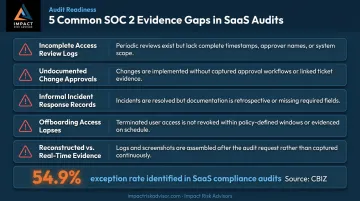
There's also a meaningful distinction between evidence captured in real-time versus evidence reconstructed at audit time. As Schellman notes, evidence about control operation in prior periods does not demonstrate effectiveness during the current period. In practice, this means reconstructed logs or retroactively created records often result in qualified opinions or additional testing requirements.
Building Evidence Systems That Hold Up
Manual evidence collection breaks down at scale. When engineers are responsible for pulling their own screenshots, timestamps get missed, quarterly reviews get skipped, and the burden compounds over 12 months.
Practical fixes:
- Establish automated or semi-automated evidence collection workflows before the observation window opens
- Designate a named compliance owner for each control domain
- Use standardized evidence formats so auditors don't need to follow up repeatedly
These fixes only work if they're in place before the audit window opens, not retrofitted two months before the deadline. That's the operational gap a point-in-time consultant can't close. Impact Risk Advisors' continuous compliance model addresses this directly: maintaining evidence and control documentation year-round so nothing gets assembled in a last-minute sprint.
Challenge 3: Control Ownership, Vendor Risk, and Third-Party Dependencies
Who Actually Owns Each Control?
In a 20- to 50-person SaaS company, security responsibilities are rarely formalized. Access reviews fall to whoever manages the IAM system. Incident response is "handled by engineering." Vendor assessments happen when someone remembers.
When auditors ask who owns each control domain, "everyone" is an answer that functions like "no one." Unclear ownership leads to:
- Controls implemented inconsistently across the observation period
- Exceptions that go undetected until fieldwork begins
- Audit responses that require significant scrambling to assemble
Impact Risk Advisors' vCISO service embeds a senior security leader who owns the compliance calendar, assigns accountability for each control domain, and ensures those assignments are actually maintained between audits.
Vendor and Sub-Processor Risk
SaaS products typically rely on 10 to 50+ third-party services: cloud infrastructure, payment processors, identity providers, support platforms, monitoring tools. Each sub-processor can introduce control gaps that directly affect your compliance posture.
CBIZ found 89.6% of reviewed service providers used sub-processors, averaging 2.8 per report. That's not a statistic auditors overlook. They will ask for evidence of vendor risk management, specifically:
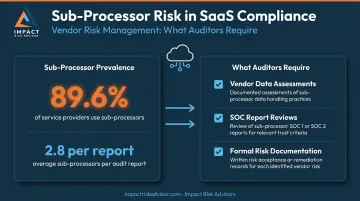
- Whether vendors handling customer data have been assessed
- Whether their SOC reports have been reviewed and documented
- Whether identified risks have been formally recorded
The Shared Responsibility Misconception
One of the most common, and costly, misconceptions: "We're on AWS, so their SOC 2 covers us."
It doesn't. AWS's SOC 2 report covers their infrastructure controls only: physical security, hypervisor management, network controls. Your SaaS application's access management, configuration, monitoring, and data handling exist entirely outside that report.
Microsoft makes this division explicit in its Azure shared responsibility model: customer data, configurations, and identity/access management remain the customer's responsibility in a SaaS context, regardless of who hosts the infrastructure.
SaaS teams must demonstrate their own application-layer controls independently. The cloud provider's report is a starting point, not a substitute.
Personnel Controls
Background checks, security awareness training completion, and prompt offboarding are cited frequently in SaaS audit findings. In companies with high hiring velocity, contractor-heavy workforces, or offshore development teams, maintaining complete evidence across all three is harder than it looks during planning.
Common personnel control gaps auditors flag include:
- Background checks not completed before system access is granted
- Security awareness training records missing for contractors or offshore staff
- Offboarding procedures that lag behind actual departure dates
None of these are technically complex to fix. But without assigned ownership and a consistent process, they generate findings that are difficult to explain after the fact.
Overcoming SOC 2 Type 2 Challenges: A Practical Approach
Start With a Structured Readiness Assessment
The single highest-leverage step any SaaS company can take is completing a structured readiness assessment 3 to 6 months before the observation window opens. A readiness assessment surfaces control gaps, clarifies scope boundaries, and produces a remediation roadmap so you're fixing issues before they become findings, not scrambling to address them once fieldwork begins.
Impact Risk Advisors' readiness process is practitioner-led and risk-based. SaaS clients get a prioritized roadmap focused on the controls that matter most for their specific environment, sized appropriately for their tech stack rather than applied as a one-size-fits-all checklist.
Shift from Audit Event to Continuous Compliance
Companies that consistently achieve clean Type 2 reports don't treat compliance as an annual project. They treat it as an ongoing operational discipline.
What that looks like in practice:
- Named owners assigned to each control domain, permanently, not just before audit season
- Compliance checkpoints embedded into sprint cycles and change management workflows
- Evidence reviewed quarterly, not assembled in the six weeks before fieldwork
- Vendor SOC reports reviewed annually with documented findings
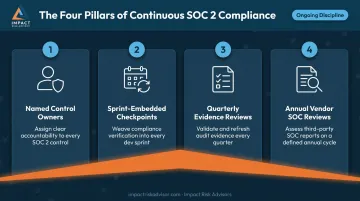
The difference between a SaaS team that scrambles and one that sails through an audit is operational discipline, not technical sophistication.
The Role of vCISO Leadership
Most early- to mid-stage SaaS companies don't need a full-time CISO, but they do need senior security leadership to own the compliance program, make risk-based decisions, and interface with auditors credibly.
A vCISO engagement provides that strategic layer without the overhead of a full-time hire. Impact Risk Advisors' vCISO service embeds a seasoned security leader directly into the organization to:
- Own the security roadmap and compliance calendar
- Communicate risk findings to the board
- Keep controls maintained between audit cycles so the program evolves alongside the product
Quick-Start Checklist
Five actions SaaS teams can take immediately:
- Map all systems touching customer data and confirm scope before any observation window begins
- Assign a named owner to each control domain: access management, change management, incident response, vendor risk, personnel controls
- Establish automated evidence capture workflows so logs and approvals are captured as work happens
- Review vendor SOC reports annually and document what you found and any gaps identified
- Run a tabletop incident response exercise and document it, as auditors want proof the process works, not just that it exists
Frequently Asked Questions
What is SOC 2 compliance for SaaS platforms?
SOC 2 is a third-party attestation framework developed by the AICPA that validates a SaaS company's security controls against the Trust Services Criteria. It's not legally mandated, but enterprise buyers increasingly require it before agreeing to share data with a SaaS vendor.
What is a SOC 2 Type 2 audit?
A SOC 2 Type 2 audit evaluates whether your security controls were both properly designed and consistently operating over an observation period, typically 3 to 12 months. It gives buyers far more assurance than a Type 1 report, which only confirms controls existed at a single point in time.
What are the 5 pillars of SOC 2?
The five Trust Services Criteria are: Security (mandatory), Availability, Processing Integrity, Confidentiality, and Privacy. SaaS companies typically start with Security and add others based on the type of data they handle and their customer commitments.
What are the primary security concerns for organizations using SaaS?
The core concerns are unauthorized access to customer data, inadequate vendor and sub-processor controls, insufficient logging and monitoring, and maintaining consistent security practices in a rapidly changing product environment.
How long does SOC 2 Type 2 compliance take for a SaaS company?
The observation period runs 3 to 12 months, but total time from readiness assessment through final report delivery is typically 9 to 15 months for a first-time engagement. Starting before enterprise deals are actively in-flight prevents the compliance process from blocking revenue.
How can SaaS companies maintain SOC 2 compliance between audits?
Sustained compliance requires embedding control monitoring into everyday operations: quarterly access reviews, continuous change management documentation, annual vendor risk reviews, and regular security training. Many SaaS companies use a vCISO or embedded compliance advisor to own this function without the cost of a full-time hire.