Virtual CISO (vCISO) services have emerged as the dominant answer. Among MSPs and MSSPs, vCISO offerings have tripled in recent years, and among providers not yet offering the service, 50% planned to add it by end of 2025. Supply is growing because demand is real.
But vCISO pricing is not a fixed number. What you'll pay depends heavily on your engagement model, company size, industry, and how much hands-on work is actually required. This article breaks down the realistic cost ranges, what drives prices up or down, what's included at each tier, and what hidden costs catch buyers off guard after they sign.
Key Takeaways
- Cost ranges: Hourly ($200–$400/hr), monthly retainer ($3K–$20K/mo), or fixed-scope project ($10K–$75K)
- What pushes prices higher: Regulated industries (healthcare, fintech, defense), multi-framework compliance, board reporting, complex infrastructure
- Who pays less: Startups with limited scope, single-framework compliance needs, advisory-only arrangements
- Biggest mistake buyers make: Focusing only on the retainer and missing implementation labor, tool costs, and separately billed audit fees
How Much Do vCISO Services Cost?
vCISO pricing doesn't follow a fixed rate card. Two companies with similar headcounts can receive quotes that differ by $8,000 a month, because scope, regulatory complexity, and required practitioner expertise vary dramatically between them.
Buyers who misunderstand this end up either underbudgeting (and getting surprised by add-on costs) or choosing the wrong model entirely and paying hourly rates for work that should be a retainer.
Pricing by Engagement Model
Three primary models dominate the market:
| Model | Typical Range | Best For |
|---|---|---|
| Hourly | $200–$400/hr | Short-term advisory, incident response consultation, one-off risk reviews |
| Monthly Retainer | $3,000–$20,000/mo | Ongoing security leadership, compliance management, continuous program ownership |
| Fixed-Scope Project | $10,000–$75,000 | Defined deliverables: gap assessments, policy builds, audit readiness sprints |
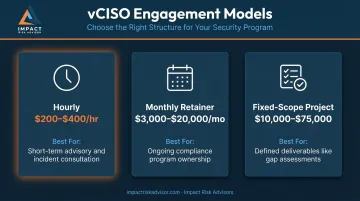
Monthly retainers are the most common model for organizations that need sustained security leadership. Hourly arrangements work for specific questions or short engagements, but the per-hour premium adds up quickly if scope expands.
Pricing by Company Size
Retainer cost correlates closely with headcount; more employees generally means more systems, more vendors, and more compliance surface area.
| Company Size | Typical Monthly Retainer | Typical Scope |
|---|---|---|
| Startup (1–50 employees) | $1,500–$4,000/mo | Core policy development, single-framework compliance, monthly check-ins |
| Small Business (50–200 employees) | $3,000–$6,000/mo | Gap assessments, basic vendor risk, compliance guidance, security questionnaire support |
| Mid-Market (200–500 employees) | $5,000–$12,000/mo | Full compliance program management, bi-weekly touchpoints, metrics reporting |
| Upper Mid-Market (500–1,000 employees) | $10,000–$20,000/mo | Multi-framework programs, board reporting, IR readiness, M&A support |
vCISO vs. Full-Time CISO: The Cost Reality
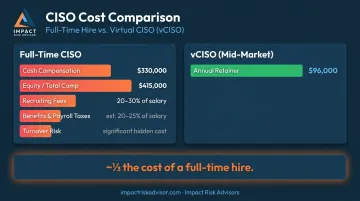
IANS Research's 2025 data puts small and midmarket CISO cash compensation at $330,000 and total compensation (including equity) at $415,000. At firms under $50M revenue, cash compensation alone averages around $260,000.
Those figures don't include:
- Recruiting fees (typically 20–30% of first-year salary)
- Benefits, payroll taxes, and onboarding costs
- Turnover exposure: 15% of CISOs changed employers in 2025, making replacement cost a real budget risk
A mid-market company spending $8,000/month on a vCISO pays $96,000 annually for embedded security leadership, roughly one-third the cash compensation of a full-time hire at the same tier.
Key Factors That Drive vCISO Pricing
Pricing reflects the level of risk and complexity a provider is being asked to manage. Two organizations of similar size can receive very different quotes based on the following factors.
Scope of Services
Advisory-only arrangements cost less. If you need a vCISO to attend quarterly board meetings, review a policy, and answer occasional questions, you're looking at the lower end of the retainer range.
Full-program engagements where the vCISO owns compliance calendars, builds vendor risk programs, manages evidence collection, and runs tabletop exercises, require far more hours and carry higher monthly fees.
Industry and Regulatory Environment
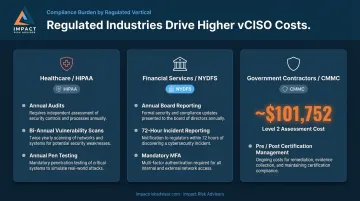
Regulated industries carry heavier compliance burdens and require practitioners with genuine framework expertise.
- Healthcare (HIPAA): Proposed HIPAA Security Rule updates include requirements for annual compliance audits, vulnerability scans every six months, and annual penetration testing, each adding workload adjacent to the vCISO engagement
- Financial Services (NYDFS/GLBA): NYDFS requires annual CISO reporting to the board, 72-hour incident reporting, and MFA across the environment, ongoing governance work a vCISO must manage
- Government Contractors (CMMC): DoD estimates Level 2 certification assessment costs at $101,752 for small entities, creating substantial compliance management work before and after assessment
Practitioner Experience and Credentials
vCISOs with CISSP, CISM, or CCISO credentials and backgrounds running enterprise-scale programs command higher rates than generalist practitioners. For organizations requiring board presentations, multi-framework compliance, or regulatory exam preparation, the difference in practitioner depth directly affects outcomes.
Impact Risk Advisors positions its vCISO team as practitioner-led, combining experience from security leadership, audit, and offensive testing rather than purely advisory backgrounds.
IT Complexity and Organization Size
More complexity means more hours. The following environments push costs higher:
- Multi-cloud architectures with simultaneous migration and modernization workloads
- Large SaaS portfolios (organizations average 106 SaaS tools, per BetterCloud's 2025 research)
- OT/ICS systems requiring specialized knowledge
- Active M&A activity or international operations
Engagement Length and Frequency
Short-term or hourly engagements carry a higher per-hour rate. Long-term retainers offer better cost efficiency, but there's a front-loading dynamic to plan for.
Months 1–6 typically demand far more hours: gap assessments, policy builds, risk registers, and initial framework mapping. After that foundation is set, the ongoing maintenance cadence lightens. Budget for higher initial spend before committing to a flat monthly rate.
What's Included at Each Price Point
What you receive at $3,000/month is a fundamentally different product from what $12,000/month provides. Compare scope, not just price.
Foundational Tier ($1,500–$4,000/month)
Best suited for startups and small businesses building their first security program. Typical inclusions:
- Initial risk/gap assessment and basic risk register
- Core policy development (5–10 policies)
- Monthly check-in calls
- Security questionnaire support
- Single-framework compliance guidance (SOC 2 or HIPAA)
- Email access for ad hoc questions
This tier gets a program off the ground. It won't sustain a multi-framework compliance program or provide active board-level reporting.
Program Management Tier ($4,000–$8,000/month)
Best fit for mid-market companies with active compliance requirements and recurring audit obligations. What this tier adds:
- Full compliance program management (SOC 2, HIPAA, NIST CSF)
- Bi-weekly or weekly touchpoints
- Vendor risk management program
- Incident response plan development and tabletop exercises
- Security metrics reporting and dashboards
- Vendor-neutral tool recommendations
- Active audit readiness and evidence management
Impact Risk Advisors' vCISO model operates at this level: embedded, practitioner-led support built around continuous audit readiness and measurable program improvements over time.
Full Program Leadership Tier ($8,000–$20,000/month)
As compliance obligations grow more complex, so does the need for sustained executive-level leadership. This tier serves regulated industries (financial services, healthcare, and CMMC contractors) that need a vCISO functioning as a true strategic partner. Additional services beyond program management:
- Board-level security presentations and executive risk reporting
- Multi-framework compliance management in parallel (e.g., SOC 2 + HIPAA + ISO 27001)
- M&A security due diligence
- Regulatory exam preparation (NYDFS, bank examiners, federal audits)
- Security budget planning and vendor selection
- Cyber insurance application support
- On-call incident response availability
Hidden and Overlooked vCISO Costs
The monthly retainer is only part of total spend. These are the costs that catch organizations off guard after they sign.
Required Tool Purchases and Implementation Labor
Some providers require specific GRC platforms or SIEM tools as a condition of engagement, adding $500–$5,000/month on top of the retainer. Ask explicitly whether the engagement is tool-agnostic before signing.
Beyond tools, a vCISO sets strategy, but someone must execute it. If your internal IT team lacks capacity, implementation contractors typically add $2,000–$10,000/month in additional labor. Clarify execution responsibilities before the engagement begins.
Overage Billing and Audit/Assessment Fees
Many retainers carry hour caps. When those caps are exceeded, say during an incident or a regulatory inquiry, overage rates run $250–$400/hr. Incidents can burn through a monthly allotment in days.
Penetration tests, formal audits, and vulnerability assessments are almost always billed outside the retainer:
- Penetration tests: $10,000–$150,000+ depending on scope (per Packetlabs)
- SOC 2 audits: Type 1 audits typically $7,000–$15,000 (market range); Type 2 audits typically $12,000–$20,000 (market range)
- ISO 27001 certification: $15,000–$60,000 total investment (Elevate Consult)
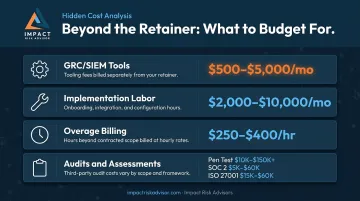
Get a projected assessment schedule and cost estimate from your provider before signing, not as the work begins.
Contract Terms and Ownership of Work Product
Watch for 12–24 month contracts with early exit penalties of 2–3 months' fees. Confident providers offer month-to-month terms. A provider pushing long commitments before they've demonstrated value is a red flag worth acting on.
Every policy, risk register, and evidence package created during the engagement should contractually belong to your organization, not the provider. Confirm this in writing before signing. Losing access to your own compliance documentation when a relationship ends can set your program back significantly.
How to Estimate the Right vCISO Budget
The right budget isn't the lowest one. It's the one that matches the actual risk your organization is carrying.
Key Factors to Evaluate Before Scoping
Before requesting proposals, assess the following:
- Starting from scratch requires significantly more hours than maintaining an existing program; scope accordingly
- Upcoming audits or certification deadlines compress work into fewer months, which raises cost
- Limited IT bandwidth means the vCISO may need to carry more implementation weight, not just advise
- Board-level reporting adds scope; monthly cadence costs more than quarterly
- On-call incident response is a premium add-on; confirm upfront whether it's included or billed separately
What to Look for in a Provider
Once you've scoped your needs, evaluating providers comes down to how they actually operate day-to-day. A few practical questions to ask before committing:
- How many active clients does each vCISO manage? More than 8–10 often means thin coverage and slow response times
- Are SLAs defined? Response time commitments and minimum engagement hours should be documented
- Does the practitioner have direct experience in your regulatory environment?
- Who owns the work product when the engagement ends?
Impact Risk Advisors' vCISO model is built around this embedded, continuous approach, practitioner-led support designed specifically for regulated industries including financial services, healthcare, SaaS, and government contractors. The practical results: fewer audit findings, faster deal closure, continuous audit readiness, and clean results when examiners arrive.
Frequently Asked Questions
How much do vCISO services cost?
vCISO services are priced three ways: hourly ($200–$400/hr), monthly retainer ($3,000–$20,000/mo), or fixed-scope project ($10,000–$75,000). Monthly retainer cost depends most heavily on company size, compliance scope, and the level of hands-on program management required.
How much does a fractional vCISO cost?
Fractional vCISO engagements run $1,500–$12,000+/month depending on company size and compliance scope. Startups with minimal requirements sit at the low end; mid-market organizations running active SOC 2, HIPAA, or multi-framework programs typically land in the $6,000–$12,000 range.
What is the difference between a vCIO and a vCISO?
A vCIO focuses on overall IT strategy, technology infrastructure, and business-technology alignment. A vCISO focuses specifically on cybersecurity strategy, risk management, compliance programs, and incident response. The roles are complementary but not interchangeable. In regulated environments, a vCIO does not replace the need for dedicated security leadership.
What is the average cost of a data breach?
IBM's 2025 Cost of a Data Breach report puts the global average breach cost at $4.44M, based on 600 organizations studied. That cost context makes a $5,000–$8,000/month vCISO retainer (roughly $60,000–$96,000 annually) a meaningful risk offset for most mid-market organizations evaluating security leadership options.
How much does SOC as a Service cost?
SOC as a Service (SOCaaS) covers 24/7 threat monitoring, detection, and incident response, typically priced at $5,000–$50,000/month depending on asset coverage and service level. This is a security operations function, distinct from vCISO services (strategic leadership and compliance governance). Most mid-market organizations need both: vCISO for program strategy and governance, SOCaaS for ongoing threat detection and response.