Against that backdrop, a cybersecurity risk assessment isn't optional; it's a baseline. But what does one cost?
There's no single answer. Prices vary dramatically based on organization size, infrastructure complexity, regulatory requirements, and depth of analysis. Getting the budget wrong in either direction creates problems: too little and you get a shallow scan that misses real gaps; too much for your actual risk profile and you've wasted money that should fund remediation.
This article breaks down pricing by organization size, explains the factors that move the needle, and gives you a practical framework for building the right budget.
Key Takeaways
- Small businesses (under 100 users): ~$3,000–$15,000
- Mid-market (100–250 users): ~$15,000–$50,000
- Enterprise (250+ users): ~$50,000–$150,000+
- Key cost drivers: organization size, infrastructure complexity, compliance scope, and assessment depth
- Remediation, follow-up testing, and employee training are rarely included; budget for each separately
- Regulated industries (healthcare, finance, government contracting) should plan for annual reassessment
How Much Does a Cybersecurity Risk Assessment Cost in 2026?
Cybersecurity risk assessment pricing doesn't follow a fixed schedule. Providers scope engagements based on your specific environment, and two organizations with similar headcounts can receive very different quotes depending on what's actually involved.
The directional pricing tiers below are consistent with official cost estimates from the DoD's 2024 CMMC final rule, the strongest publicly available pricing benchmark for compliance-mapped assessments, and reflect general market ranges for comparable professional services engagements.
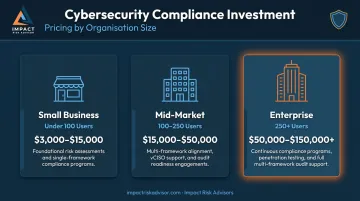
| Tier | Organization Size | Approximate Range |
|---|---|---|
| Small Business | Under 100 users | $3,000–$15,000 |
| Mid-Market | 100–250 users | $15,000–$50,000 |
| Enterprise | 250+ users | $50,000–$150,000+ |
Pricing Tier 1: Small Business (Under 100 Users)
Approximate range: $3,000–$15,000
At this tier, assessments typically cover:
- Asset and software inventory
- Basic vulnerability scanning (often automated)
- Limited policy and access control review
- A risk report with general remediation guidance
This tier fits early-stage startups, small professional services firms, and businesses without complex multi-location infrastructure or heavy compliance obligations. If you're a sub-50-person company without a SOC 2 or HIPAA requirement, a focused engagement in this range will cover the fundamentals.
What it usually won't include: manual penetration testing, compliance framework mapping, or a detailed remediation roadmap.
Pricing Tier 2: Mid-Market (100–250 Users)
Approximate range: $15,000–$50,000
Mid-market assessments go deeper. This range generally includes:
- Deeper vulnerability scanning with manual validation
- Compliance framework mapping (HIPAA, PCI-DSS, NIST, SOC 2, GLBA)
- More thorough policy and procedure review
- A detailed, prioritized remediation roadmap
- Interviews with key personnel across IT, operations, and compliance
This tier is most relevant for mid-sized businesses in regulated sectors: healthcare organizations, fintech platforms, SaaS companies handling sensitive customer data, and government contractors with CMMC obligations.
For reference, the DoD's 2024 CMMC final rule estimates a Level 2 self-assessment at $34,277–$43,403 triennially, which falls squarely within this range.
Pricing Tier 3: Enterprise (250+ Users)
Approximate range: $50,000–$150,000+
Enterprise engagements typically span weeks to months and involve multiple parallel workstreams. Expect:
- Multi-location on-site visits and assessments
- Red team or offensive testing alongside defensive posture review
- Full compliance audits across multiple overlapping frameworks
- Incident response preparedness reviews
- Executive reporting and board-level risk summaries
This tier applies to large organizations with complex infrastructure, multiple offices, or cross-border operations, particularly those subject to several regulatory frameworks at once. A health tech company satisfying HIPAA, SOC 2, and NIST 800-53 under a single program is a common example.
For reference, CMMC Level 2 C3PAO certification assessments run $101,752–$112,345 triennially, supporting the upper end of this range for highly regulated environments.
Key Factors That Drive the Cost Up or Down
Two organizations of similar size can receive quotes that differ by tens of thousands of dollars. That's because cost is determined by a combination of technical, operational, and regulatory factors, not just headcount.
Organization Size and Number of Users
More users means more endpoints, more accounts to audit, and more potential attack vectors. Each additional device or user expands the scope of scanning, evidence collection, and manual review. A 50-person company with a simple flat network is a fundamentally different engagement than a 200-person company with contractors, third-party integrations, and BYOD policies.
Infrastructure Complexity and Number of Locations
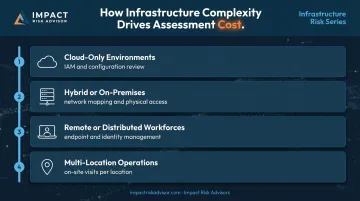
NIST SP 800-115 specifies that assessment scope depends directly on the number of components, network size, and complexity of heterogeneous environments. In practice, this means:
- Cloud-only environments require cloud-specific configuration review and IAM analysis
- Hybrid or on-premises environments require deeper network mapping and physical access review
- Remote or distributed workforces add endpoint coverage and identity management complexity
- Multi-location operations may require on-site visits per location, each adding travel time and labor cost
A hospital system with 12 regional facilities is not scoped the same way as a single-office accounting firm.
Type and Depth of Assessment
There's a meaningful difference between a defensive posture review (vulnerability scanning, policy review, configuration analysis) and a comprehensive assessment that adds offensive elements (penetration testing, simulated phishing, and active exploitation testing).
Comprehensive assessments start significantly higher because they require certified practitioners running real attack scenarios, not just running automated tools. If your risk exposure includes sophisticated adversaries or you're in a sector with active targeting (financial services, healthcare, defense contracting), this depth is worth the premium.
Regulatory and Compliance Requirements
Operating under HIPAA, PCI-DSS v4.0, CMMC, SOC 2, GLBA, or NIST 800-53 adds layers of complexity that a standard assessment doesn't cover. Compliance-mapped assessments require:
- Evaluating controls specific to each framework's requirements
- Documenting evidence in formats auditors will accept
- Mapping findings to specific control deficiencies
- Addressing framework-specific cadence requirements (CMMC Level 1 is annual; GLBA requires penetration testing and vulnerability assessments at defined intervals)
When multiple frameworks apply simultaneously, firms that map controls across all of them in a single engagement avoid redundant effort, and lower your overall cost compared to treating each framework as a separate assessment.
Scope Customization and Assessor Expertise
An assessment built around your actual risk profile costs more than an off-the-shelf package, but the findings are specific enough to act on. Automated tools flag known vulnerabilities across standard attack surfaces. Practitioners determine which of those vulnerabilities are actually exploitable given your architecture, your data flows, and the adversaries most likely to target your sector, a distinction that changes both prioritization and remediation cost.
Specialists in specific sectors (healthcare, government contracting, fintech) command higher rates that reflect hard-won industry knowledge. A healthcare-focused team knows what the Office for Civil Rights (OCR) actually scrutinizes; a CMMC specialist understands what a third-party assessment organization will look for during certification. That context changes what gets flagged and how findings are prioritized.
What's Included in a Cybersecurity Risk Assessment, and What Isn't
What a Thorough Assessment Covers
A well-scoped cybersecurity risk assessment should include:
- Asset and software inventory: cataloging what's in scope before anything can be evaluated
- Vulnerability scanning: both automated and manual, with credentialed access where possible
- Network and access control review: who has access to what, and whether that access is appropriate
- Policy and procedure evaluation: whether documentation matches actual practice
- Compliance framework mapping: gap analysis against applicable frameworks (HIPAA, NIST, SOC 2, etc.)
- Risk register with prioritized remediation recommendations: ranked by business impact, not just technical severity
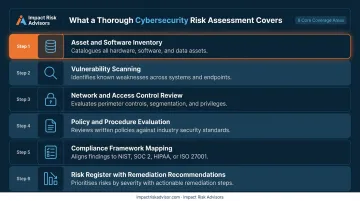
A quality assessment ties findings to business impact. Impact Risk Advisors, for example, maps results against NIST, ISO 27001, HIPAA, and SOC 2 simultaneously, delivering a prioritized remediation plan rather than a raw list of technical findings.
What's Almost Never Included
This is where many organizations get surprised. Base assessment prices almost never include:
- Remediation work: patching systems, reconfiguring networks, updating policies
- Employee security awareness training
- Follow-up re-validation to confirm fixes were implemented correctly
These are separate engagements with their own costs. Budget for them independently, because findings without remediation don't reduce risk.
Hidden Cost Drivers to Watch For
A few client-side factors can extend timelines and increase costs that providers may not flag upfront:
- Delays in granting system access or providing environment documentation
- Undocumented or shadow IT infrastructure that requires additional discovery work
- Operational constraints in healthcare, manufacturing, or multi-shift environments where testing windows are limited
These factors are routine in the regulated industries where thorough risk assessments are most critical.
Low-Cost vs. High-Cost Assessments: What Are You Actually Getting?
What Lower-Cost Assessments Look Like
Budget assessments typically rely on:
- Automated scanning tools with limited practitioner review
- Generic risk scoring not tailored to your industry or regulatory context
- Templated reports that may not translate into actionable next steps
The risk isn't just incomplete findings; it's false confidence. An automated scan that clears your environment can still miss complex vulnerabilities. NIST SP 800-115 specifically identifies these as beyond automated detection: attack pattern combinations, logic flaws, and weaknesses that only surface under credentialed access.
What Higher-Cost Assessments Provide
Practitioner-led assessments deliver:
- Manual testing that finds what automated tools miss
- Industry-specific compliance context (a HIPAA finding reads differently than a generic "access control gap")
- Risk prioritization by business impact, not just CVSS scores
- Findings that map directly to your remediation roadmap
Thoroughness matters, but the real value is specificity: knowing which vulnerabilities to fix first, why each one matters to your business, and what's at stake if you deprioritize them.
The ROI Case
That specificity has a dollar value. Consider the math. A thorough mid-market assessment costs $15,000–$50,000. IBM puts the average breach cost at $4.44 million. For healthcare organizations specifically, HIPAA penalties for uncorrected willful neglect can reach $2,190,294 per violation category under current HHS inflation-adjusted tables.
Assessment cost as a fraction of breach cost: typically less than 1%. Add operational downtime, reputational damage, and the regulatory scrutiny that intensifies when no documented risk assessment existed, and that gap widens further.
How to Budget for a Cybersecurity Risk Assessment
The Most Common Budgeting Mistake
Organizations focus on the assessment quote and forget everything downstream. The assessment is the diagnosis. Remediation, policy updates, system reconfigurations, and re-validation testing each carry their own cost, one that can easily exceed the assessment itself depending on what's found.
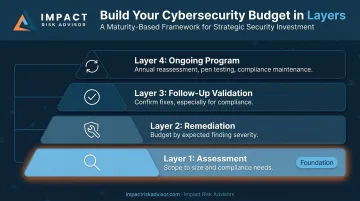
Build your budget in layers:
- Assessment: scoped to your size, infrastructure, and compliance obligations
- Remediation: budget a range based on expected finding severity (ask your provider for guidance during scoping)
- Follow-up validation: confirming fixes are working, especially for compliance-mapped assessments
- Ongoing program costs: annual reassessment, periodic penetration testing, and compliance maintenance
A Practical Scoping Framework
Before requesting quotes, clarify:
- User count and device inventory: directly determines assessment scope
- Number of locations: each adds labor and potentially travel
- Applicable compliance frameworks: HIPAA, CMMC, PCI-DSS, GLBA, SOC 2
- Infrastructure type: cloud-only, hybrid, or on-premises
- Goal: one-time audit or foundation for an ongoing compliance program
Regulated industries should plan for annual reassessment as standard. CMMC Level 1 requires annual self-assessment and affirmation. GLBA requires periodic reassessment and vulnerability assessments at least every six months. A one-time assessment that sits on a shelf doesn't maintain compliance.
Choosing the Right Provider
The right assessment is one scoped to your actual risk profile and delivered by practitioners who understand your industry, not a generic checklist handed off to junior staff. That distinction matters when findings need to map to real regulatory obligations.
Impact Risk Advisors works this way: practitioner-led engagements with 18+ years of experience and 150+ compliance audits across financial services, health tech, SaaS, and government contracting.
Their model is built around embedded, continuous compliance support, not point-in-time findings that go stale. For organizations in regulated industries, that kind of ongoing support translates to fewer audit surprises, faster enterprise deal cycles, and documented risk management maturity that supports better positioning with cyber insurers.
Frequently Asked Questions
How much does a cybersecurity risk assessment cost?
Costs range from approximately $3,000–$15,000 for small businesses, $15,000–$50,000 for mid-market organizations, and $50,000–$150,000+ for enterprises. Final pricing depends on organization size, infrastructure complexity, number of locations, and applicable compliance frameworks.
How is a cybersecurity risk assessment different from a vulnerability assessment?
A vulnerability assessment focuses on scanning for technical weaknesses in systems and networks. A cybersecurity risk assessment is broader: it evaluates people, processes, and technology together, maps findings to compliance frameworks, and prioritizes risks by business impact rather than technical severity alone.
How often should a cybersecurity risk assessment be conducted?
Annual assessments are the standard recommendation. For regulated industries, frequency is often mandated; CMMC Level 1 requires annual assessment and affirmation, GLBA requires vulnerability assessments at least every six months, and reassessment is warranted after major infrastructure changes or security incidents.
Is remediation included in the cost of a cybersecurity risk assessment?
Almost never. Remediation (patching systems, reconfiguring networks, updating policies) is a separate engagement. Budget for it independently, as costs vary significantly based on the severity and volume of findings identified during the assessment.
Can a cybersecurity risk assessment help lower cyber insurance premiums?
Insurers increasingly require documented risk assessments as part of underwriting. Aon's 2025 cyber market report notes that broader coverage and higher limits are available for organizations demonstrating responsive cybersecurity controls. A well-documented assessment and remediation program supports that positioning, though no single assessment guarantees specific premium reductions.
What should I look for when choosing a cybersecurity risk assessment provider?
Prioritize providers with industry-specific expertise in your sector, transparent scoping and pricing, practitioner-led delivery rather than generic automated tools, and a track record supporting the compliance frameworks that apply to your business. Be cautious of fixed, one-size-fits-all packages; they're usually a sign the assessment isn't scoped to your environment.