The decision between a fractional CISO and an in-house hire isn't just about cost. It directly shapes your compliance readiness, security program quality, and how fast you can respond when something goes wrong. Get it right, and you get executive-level security leadership that fits your stage. Get it wrong, and you either overpay for capacity you don't need or under-invest when the stakes are highest.
This article breaks down what each model actually delivers, what each costs, and how to determine which one fits your organization right now.
Key Takeaways
- A fractional CISO provides part-time or contract-based security leadership, typically via monthly retainer, at significantly lower cost than a full-time hire
- An in-house CISO is a full-time, embedded executive best suited for large, complex, or heavily regulated organizations with dedicated security teams
- Cost gap is real: full-time CISO total compensation averages $415K at companies under $1B revenue; fractional retainers run $5K–$20K/month
- Fractional CISOs bring cross-industry compliance experience and fast deployment; in-house CISOs offer deeper cultural integration and direct team management
- Many organizations start with a fractional CISO and transition to a full-time hire as security complexity grows
Fractional CISO vs In-House CISO: Quick Comparison
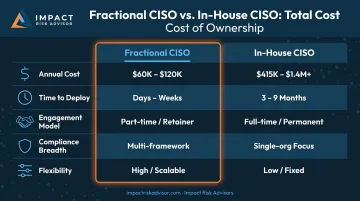
| Factor | Fractional CISO | In-House CISO |
|---|---|---|
| Annual Cost | $60K–$120K (retainer) | $415K–$1.4M+ (total comp) |
| Time to Deploy | Days to weeks | 3–9 months (search + onboarding) |
| Engagement Model | Part-time, retainer or project-based | Full-time, permanent employee |
| Compliance Breadth | Multi-framework, cross-industry experience | Deep institutional knowledge, single-org focus |
| Flexibility to Scale | High: scope adjusts as needs change | Low: headcount and cost are fixed |
A note on terminology: "Fractional CISO" and "virtual CISO" (vCISO) are often used interchangeably. The nuance: fractional CISOs tend to be more embedded, sometimes including on-site presence, while vCISOs are typically fully remote. Both contrast sharply with a full-time in-house hire in cost, commitment, and flexibility.
Neither model is universally better. The decision turns on your organization's size, compliance obligations, and how much security leadership you need on a daily basis, factors the sections below break down in detail.
What Is a Fractional CISO?
A fractional CISO is a seasoned cybersecurity executive engaged on a part-time or contract basis. They provide strategic security leadership, risk oversight, and compliance guidance without the cost or commitment of a permanent hire.
Core Responsibilities
A fractional CISO handles the full scope of executive security leadership:
- Developing security strategy and program roadmaps
- Conducting risk assessments and managing risk registers
- Leading compliance programs across SOC 2, HIPAA, ISO 27001, NIST 800-53, GLBA, and similar frameworks
- Overseeing incident response planning and facilitating tabletop exercises
- Reporting security posture and risk to boards and executive teams
- Managing vendor risk and third-party oversight
Why Organizations Choose the Fractional Model
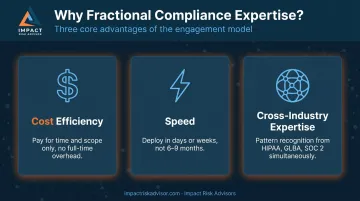
Three practical advantages drive adoption:
- Cost efficiency: you pay for the time and scope you need, not a full-time salary plus benefits
- Speed: deployment takes days or weeks, not the 3–9 months a CISO search typically requires
- Cross-industry exposure: practitioners serving multiple clients simultaneously apply lessons from sectors you may never have encountered internally
A fractional CISO who has guided a healthcare SaaS company through HIPAA, a fintech through GLBA, and a cloud platform through SOC 2 within the same year brings pattern recognition that a single-org hire can't replicate. That breadth compounds fast.
How Impact Risk Advisors Delivers This Model
Impact Risk Advisors' vCISO service is built on embedded, continuous engagement, not point-in-time consulting. Rather than delivering a report and moving on, the vCISO owns the security roadmap, manages the compliance calendar, and communicates risk to the board on an ongoing basis.
The service covers SOC 2, HIPAA, ISO 27001, NIST 800-53, and GLBA, and is designed specifically for organizations that need executive-level security leadership without the full-time overhead. Documented client outcomes include reduced cyber insurance premiums, cleaner audit results, fewer last-minute fire drills, and faster enterprise sales cycles, because prospects and customers see a security-ready organization before they even ask.
Use Cases for a Fractional CISO
The fractional model fits best when:
- Budget doesn't support a full-time executive hire, common for SMBs and growth-stage companies
- A compliance deadline is approaching; SOC 2 Type II, HIPAA, and ISO 27001 readiness move faster with a practitioner who has done it before
- The organization is in leadership transition; fractional fills the gap while a permanent search runs
- An IT team lacks strategic oversight; technical staff often need an executive layer for board communication and program direction
- You want to pilot executive security leadership before committing to a full-time hire
A practical example: WayPath Consulting engaged a vCISO to build their cybersecurity program and achieve SOC 2 compliance, with one client achieving SOC 2 Type 1 attestation in a matter of months, a timeline that would have been difficult to reach without dedicated security leadership already in place.
What Is an In-House CISO?
An in-house CISO is a full-time, permanent security executive embedded within the organization. Their job is to build and lead a security team, shape company culture around risk, and maintain continuous oversight of the security program.
Core Responsibilities
- Day-to-day security operations management
- Direct management and mentorship of an internal security team
- Real-time incident response leadership
- Continuous executive and board-level security reporting
- Embedded collaboration with HR, legal, product, and engineering on security policy and risk decisions
The Business Case for a Full-Time Hire
An in-house CISO provides advantages a fractional model can't fully replicate:
- Constant availability for operational decisions, crises, and cross-functional collaboration
- Deep institutional knowledge built over years of working inside the organization
- Direct team management: fractional CISOs advise and guide, but don't manage headcount daily
- Cultural integration: security becomes embedded in how the organization operates, not treated as a periodic compliance exercise
The Full Cost Picture
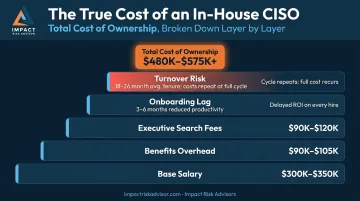
Base salary is only part of it. According to IANS and Artico's 2025 Small and Middle Market CISO Report, average total CISO compensation at organizations under $1B revenue is $415K. Add benefits overhead (the BLS reports benefits account for 29.9% of total private-sector employer compensation costs) and the number climbs further.
Beyond compensation, factor in:
- Executive search fees: executive search firms typically charge 30–35% of first-year salary as a placement fee
- Time to fill: most CISO searches take 6–9 months; even well-run searches rarely close in under 90 days
- Onboarding lag: a new CISO needs 3–6 months to become operationally effective
- Turnover risk: CISO average tenure often runs 18–26 months, meaning hiring costs recur faster than most budget cycles anticipate
Use Cases for an In-House CISO
An in-house hire makes sense when:
- The organization has 500–1,000+ employees with operational complexity that demands daily security leadership
- There's already a dedicated security team that needs direct management and mentorship
- A regulator or major enterprise client specifically requires a named, dedicated security officer
- Security is a core competitive differentiator, for example a cloud platform selling into regulated enterprise markets
- The business is navigating M&A activity, major product launches, or persistent high-threat environments where reactive leadership isn't enough
Fractional CISO vs In-House CISO: Which Model Fits Your Business?
Key Decision Criteria
Before making the call, assess these five dimensions honestly:
- Company size and operational complexity: specifically, how many systems, teams, and processes need daily security oversight
- Budget: can you sustain $415K+ in total compensation, plus recruiting, benefits, and turnover risk?
- Compliance obligations: how many frameworks are in scope, and how urgent are the deadlines?
- Security program maturity: do you have foundational controls in place, or are you starting from scratch?
- Speed requirements: do you need security leadership in weeks, or can you afford a 6–9 month search?
Clear Situational Recommendations
Choose a fractional CISO if:
- Your organization is under ~500 employees
- You're facing a compliance deadline within 6–12 months
- You lack a dedicated internal security team
- You need to close an enterprise deal that requires security documentation
- You want security leadership without the long-term fixed cost
Choose an in-house CISO if:
- You manage a security team of several people who need daily executive leadership
- A regulator or major customer explicitly requires a dedicated, named security officer
- Security operations are a continuous, full-time operational requirement, not a periodic governance function
- You have the budget and runway to absorb full compensation, recruiting costs, and turnover risk
The Hidden Cost Argument for Fractional
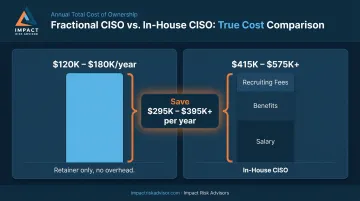
The comparison isn't just salary vs. retainer. A realistic total cost of ownership for an in-house CISO at a mid-market company includes:
- Base salary: ~$300K–$350K (smaller organizations)
- Benefits overhead: ~$90K–$105K (29.9% of total comp)
- Executive search fees: ~$90K–$120K (30–35% of first-year salary)
- Onboarding and ramp time: 3–6 months of reduced productivity
- Turnover risk: estimated 18–26 month average tenure means this cycle repeats
A fractional CISO retainer at $10K–$15K/month delivers executive-level security leadership at $120K–$180K annually, without benefits, recruiting fees, or turnover exposure.
The Transition Path
Most organizations treat this as a sequence, not a permanent choice. A fractional vCISO builds the program foundation first: security policies, risk registers, compliance roadmaps, incident response plans, and audit documentation. When the organization grows to a scale where daily embedded leadership is warranted, the full-time CISO inherits a structured, operational program.
For organizations in financial services, healthcare, SaaS, or government contracting, Impact Risk Advisors' vCISO service provides embedded, practitioner-led security leadership that produces measurable program improvements. Schedule a free consultation to assess where your program stands and define a realistic path forward.
Conclusion
Neither model wins universally. A fractional CISO delivers maximum value when the organization needs strategic security leadership on a budget or timeline that doesn't support a full-time hire. An in-house CISO is the right investment when daily, embedded security leadership is a genuine operational requirement.
The decision maps directly to four business outcomes:
- Cost efficiency: fractional models reduce overhead without sacrificing strategic depth
- Compliance readiness: the right leader accelerates audit preparation and framework alignment
- Cyber insurance posture: documented programs and clear ownership lower premiums
- Enterprise trust: buyers and partners expect visible, accountable security leadership
Match the model to where your organization is today, not where you hope to be. Getting that fit right is what separates a security program that stalls from one that scales.
Frequently Asked Questions
What is a fractional CISO role?
A fractional CISO is a part-time or contract security executive who provides strategic leadership, compliance oversight, and risk management without the cost or commitment of a full-time hire. They typically serve multiple clients simultaneously, bringing cross-industry experience that a single-org hire can't replicate.
What is the difference between a fractional CISO and an in-house CISO?
A fractional CISO works on a part-time or retainer basis and brings cross-client exposure across industries and frameworks. An in-house CISO is a full-time employee embedded in daily operations.
How much does a fractional CISO cost?
Fractional CISO retainers typically run $5K–$20K/month, or $60K–$120K annually. Full-time CISO total compensation averages $415K at smaller organizations and reaches $500K–$700K+ at larger enterprises, not counting benefits, recruiting fees, and turnover costs.
What are the different types of CISO?
The main models are: full-time in-house CISO (permanent employee), fractional CISO (part-time or contract, often with on-site presence), and virtual CISO or vCISO (typically fully remote and consultative). Fractional and virtual are often used interchangeably, but fractional engagements tend to be more deeply embedded.
When should a company hire an in-house CISO instead of a fractional one?
An in-house CISO makes sense when the organization has grown beyond 500–1,000 employees, manages a dedicated internal security team requiring daily executive oversight, or operates in an environment where a regulator or major client specifically requires a named, dedicated security officer.
Can a fractional CISO help with compliance frameworks like SOC 2 or HIPAA?
Yes, compliance readiness is one of the primary reasons organizations engage fractional CISOs. Experienced practitioners routinely guide companies through SOC 2, HIPAA, ISO 27001, NIST 800-53, and GLBA, often managing multiple certifications simultaneously across their client base.