Introduction
Cybercrime costs are projected to reach $10.5 trillion annually by 2025, and the threat picture keeps shifting. According to Verizon's 2025 Data Breach Investigations Report, ransomware appeared in 44% of breaches, up from 32% the prior year, while third-party involvement in breaches doubled from 15% to 30%.
For businesses in financial services, healthcare, SaaS, and government contracting, the consequences aren't just technical. The SEC levied civil penalties of $4M, $1M, $995,000, and $990,000 against four companies for inadequate cyber disclosures in 2024 alone. Meanwhile, cyber insurance underwriters are tightening requirements, and enterprise procurement teams are scrutinizing vendors far more closely than they did even two years ago.
Choosing the right cybersecurity risk assessment consultant now directly shapes regulatory standing, insurance eligibility, and whether enterprise deals close at all.
This guide covers what separates effective risk assessment consulting from checkbox exercises, which firms stand out in 2026, and how to select the right partner for your specific risk profile.
Key Takeaways
- The best risk assessment consultants translate vulnerabilities into business risk, compliance posture, and prioritized remediation, not just scan reports.
- Top firms in 2026 pair practitioner-led methodology with ongoing engagement rather than one-time deliverables.
- Top firms covered: Impact Risk Advisors, Deloitte Cyber Risk, Palo Alto Networks (Unit 42), Rapid7, and CrowdStrike Services.
- Key selection criteria: industry experience, framework depth, deliverable transparency, and measurable risk reduction.
- Firms offering vCISO leadership alongside assessments tend to produce the most sustained compliance outcomes.
What Is Cybersecurity Risk Assessment Consulting?
Cybersecurity risk assessment consulting is a structured process of identifying and prioritizing threats to an organization's systems, data, and operations. External practitioners apply frameworks like NIST CSF, ISO 27001, or SOC 2 to produce an actionable risk picture with concrete remediation guidance.
Why Organizations Outsource It
The skills gap is real and widening. The WEF Global Cybersecurity Outlook 2026 found that 54% of organizations cite insufficient knowledge and skills as an obstacle to deploying AI for cybersecurity, with the gap hitting 57% among public sector organizations.
Most mid-market companies don't have the internal capacity to run rigorous, framework-aligned risk assessments. External consultants bring practitioner depth that would take years to build in-house, especially in regulated industries where frameworks like HIPAA, GLBA, and NIST 800-53 evolve alongside regulatory expectations.
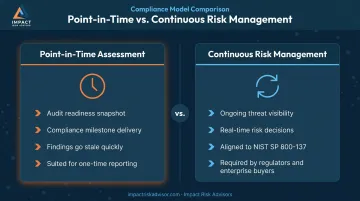
Point-in-Time vs. Continuous Risk Management
The two models serve very different needs:
- Point-in-time assessment: Delivers a snapshot useful for audit readiness or a compliance milestone. Findings can become stale within weeks after a new SaaS integration, cloud misconfiguration, or newly disclosed vulnerability.
- Continuous risk management (per NIST SP 800-137): Maintains ongoing visibility into information security, vulnerabilities, and threats to support real-time risk decisions. For fintech, healthcare, and government contractors, this is what regulators and enterprise customers expect.
The most common gap Impact Risk Advisors observes is organizations that assemble documentation only in the weeks before an audit, then let controls drift for the remaining eleven months. That approach consistently produces more audit findings, more remediation fire drills, and significantly more exposure.
Top Cybersecurity Consultants for Risk Assessment in 2026
These firms were evaluated on the depth of their risk assessment methodology, regulated-sector expertise, deliverable transparency, and ability to translate findings into prioritized business action.
Impact Risk Advisors
Impact Risk Advisors is a US-based cybersecurity compliance and risk advisory firm built around practitioner-led, embedded support: covering risk assessments, penetration testing, and virtual CISO (vCISO) leadership for businesses in financial services, healthcare, SaaS, and government contracting.
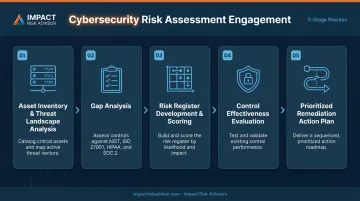
Assessments are scoped to each client's actual threat landscape and regulatory standing, not a generic control checklist applied uniformly. Each engagement includes:
- Asset inventory and threat landscape analysis
- Gap analysis against NIST, ISO 27001, HIPAA, and SOC 2
- Risk register development and scoring
- Control effectiveness evaluation
- Prioritized remediation action plan
Deliverables are built for business decision-makers, not just security teams. Findings translate into a business-aligned risk register and remediation roadmap that executives can understand and act on. The firm has supported 150+ compliance audits across its primary verticals and structures its engagements for continuous improvement rather than annual checkboxes.
Measurable outcomes clients experience include reduced cyber insurance premiums, cleaner audit results, and faster enterprise sales cycles where security posture had previously been a friction point.
| Detail | Info |
|---|---|
| Key Services | Risk assessments, penetration testing, vCISO leadership, proactive compliance programs |
| Best Fit For | Financial services, health tech, SaaS companies, and government contractors seeking embedded, ongoing risk management |
| Frameworks | NIST, ISO 27001, HIPAA, SOC 2, NIST 800-53, GLBA |
| Pricing | Custom-scoped; contact for engagement details |
Deloitte Cyber Risk
Deloitte's cyber risk advisory practice operates at enterprise scale, with more than 35,000 cybersecurity practitioners globally and the No. 1 position in Gartner's 2024 Security Services market share report. That report measured a market of $77.1 billion, with Deloitte holding 16.6% global share.
Risk assessment capabilities cover:
- Cyber maturity modeling and risk quantification
- Governance design and third-party supply chain risk
- Board-level reporting aligned to SOX, HIPAA, and GDPR
For large organizations running multi-quarter compliance transformation programs, Deloitte's breadth and institutional credibility are clear advantages.
That said, engagement complexity and cost can be disproportionate for mid-market or growth-stage organizations that need agility rather than enterprise governance transformation.
| Detail | Info |
|---|---|
| Key Services | Cyber maturity assessments, risk quantification, governance design, third-party risk management |
| Best Fit For | Large enterprises undergoing regulatory transformation or requiring board-level security governance |
| Pricing | Custom-quoted; official pages direct buyers to contact Deloitte or submit an RFP |
Palo Alto Networks (Unit 42)
Unit 42 is the threat intelligence and consulting division of Palo Alto Networks, built around incident response, ransomware readiness, and risk-led advisory informed by frontline breach investigations.
The numbers behind their methodology are notable. According to the 2026 Unit 42 Global Incident Response Report, more than 90% of 2025 incidents involved preventable gaps, 87% involved multiple attack surfaces, and the fastest-quartile attacker reached exfiltration in just 72 minutes, down from 285 minutes in 2024. SaaS applications were relevant in 23% of cases, up from 18% in 2024.

Unit 42 assessments benchmark findings against real adversary behavior rather than theoretical controls. This threat-intelligence-informed approach is particularly valuable for organizations in high-exposure industries where active threat actor targeting is a genuine concern.
| Detail | Info |
|---|---|
| Key Services | Ransomware readiness assessments, SOC gap analysis, red/purple teaming, vCISO advisory |
| Best Fit For | Organizations prioritizing incident readiness and threat-led risk validation |
| Pricing | Credit-based retainer model (tiers from 250 to 2,500+ credits); dollar pricing not publicly disclosed |
Rapid7
Rapid7 combines security technology with hands-on consulting, connecting penetration testing, vulnerability management, and managed detection with assessment services that link findings directly to remediation action.
Its published platform pricing offers a useful benchmark: InsightVM starts at $1.62 per month per asset for 500 assets, with InsightAppSec from $175 per month per application and InsightCloudSec from $5,775 per month for up to 500 instances. These are platform rates, not full consulting engagements, but they reflect how Rapid7 structures its exposure management services.
Rapid7's consulting approach centers on actionability. Findings are ranked by real-world exploitability, not just theoretical severity, and paired with practical remediation steps. That appeals to mid-market security teams who need strategic insight and execution support in the same engagement.
| Detail | Info |
|---|---|
| Key Services | Penetration testing, continuous exposure management, vulnerability assessments, IR consulting |
| Best Fit For | Mid-market organizations seeking risk assessments paired with concrete, measurable remediation outcomes |
| Pricing | InsightVM: from $1.62/month per asset (500 assets); consulting engagements are custom-quoted |
CrowdStrike Services
CrowdStrike's consulting arm brings adversary-focused risk assessment and strategic advisory powered by real-time global threat telemetry. Its 2026 Global Threat Report found that 82% of detections were malware-free and average eCrime breakout time dropped to 29 minutes.
The services most relevant to risk assessment include identity and Active Directory assessments, tabletop exercises modeled on targeted attack scenarios, adversary emulation, and SaaS/cloud configuration reviews. The intelligence layer is CrowdStrike's clearest differentiator: findings are contextualized against live adversary behavior, helping organizations understand not just what's exposed but who is likely to exploit it.
Published Falcon platform tiers run $7.99, $14.99, and $19.99 per device per month. These are product pricing tiers, not consulting rates. Advisory services are custom-quoted.
| Detail | Info |
|---|---|
| Key Services | Identity and access risk assessments, adversary emulation, tabletop exercises, SaaS security reviews |
| Best Fit For | Organizations seeking threat-intelligence-enriched risk assessments or detection and response validation |
| Pricing | Falcon tiers: $7.99–$19.99/device/month (platform); consulting services are custom-quoted |
How We Selected These Firms
These firms were assessed against five criteria:
- Framework alignment, scoping rigor, and deliverable quality
- Demonstrated experience in financial services, healthcare, SaaS, or government contracting
- Ability to support ongoing risk management, not just one-time audits
- Findings communicated in business terms, not purely technical output
- Track record of compliance milestones, reduced exposure, or measurable security posture improvement
The Most Common Selection Mistake
Organizations frequently choose based on brand recognition rather than methodology fit. A large firm may deliver a technically thorough report that's too generic to drive action, or too enterprise-focused to apply to a 50-person SaaS company preparing for SOC 2 Type II.
The mismatch shows up in the deliverable: 200 findings with no business-impact ranking, or findings framed in technical language that leadership can't translate into a security roadmap. Neither outcome moves the needle on actual risk reduction.
Who Benefits Most from Continuous Advisory
Growth-stage organizations get the most out of consultants who combine assessment rigor with ongoing advisory:
- SaaS companies approaching SOC 2 Type II for the first time, where compliance posture directly affects enterprise deal velocity
- Fintechs preparing for third-party audits from bank partners or regulators
- Healthcare providers under HIPAA, where risk analysis must address evolving threats continuously, not annually
- Government contractors managing NIST 800-53 compliance with regular control reviews
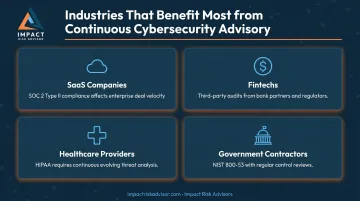
For these segments, an annual point-in-time assessment leaves real gaps. Controls drift, infrastructure changes, and new threat vectors emerge well before the next twelve-month cycle begins.
Conclusion
The right cybersecurity risk assessment consultant in 2026 isn't necessarily the largest one. It's the one whose methodology, industry experience, and engagement model match your actual risk posture and business goals.
Before selecting a firm, evaluate:
- Does their assessment scope to your threat profile, or apply a generic framework?
- Can they deliver findings in business terms your leadership team can act on?
- Do they support ongoing remediation, or disappear after the report?
- Have they demonstrated outcomes in your specific industry and compliance environment?
A risk assessment only creates value when its findings get executed. That requires a partner who stays engaged after the report is delivered, not one who hands off a PDF and moves on.
For organizations in financial services, healthcare, SaaS, or government contracting, Impact Risk Advisors offers practitioner-led assessments, vCISO leadership, and compliance programs built on embedded support, not one-time engagements. Reach out for a consultation to understand your current risk posture and what it would take to address it.
Frequently Asked Questions
What are the top cybersecurity trends to expect in 2026?
94% of respondents to the WEF's 2026 survey identify AI as the most significant driver of cybersecurity change, making AI-powered attacks the top concern heading into 2026. Cloud risk, expanding SaaS attack surfaces, and tightening regulatory requirements in financial services and healthcare are close behind, with Gartner projecting 50% of organizations will implement zero-trust data governance by 2028.
What does a cybersecurity risk assessment consultant do?
They identify vulnerabilities and threats across systems, data, and operations, then prioritize risks based on business impact and regulatory exposure. The deliverable is typically a risk register and remediation roadmap aligned to frameworks like NIST, ISO 27001, or SOC 2, giving internal teams a clear, ranked action plan rather than a raw list of findings.
How much does a cybersecurity risk assessment consultant cost?
Publicly disclosed pricing is limited. Platform tools like Rapid7 InsightVM start at $1.62/month per asset; CrowdStrike Falcon tiers run $7.99–$19.99/device/month. Full consulting engagements vary based on asset count, regulatory scope, and whether the work is point-in-time or ongoing; most firms require a scoping conversation before quoting.
What is the difference between a vCISO and a cybersecurity risk assessment consultant?
A risk assessment consultant conducts a scoped evaluation and delivers prioritized findings. A vCISO provides ongoing strategic security leadership, owning the security roadmap, managing the compliance calendar, and reporting to the board. The most effective engagements combine both: assessment to establish the risk baseline, vCISO to drive continuous improvement against that baseline.
How often should a business conduct a cybersecurity risk assessment?
Most frameworks, including NIST and ISO 27001, recommend at minimum an annual assessment. High-growth companies, post-merger organizations, and those in regulated industries typically need continuous or quarterly reassessment cycles, particularly when infrastructure, team size, or regulatory requirements are changing.
What certifications should a cybersecurity risk assessment consultant have?
Key credentials include CISSP (security leadership and implementation), CISA (audit and control), and CRISC (IT risk assessment and governance), all from recognized bodies like ISC2 and ISACA. For framework-specific work, look for ISO/IEC 27001 Lead Auditor or PCI QSA qualifications. Certifications matter, but validate them alongside hands-on experience in your specific industry and compliance environment.