The pressure is real. According to NAIC's 2025 Cybersecurity Insurance Report, 35.5% of 2024 data breaches originated from third-party compromises, and U.S. cyber insurance claims rose nearly 40% to almost 50,000 claims. Procurement teams aren't sending security questionnaires as a formality anymore; they're making vendor decisions based on them.
Holding both SOC 2 and ISO 27001 does more than satisfy a checkbox. It signals that your security program is built to last, not assembled for an audit. This article covers the top cybersecurity compliance firms delivering dual SOC 2 and ISO 27001 capabilities in 2026, what makes each one worth considering, and how to choose the right partner for your situation.
Key Takeaways
- SOC 2 dominates North American vendor due diligence; ISO 27001 carries international weight, and many enterprise buyers now require both
- 35.5% of 2024 data breaches involved third-party vendors, making compliance credentials a vendor requirement, not a differentiator
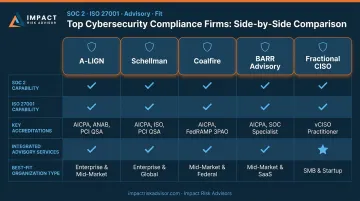
- Top firms for dual SOC 2 + ISO 27001 in 2026: A-LIGN, Schellman, Coalfire, BARR Advisory, and Fractional CISO
- The right partner depends on your audit scope, industry, timeline, and whether you need ongoing advisory or a one-time report
- Embedded, practitioner-led programs produce stronger long-term outcomes than annual audit cycles
Why SOC 2 & ISO 27001 Compliance Matters in 2026
What Each Framework Actually Covers
SOC 2 is an AICPA-defined attestation against five Trust Services Criteria: Security, Availability, Processing Integrity, Confidentiality, and Privacy. It's the standard North American enterprises use when evaluating vendor risk. A SOC 2 Type I assesses control design at a point in time; a Type II covers operating effectiveness over an observation period, typically six to twelve months.
ISO 27001 is the internationally recognized standard for building and certifying an Information Security Management System (ISMS). The current version (ISO/IEC 27001:2022) is the only relevant standard heading into 2026, as the transition period from the 2013 version ended October 31, 2025. Organizations serving global clients, or those requiring a formal certification (not just an attestation report), often pursue ISO 27001 alongside SOC 2.
The Business Case in 2026
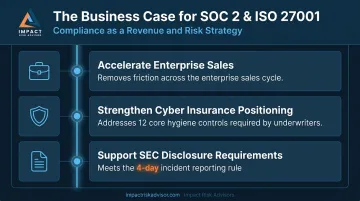
Most compliance investments are driven by three concrete outcomes:
- Removes friction from enterprise sales cycles; security questionnaires and vendor due diligence stall deals, and a current SOC 2 report or ISO 27001 certificate clears the path
- Strengthens cyber insurance positioning: Marsh's Q4 2024 cyber insurance update notes that underwriters evaluate 12 core cyber hygiene controls, and a documented compliance program directly supports that assessment
- Backs SEC disclosure requirements: public companies must now report material incidents within four business days and disclose risk governance annually; SOC 2 and ISO 27001 programs provide the documentation those disclosures require
The regulatory calendar makes this more urgent. New state privacy laws took effect across more than a dozen states between 2024 and 2026, including Indiana and Kentucky in January 2026. CMMC Phase 1 for DoD contractors runs through November 2026. For mid-market organizations in regulated industries, self-certification is no longer a realistic path.
Top Cybersecurity Firms with SOC 2 & ISO 27001 Compliance in 2026
The firms below were selected based on demonstrated dual SOC 2 and ISO 27001 delivery capability, accreditation quality, service depth, and track record across financial services, healthcare, SaaS, and government contracting.
A-LIGN
A-LIGN is one of the largest end-to-end compliance providers in the US, serving more than 4,000 global organizations across SOC 1, SOC 2, ISO 27001, FedRAMP, HITRUST, CMMC, and PCI DSS. Its structure is rare: a licensed CPA firm and ANAB-accredited ISO 27001 certification body under one roof. That means it can issue both the SOC 2 attestation report and the ISO 27001 certificate without routing either component to a separate entity.
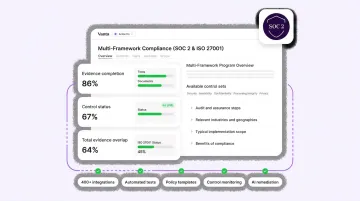
Its compliance automation platform, A-SCEND, is the firm's clearest advantage for organizations pursuing both frameworks simultaneously. A-SCEND maps controls across standards, identifies overlapping evidence requirements, and provides real-time audit progress visibility, cutting the manual coordination burden that makes dual-framework engagements costly and slow.
| Attribute | Details |
|---|---|
| Key Services | SOC 1, SOC 2, ISO 27001, FedRAMP, HITRUST, CMMC, PCI DSS |
| Accreditations | AICPA-licensed CPA firm; ANAB-accredited ISO certification body; FedRAMP 3PAO; CMMC C3PAO |
| Best Suited For | Mid-market to enterprise orgs, SaaS/cloud providers, government contractors pursuing multi-framework audits |
Schellman
Schellman has operated as an IT compliance-focused assessor for more than 20 years and issues more than 2,000 SOC reports annually, among the highest volumes of any firm in the US. It is the only Top 50 CPA firm focused exclusively on IT compliance and cybersecurity, and holds both AICPA licensure and ANAB/UKAS transition accreditation for ISO 27001:2022.
Schellman's independence model sets it apart: the firm does not provide remediation or consulting services alongside its audit work, eliminating any conflict of interest between advisory and attestation functions. For organizations that need clean separation between their compliance advisor and their auditor, this structure matters. Its coordinated audit approach also reduces duplicate evidence requests when clients pursue SOC 2 and ISO 27001 together.
| Attribute | Details |
|---|---|
| Key Services | SOC 2, ISO 27001, FedRAMP, PCI DSS, HITRUST, CSA STAR, Privacy assessments |
| Accreditations | AICPA-licensed CPA firm; ANAB/UKAS-accredited ISO certification body; FedRAMP 3PAO (202 assessments) |
| Best Suited For | SaaS and cloud providers, healthcare tech, financial services firms requiring unbiased third-party attestation |
Coalfire
Coalfire brings over 20 years of cybersecurity experience and completes more than 400 SOC assessments annually, with 75% of its SOC engagements serving cloud service providers including Google, Amazon, IBM, and Microsoft. Its certification body (Coalfire Certification, formerly Coalfire ISO) operates under ANAB accreditation for management system certification services.
Unlike pure audit firms, Coalfire integrates penetration testing, cloud architecture review, and threat modeling directly into its SOC 2 and ISO 27001 engagements. For cloud-native organizations with complex infrastructure, this means audit readiness and real security improvements happen in the same cycle, not sequentially.
| Attribute | Details |
|---|---|
| Key Services | SOC 2, ISO 27001, FedRAMP, CMMC, PCI DSS, HITRUST, penetration testing |
| Accreditations | AICPA-licensed CPA firm; Coalfire Certification (ANAB); FedRAMP 3PAO; CMMC C3PAO |
| Best Suited For | Cloud-native SaaS, government contractors, fintech firms needing integrated security and compliance |
BARR Advisory
BARR Advisory operates with a distinct structural advantage: its related certification body, BARR Certifications, is ANAB-accredited for ISO 27001, while BARR Advisory handles SOC 2 attestation as a licensed CPA firm. This means a single coordinated team can execute both frameworks concurrently: one evidence set, one audit cycle, two outputs.
Its coordinated audit model compresses timelines and reduces the administrative burden that typically comes from managing two separate engagement relationships. BARR also extends into advisory services including virtual CISO, readiness assessments, and continuous monitoring, making it a viable long-term partner rather than a one-time auditor.
| Attribute | Details |
|---|---|
| Key Services | SOC 2 (Type I & II), ISO 27001, HIPAA, HITRUST, FedRAMP, PCI DSS, vCISO advisory |
| Accreditations | AICPA-licensed CPA firm; ANAB-accredited ISO certification body (BARR Certifications) |
| Best Suited For | Organizations pursuing both frameworks simultaneously, SaaS platforms, businesses expanding into international markets |
Fractional CISO
Fractional CISO is an advisory and audit management firm, not a certification body. It does not issue SOC 2 reports directly (those are signed by a third-party CPA), and it does not hold ISO 27001 accreditation. Instead, it embeds experienced security leaders into client organizations to own the compliance journey from gap assessment through certification.
For SMBs and growth-stage companies without an in-house CISO, this model solves a real problem: you get executive-level security leadership and end-to-end compliance program management without a full-time hire. The vCISO manages auditor relationships, coordinates evidence collection, and maintains the security program post-certification.
| Attribute | Details |
|---|---|
| Key Services | SOC 2, ISO 27001, CMMC, TX-RAMP, cybersecurity program development, vCISO services |
| Accreditations | Advisory/vCISO firm; manages third-party CPA audit and ISO certification relationships on client's behalf |
| Best Suited For | SMBs and growth-stage SaaS, organizations without in-house CISO, businesses needing embedded compliance leadership |
How to Choose the Right Cybersecurity Compliance Partner
Evaluation Criteria That Actually Matter
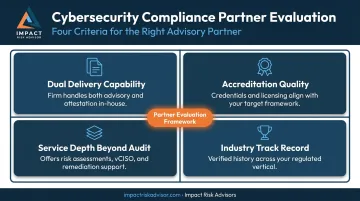
The firms above were assessed against four criteria:
- Dual delivery capability: Can they manage or issue both SOC 2 and ISO 27001 within one engagement?
- Accreditation quality: AICPA licensure for SOC 2; ANAB accreditation for ISO 27001 certification body status
- Service depth beyond the audit: Readiness advisory, vCISO support, and continuous monitoring
- Industry track record: Demonstrated experience in financial services, healthcare, SaaS, or government contracting
The Most Common Selection Mistake
Organizations frequently choose a compliance partner based on price or name recognition alone, without evaluating post-certification support. The audit is only one phase. Ongoing control monitoring, policy maintenance, and annual surveillance audits are where compliance programs succeed or fail.
Two mistakes derail most selection decisions:
- Choosing on price alone: A firm that delivers a clean report and disappears leaves you rebuilding from scratch twelve months later.
- Hiring a pure audit firm when you need strategy: If you lack in-house security leadership, a point-in-time auditor cannot fill that gap.
When an Embedded Advisory Model Makes Sense
Organizations with specific needs, especially those without a dedicated security leader, may benefit from a different kind of partner altogether. Impact Risk Advisors takes a practitioner-led, embedded approach to compliance, supporting clients through SOC 2, ISO 27001, HIPAA, NIST, and GLBA programs while providing vCISO leadership and penetration testing as continuous components of the engagement. With 18+ years of experience and more than 150 compliance audits supported, the firm structures engagements around continuous control monitoring and policy maintenance, so clients aren't scrambling to assemble documentation in the weeks before each audit cycle.
For financial services firms managing GLBA Safeguards Rule alongside SOC 2, or SaaS companies pursuing dual-framework certification for the first time, this kind of embedded model fills the internal resource gap that often derails compliance timelines.
Conclusion
In 2026, SOC 2 and ISO 27001 are no longer differentiators for businesses in high-trust industries; they're the floor. Enterprise procurement teams expect them. Cyber insurers price against them. Regulators use them as reference points for governance maturity.
Choosing the right compliance partner means thinking past the certificate. Before committing, ask:
- Does the firm support post-certification monitoring, or just the initial audit?
- Does their team have hands-on experience in your specific vertical?
- Does the engagement model match your internal capacity?
A pure audit firm works well if you have strong internal security leadership. An integrated advisory partner or embedded vCISO model fits better if you're building the program from scratch or need ongoing strategic support.
If you need a practitioner-led compliance program covering SOC 2, ISO 27001, penetration testing, and vCISO leadership, reach out to Impact Risk Advisors for a free consultation. A short conversation can clarify your roadmap and surface the gaps that matter most before your next audit.
Frequently Asked Questions
What are the new cybersecurity regulations for 2025?
Three developments stand out: the SEC's cybersecurity disclosure rules (material incident reporting within four business days, plus annual risk governance disclosures), CMMC 2.0 Phase 1 enforcement for DoD contractors through November 2026, and privacy laws now active in more than a dozen states. All three push organizations toward documented compliance programs rather than ad hoc security practices.
Which companies need SOC 2 compliance?
SOC 2 applies to SaaS companies, cloud and managed service providers, and any organization that stores or processes customer data on behalf of enterprise clients. It's effectively a requirement when selling into healthcare, financial services, or government markets where vendor security reviews are standard.
Which is better, SOC 2 or ISO 27001?
Neither is universally better; they serve different purposes. SOC 2 is the standard for North American markets and produces an attestation report. ISO 27001 is accepted across EU, APAC, and most regulated markets globally, and results in a formal certification of your ISMS. Organizations with global clients or those seeking the most rigorous framework structure often pursue both.
Can a cybersecurity firm hold both SOC 2 and ISO 27001 certifications?
Yes, and the ability to issue both from a single provider is a meaningful differentiator. Doing so requires both AICPA licensure (for SOC 2 attestation) and ANAB accreditation (for ISO 27001 certification). Firms like A-LIGN, Schellman, and BARR Advisory meet both requirements, which reduces redundant audit work for clients pursuing both frameworks.
How long does it take to achieve SOC 2 and ISO 27001 compliance?
SOC 2 Type I typically takes 3–6 months; Type II requires a minimum six-month observation period, putting the total at 9–15 months. ISO 27001 certification generally takes 6–12 months depending on ISMS maturity. Coordinating both through a single provider reduces redundant fieldwork and can cut the combined timeline by several months.
What should I look for when choosing a cybersecurity compliance partner?
Prioritize dual SOC 2 and ISO 27001 delivery capability, relevant industry experience, and whether the firm offers readiness advisory and ongoing support beyond the audit itself. The most overlooked factor: whether the engagement model is embedded and continuous, or point-in-time only. Embedded programs catch control gaps before auditors do; that's the difference between a clean report and a findings-heavy one.