Introduction
Picture this: a security leader at a government contractor gets asked by their procurement team to demonstrate cybersecurity posture ahead of a contract renewal. They pull out their compliance documentation (policies, control lists, audit checklists) and realize none of it answers the actual question: do your defenses hold up under attack?
That gap is why penetration testing sits at the center of NIST-aligned security programs. The NIST Cybersecurity Framework gives organizations a structured way to manage risk, but documentation alone doesn't validate whether controls actually work.
The NIST ecosystem spans several publications, each with a distinct role in that validation:
- CSF 2.0: the overarching risk management framework, now covering all industries
- SP 800-115: the technical methodology guide for conducting security tests
- SP 800-53: the control catalog, including CA-8, which explicitly addresses penetration testing
- SP 800-171: CUI protection requirements for government contractors
This article covers how CSF 2.0's six functions map to pen testing activities, the SP 800-115 methodology, which organizations face the strongest alignment pressure, and how to set a defensible testing cadence.
Key Takeaways
- CSF 2.0 (released February 2024) added a Govern function, making pen testing a board-level risk management tool
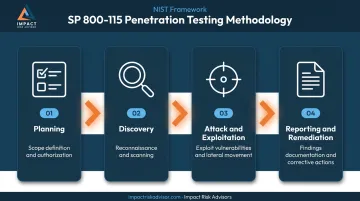
- SP 800-115 defines a four-phase methodology: Planning, Discovery, Attack, Reporting
- SP 800-53 Control CA-8 requires penetration testing at an organization-defined frequency, not a universal annual mandate
- Federal agencies, government contractors, healthcare providers, financial services firms, and SaaS companies all face NIST alignment requirements or contractual obligations
- Point-in-time tests satisfy compliance checkboxes; embedded programs actually fulfill the CSF's intent
What Is the NIST Cybersecurity Framework (and What Changed in CSF 2.0)?
The NIST Cybersecurity Framework is a voluntary, risk-based set of standards developed by the National Institute of Standards and Technology to help organizations manage cybersecurity risk. Originally built for critical infrastructure, CSF 2.0 (released February 26, 2024) broadened its scope to organizations of all sizes and sectors, including industry, government, academia, and nonprofits.
The Addition of Govern
The most consequential change in CSF 2.0 is the introduction of a sixth core function: Govern. This function addresses how cybersecurity risk management strategy, expectations, and policy are established, communicated, and monitored across the organization.
Before CSF 2.0, cybersecurity risk lived primarily in the technical domain. The Govern function elevates it to an enterprise risk management priority, putting it in the same category as financial and operational risk that senior leadership must own, not just IT teams.
The five original functions remain intact:
| Function | Core Purpose |
|---|---|
| Identify | Understand assets, risks, and exposures |
| Protect | Implement safeguards to prevent attacks |
| Detect | Monitor for anomalies and threat activity |
| Respond | Act on detected incidents |
| Recover | Restore capabilities after disruption |
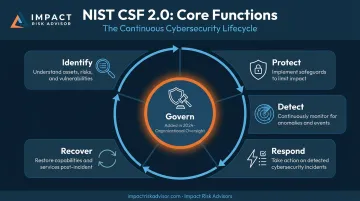
These six functions form a continuous cycle. Penetration testing generates evidence across all of them, from validating asset inventories in Identify to stress-testing incident response in Respond.
The Key NIST Publications That Govern Pen Testing
Three publications define most of the pen testing obligations organizations encounter. Which one applies to your situation determines how you scope, conduct, and report testing, so it's worth knowing the distinctions before you start.
SP 800-115: The Testing Methodology Guide
NIST SP 800-115, Technical Guide to Information Security Testing and Assessment, is the foundational NIST document defining how penetration testing should be planned, executed, and reported. Its four-phase methodology (Planning, Discovery, Attack, Reporting) applies regardless of industry, making it relevant to private-sector and regulated organizations well beyond its federal origins.
One important distinction SP 800-115 draws: penetration testing goes beyond automated vulnerability scanning. Skilled testers validate whether vulnerabilities are actually exploitable in context, not just flagged by a scanner.
SP 800-53 and Control CA-8
SP 800-53 is the control catalog for federal information systems. Control CA-8 states explicitly: "Conduct penetration testing [Assignment: organization-defined frequency] on [Assignment: organization-defined systems or system components]."
Three CA-8 enhancements are worth noting:
- CA-8(1): Requires an independent penetration testing agent or team
- CA-8(2): Authorizes red team exercises to simulate adversary attempts and test detection and response
- CA-8(3): Covers facility (physical access) penetration testing
CA-8 is mandatory for federal agencies and is increasingly referenced by private-sector organizations, particularly those pursuing FedRAMP authorization or needing to demonstrate a high-assurance security posture to enterprise customers.
SP 800-171 and CUI Environments
SP 800-171 Rev. 3 governs protection of Controlled Unclassified Information (CUI) in non-federal systems. Section 3.11 requires:
- 3.11.2: Periodic vulnerability scanning, plus scanning when new vulnerabilities are identified
- 3.11.3: Risk-based remediation aligned with assessment findings
SP 800-171 does not explicitly name penetration testing. Even so, pen testing provides the strongest validation evidence that scanning and remediation requirements are actually being met, not just documented on paper.
How Penetration Testing Fulfills All Six NIST CSF Functions
Pen testing isn't just a "Protect" activity. A well-scoped engagement generates evidence across the entire CSF framework.
Govern
Pen test findings give executives and boards something compliance documentation can't: proof of whether the organization's security strategy is reflected in actual system defenses. Scope decisions, independent testing (CA-8(1)), cadence, and remediation ownership all become governance artifacts, business-contextualized findings designed for board-level risk reporting, not just technical output handed to engineering teams.
Identify
The reconnaissance and discovery phases surface unmanaged assets, forgotten systems, and misconfigurations that passive asset inventories routinely miss. This directly supports the Identify function's goal: developing a comprehensive understanding of what the organization has, what's exposed, and what the risk actually is.
Protect
The exploitation phase is where documentation meets reality. It tests whether access controls, data protection mechanisms, and other safeguards actually resist attack, not whether they're configured on paper. That gap between assumed and tested effectiveness is exactly where compliance paperwork breaks down.
Detect
CA-8(2) red team exercises test whether monitoring, alerting, and detection systems identify simulated attack activity. When a pen test goes undetected by your SIEM or EDR, that isn't a passing result. It's a critical finding, and a direct input for improving detection capabilities.
Respond
The pen test report becomes an input into incident response plan updates. Findings expose gaps in:
- Playbooks that don't account for lateral movement or privilege escalation paths
- Communication protocols that break down under real attack timelines
- Escalation procedures attackers could exploit before a response is mounted
The reporting phase of SP 800-115 is explicitly designed to turn exploit results into corrective actions.
Recover
Retesting after remediation validates that fixes were correctly implemented, not just patched on paper. SP 800-171's risk-based remediation requirement (3.11.3) requires verification that the vulnerability is actually gone, not just that a ticket was closed.
The NIST Pen Testing Methodology: Four Phases from SP 800-115
SP 800-115 defines a four-phase process designed to make penetration testing systematic, repeatable, and auditable. Whether findings are used internally or presented to federal auditors, this structure ensures they're defensible in audits and risk reviews.
Phase 1: Planning
The planning phase establishes scope, objectives, rules of engagement, and legal authorization. Key decisions at this stage:
- Which systems are in scope
- What testing techniques are permitted
- Who holds authorization authority
- How sensitive data encountered during testing will be handled
A poorly scoped test is one of the most common causes of incomplete or misleading results. Organizations that rush scoping often discover the gap during exploitation, when it's too late to course-correct without restarting the engagement.
Phase 2: Discovery
Testers gather information through both passive and active means:
- Passive reconnaissance: OSINT, DNS enumeration, certificate transparency logs
- Active scanning: Port scanning, service identification, vulnerability enumeration
This phase populates the vulnerability list that gets prioritized for exploitation. Manual discovery consistently surfaces forgotten assets and shadow infrastructure that automated scans miss entirely. Those overlooked assets are often the entry points that matter most in Phase 3.
Phase 3: Attack and Exploitation
The attack phase involves actively attempting to exploit identified vulnerabilities to confirm they're exploitable in context, not just present. This may include:
- Privilege escalation
- Lateral movement across network segments
- Data access attempts that mirror real attacker behavior
Scope discipline is non-negotiable. Unconstrained lateral movement can trigger unintended outages or alert production monitoring systems, both of which create problems that outlast the test itself. Teams must establish communications protocols in advance to handle any unintended impacts.
Phase 4: Reporting and Remediation
Effective NIST-aligned reporting follows a dual-track structure:
| Track | Audience | Content |
|---|---|---|
| Executive Summary | Leadership, board, auditors | Business risk, remediation priorities, risk-rated findings |
| Technical Appendix | Engineering and security teams | Exploit reconstructions, step-by-step fix guidance, evidence |
Findings should be mapped to risk level. Scheduling a retest after remediation is essential, not optional. Auditors reviewing NIST compliance will look for retest evidence, as a finding logged as "remediated" without validation carries the same risk exposure as one left unaddressed.
Who Needs NIST-Aligned Pen Testing and When
Organizations That Face Real Alignment Pressure
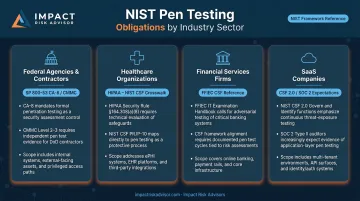
Four categories of organizations encounter the most direct NIST pen testing requirements or expectations:
- Federal agencies and contractors: SP 800-53 CA-8 applies directly; SP 800-171 governs CUI environments under DFARS 252.204-7012 and CMMC
- Healthcare organizations: HHS publishes a HIPAA Security Rule to NIST CSF crosswalk, enabling covered entities and business associates to use NIST mapping to structure risk management
- Financial services firms: The FFIEC's 2022 Cybersecurity Resource Guide references the NIST CSF as a recognized resource for financial institution risk management
- SaaS companies: CSF 2.0 explicitly applies to all sectors; enterprise customers and SOC 2 auditors increasingly expect pen testing as evidence of control validation
Testing Frequency: What NIST Actually Says
CA-8 does not mandate annual testing. Frequency is organization-defined, based on risk assessment. SP 800-115 notes that FISMA requires periodic testing no less than annually for federal systems, and that schedules should reflect system categorization, risk level, and material changes.
Practical triggers that should prompt testing outside a calendar cycle:
- Major infrastructure changes or cloud migrations
- New third-party integrations with privileged access
- Significant application releases
- Acquisition or merger activity
- Post-incident validation
Most risk-mature organizations land at annual full-scope testing with quarterly assessments for critical systems. Their documented risk assessments drive that cadence, not a calendar requirement.
Point-in-Time Tests vs. Embedded Programs
Annual tests satisfy a compliance checkbox, but the NIST framework is built around continuous improvement, not a once-a-year event.
Impact Risk Advisors structures penetration testing as an embedded part of the compliance lifecycle, integrated into ongoing risk assessments rather than treated as a standalone event. That approach directly reflects the CSF's intent: continuous risk visibility and documented improvement that stands up to auditor scrutiny.
Frequently Asked Questions
What is the NIST penetration testing methodology?
The NIST penetration testing methodology is defined in SP 800-115 and consists of four phases: Planning, Discovery, Attack, and Reporting. This structured process ensures tests are systematic, repeatable, and produce findings that are defensible in compliance or audit contexts.
Does NIST SP 800-53 require penetration testing?
SP 800-53 includes Control CA-8, which requires organizations to conduct penetration testing at a frequency determined by their own risk assessment. While 800-53 applies primarily to federal agencies, many private-sector organizations voluntarily align with it to signal a mature security posture to customers and auditors.
Is NIST SP 800-53 mandatory?
SP 800-53 is mandatory for U.S. federal agencies and organizations operating federal information systems. Private-sector organizations are not legally required to comply unless operating under a federal contract or specific regulatory mandate that references it, such as FedRAMP or certain DoD contract requirements.
What is NIST compliance in cybersecurity?
NIST compliance refers to aligning an organization's cybersecurity practices with standards published by the National Institute of Standards and Technology, including CSF 2.0 and the SP 800 series. It functions as both a voluntary best-practice benchmark and a mandatory requirement for federal contractors and agencies.
What are the 6 components of the NIST CSF 2.0?
CSF 2.0 includes six core functions: Identify, Protect, Detect, Respond, Recover, and Govern. The original five remain unchanged in purpose; Govern, added in the 2024 update, focuses on enterprise-level cybersecurity risk strategy and accountability. Govern sits above the other five, ensuring risk decisions flow from leadership rather than being delegated entirely to technical teams.
Is penetration testing required for SOC 2?
SOC 2 does not explicitly mandate penetration testing, but auditors commonly expect it, particularly under the Risk Assessment (CC3) and Logical Access (CC6) criteria. For Type II engagements, pen test evidence helps demonstrate that controls operated effectively throughout the audit period.