Introduction
Picture this: Your SaaS company has spent months negotiating a six-figure enterprise deal. The procurement team loves your product. Legal has blessed the terms. Then, 72 hours before signature, a security questionnaire arrives with one question that stops everything cold: "Please provide your current SOC 2 Type II report."
You scramble to respond. Your "compliance consultant" (hired three months ago) sends over a 47-page gap assessment PDF. No policies. No implemented controls. No audit timeline. Just a spreadsheet highlighting what's broken.
The deal stalls. Your prospect moves to a competitor who already has their report. You've just learned an expensive lesson: not all SOC 2 compliance consultants are created equal.
Some consultants perform point-in-time gap assessments, deliver a document, and step back. Others take embedded ownership of the entire compliance program: control design, policy authoring, evidence management, and audit coordination. The difference between these two approaches can cost you months of runway, tens of thousands of dollars in lost contracts, and customer trust you can't easily rebuild.
This guide walks you through exactly what to look for, so you hire a consultant who owns the outcome, not one who hands you a to-do list.
Key Takeaways
- A SOC 2 consultant prepares your organization for audit; they're distinct from the licensed CPA firm that issues your report
- The right consultant designs controls, writes policies, builds evidence repositories, and manages auditor relationships, not just hands you a checklist
- What to look for: industry experience, an embedded engagement model, full-scope deliverables, transparent pricing, and named auditor partners
- Walk away if you see vague timelines, template-only policies, or open-ended hourly billing with no fixed scope
- SOC 2 is an annual, continuous program; choose a long-term partner, not a one-time vendor
What Is a SOC 2 Compliance Consultant?
A SOC 2 compliance consultant prepares your organization for a SOC 2 examination. They design security controls, write required policies, manage evidence collection, and coordinate readiness activities, so you can undergo an audit by a licensed CPA firm and receive a clean report.
The scope of what a real consultant does versus what a minimal one delivers varies dramatically:
Full-Scope Consultant:
- Owns the entire compliance program from design through report issuance
- Writes client-specific policy documents mapped to your actual tech stack
- Designs controls tailored to your infrastructure (AWS, Azure, GCP, hybrid environments)
- Builds and maintains your evidence repository throughout the observation period
- Coordinates directly with auditors, managing evidence requests and follow-ups
- Provides ongoing support for quarterly testing and annual renewals
Minimal Consultant:
- Delivers a gap assessment PDF identifying what's missing
- Provides monthly check-in calls with generic advice
- Hands you template policies requiring significant internal customization
- Steps back once the assessment is complete
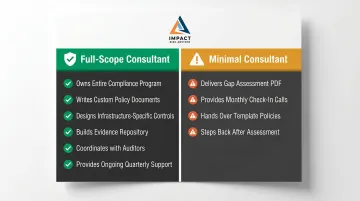
The difference? One treats SOC 2 as a managed program they execute on your behalf. The other treats it as an advisory engagement where you do the heavy lifting.
Consultant vs. Auditor: Understanding the Difference
These are two separate and legally distinct roles. A consultant prepares your organization. An auditor, a licensed CPA firm accredited by the American Institute of Certified Public Accountants (AICPA), independently examines your controls and issues the official SOC 2 report.
According to AICPA independence rules, if a firm participates in preparing or implementing the subject matter of an audit, they cannot serve as the independent auditor. This separation protects report credibility; combining both roles creates an independence conflict that undermines the entire examination.
A qualified consultant will have working relationships with multiple auditor firms and help you select the right one for your organization. This is a feature to look for, not an overlap to accept.
When Does a Business Need a SOC 2 Consultant?
Knowing when to bring in outside expertise is half the decision. Common trigger scenarios include:
Enterprise Deal Blockers Your sales team closes a Fortune 500 prospect, but procurement demands a SOC 2 report before contract execution. Over 70% of enterprise buyers now require SOC 2 reports from technology vendors, making this a revenue-critical requirement.
Customer Security Questionnaires Prospects send detailed security assessments asking for proof of access controls, encryption policies, incident response procedures, and third-party risk management, all areas a SOC 2 program addresses directly.
First-Time Compliance with No Internal Expertise Your team has deep product and engineering talent but no one who has navigated a compliance framework before. Building SOC 2 controls from scratch while running the business creates unsustainable internal burden.
Painful Prior Audit Cycles Your last audit took 14 months, generated dozens of findings, and required your CTO to drop strategic projects for three months to chase evidence requests. You cannot afford to repeat that experience.
The build-versus-buy decision comes down to internal bandwidth, timeline urgency, and prior experience. If your team cannot dedicate 15-20+ hours per week to learning a new framework from scratch, a consultant delivers faster results at lower total cost, without the learning curve tax.
Key Factors to Look for When Choosing a SOC 2 Compliance Consultant
The selection decision should be driven by business outcomes, not credentials or brand recognition alone. The right consultant shortens your path to certification, maps controls to your actual tech stack, and takes ownership of the engagement rather than leaving implementation to your team.
These factors apply regardless of company size or industry, but their relative weight shifts based on urgency (deal timelines), complexity (cloud-native versus legacy infrastructure), and target certification (Type I versus Type II).
Industry Experience and Technical Depth
A consultant familiar with SaaS, fintech, or healthcare environments already knows the common control gaps, customer expectations, and audit evidence patterns for those sectors. That institutional knowledge cuts back-and-forth and accelerates readiness.
Verify that your consultant has handled organizations of similar size, tech stack, and data sensitivity, not just "compliance experience" in the abstract.
Questions to Ask:
- Which industries do you primarily serve?
- How many organizations of our size and complexity have you guided through SOC 2?
- What cloud environments (AWS, Azure, GCP) do your teams have hands-on experience with?
- Can you describe control gaps specific to our sector that you regularly encounter?
Engagement Model: Embedded vs. Point-in-Time
Not all consultants stay involved through the finish line. Here's what separates the two common models:
Point-in-Time Consultant:
- Delivers a gap report identifying missing controls
- Steps back after initial assessment
- Provides advisory support via scheduled calls
- Leaves implementation and evidence collection to your team
Embedded Partner:
- Takes ongoing ownership of control design
- Manages evidence collection throughout the observation period
- Conducts quarterly control testing
- Coordinates directly with auditors through report issuance
- Acts as an extension of your team, not an outside advisor billing for calls
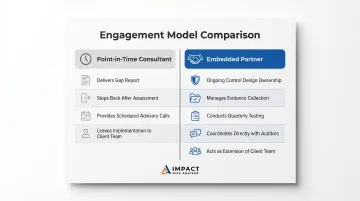
For organizations where compliance is not a full-time internal function, an embedded model directly reduces internal burden during the audit cycle. Impact Risk Advisors operates using this embedded model, integrating into client operations from discovery through continuous post-audit monitoring.
Full-Scope Deliverables: Not Just a Gap Assessment
A readiness assessment is only the starting point. A qualified consultant should deliver everything that follows it:
- Customized policy documents (not templates with placeholder company names)
- A control framework mapped to your infrastructure (your actual AWS services, SaaS tools, and data flows)
- A complete evidence repository (organized, auditor-ready documentation)
- Coordination with the auditor through report issuance (managing evidence requests, responding to findings, facilitating walkthroughs)
Request a sample deliverable list upfront. Any engagement where the primary output is a PDF report with no implementation support is unlikely to get you to a successful audit.
Impact Risk Advisors' full-scope SOC 2 engagements include control design, policy development, evidence repository creation, pre-audit readiness reviews, and end-to-end auditor communication, ensuring clients enter the audit prepared and supported.
Transparent Pricing and a Defined Timeline
SOC 2 engagements should come with fixed pricing and a committed timeline, not open-ended hourly billing. Hourly billing rewards slow progress and makes budgeting unpredictable. Fixed-fee engagements align the consultant's incentives with yours.
Consultants and auditors bill separately; this separation is required to preserve auditor independence.
Typical Market Ranges (2024-2026):
| Product | Price | Notes |
|---|---|---|
| SOC 2 Full Consulting (with pen test & risk assessment) | $25,000 | Billed monthly subscription |
| Gap Assessment | $3,000 | Included free if going for full service |
| Type 1 Security Attestation (Audit) | $5,000 (partner price) | Market range $7k–$15k |
| Type 2 Security Attestation (Audit) | $7,000 (partner price) | Market range $12k–$20k |
| GRC Tool | Extra | Priced separately |
| CPA Audit / Attestation | Extra | Priced separately |
Source: Secureframe, Drata, PUN Group CPA
Small to mid-size cloud-native organizations typically pay $7,000-$15,000 for a Type I audit and $12,000-$20,000 for a Type II audit.
Auditor Relationships and Independence
A consultant who regularly completes SOC 2 programs has established relationships with CPA firms and understands which auditors are efficient, thorough, and reasonably scoped. This matters because auditors familiar with a consultant's evidence packages move faster and raise fewer unnecessary follow-up requests.
While these relationships are valuable, the auditor and consultant must remain independent. Verify this separation explicitly before signing any contract.
Questions to Ask:
- Which CPA firms have you worked with in the past 12 months, and what were the outcomes?
- Can you help us select an auditor that fits our timeline and budget?
- Do you perform audits yourself, or only readiness consulting?
Ongoing Support After the Initial Audit
SOC 2 is an annual, continuous program. The report expires after 12 months. Controls must be maintained year-round. Evidence must be collected continuously. Access reviews and risk assessments must happen on schedule.
A consultant who disappears after the first report forces you to start over each year.
Frame ongoing support capability as a long-term value driver. Organizations that treat SOC 2 as a managed program, with continuous monitoring and quarterly validations, enter each annual audit cycle ready, rather than scrambling.
Impact Risk Advisors provides continuous monitoring as a core service, maintaining controls, updating policies, tracking control effectiveness, and keeping documentation current year-round. When the next audit window opens, clients are already ready.
Red Flags to Watch Out for When Evaluating SOC 2 Consultants
The compliance consulting market is unregulated for readiness consultants (unlike auditors who must be licensed CPAs), which means quality varies enormously. A few warning signs can prevent a costly mistake.
Red Flag 1: Selling a Readiness Assessment as the Primary Deliverable
A gap analysis report is a starting point, not an outcome. If a consultant's main offering is a document identifying what's missing, with no ownership of fixing it, you'll pay twice: once for the assessment and again for someone to do the actual work.
Red Flag 2: No Named Auditor Partners or Relationships
A consultant who cannot name specific CPA firms they've worked with repeatedly either lacks volume experience or is avoiding accountability for audit outcomes.
Ask them directly: which auditors have you worked with in the past 12 months, and what were the outcomes?
Red Flag 3: Template-Only Policy Deliverables
Generic policy templates with placeholder company names, references to technologies you don't use, or on-premise control language for a cloud-native company suggest the consultant is recycling off-the-shelf materials.
Auditors can identify template policies, which erodes confidence in your entire security program.
Red Flag 4: Timelines That Stretch to 12–18 Months for Straightforward Environments
For most cloud-native SaaS or tech companies, a qualified consultant should deliver audit-readiness in weeks to a few months. According to compliance platform benchmarks, preparation typically takes 1-3 months for Type I and 4-12 weeks for Type II (excluding the observation period).
Extended timelines for uncomplicated environments may signal understaffing, inexperience, or incentive to extend the engagement. Complex legacy environments or regulated sectors may legitimately require more time.
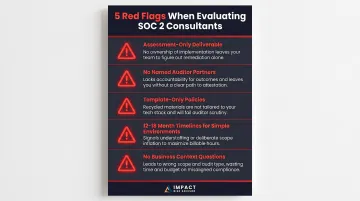
Red Flag 5: No Questions About Your Business Context
Timeline problems are often a symptom of a deeper issue: poor scoping judgment. SOC 2 is a business decision as much as a security one. A consultant who skips questions about your sales pipeline, target customers, urgency drivers, and competitive context before jumping into technical assessment is likely to build the wrong scope. That means selecting irrelevant Trust Service Criteria or pursuing the wrong audit type for your actual needs.
How Impact Risk Advisors Can Help
Impact Risk Advisors is a practitioner-led cybersecurity compliance firm that supports SOC 2 readiness through embedded, continuous engagement. With a track record supporting over 150 compliance audits across SOC 1, SOC 2, HIPAA, ISO 27001, GLBA, and NIST frameworks, the firm brings deep multi-framework expertise and real-world security experience to every engagement.
Key Differentiators
Embedded compliance management: The team integrates from discovery through continuous monitoring, managing control design, evidence collection, quarterly testing, and auditor coordination. This is a managed compliance program, not a one-time engagement.
Practitioner-led control design: Security practitioners with hands-on penetration testing and cloud security experience (AWS, Azure, GCP) design every control. Controls reflect real-world attack patterns, not just checklist requirements.
Full-service scope: Services extend beyond SOC 2 to include virtual CISO leadership, penetration testing, cybersecurity risk assessments, and ongoing compliance monitoring. Clients maintain a strong compliance posture year-round.
Multi-framework efficiency: For organizations pursuing SOC 2 alongside HIPAA, ISO 27001, or other frameworks, Impact Risk Advisors designs controls once and maps them across all applicable standards, reducing redundant work and keeping auditor coordination centralized.
Tangible Business Outcomes
That operational model translates directly to measurable results for SaaS companies, fintech firms, healthcare tech providers, and government contractors:
- Accelerated enterprise sales cycles by having audit-ready documentation that satisfies procurement requirements upfront
- Stronger customer trust through verified, independently audited security controls
- Potential reduction in cyber insurance premiums as a result of a demonstrably managed compliance program with continuous risk monitoring
Conclusion
Choosing a SOC 2 compliance consultant is a business-critical decision with direct consequences for deal velocity, customer trust, and internal team bandwidth. The right choice isn't the most well-known firm; it's the one whose engagement model, experience, and deliverables fit your organization's specific needs, timeline, and growth stage.
When evaluating candidates, keep these priorities in mind:
- Verify hands-on experience with your industry and similar audit scope
- Confirm they provide ongoing support, not just point-in-time readiness work
- Assess whether their deliverables match your audit timeline and internal capacity
- Look for evidence of long-term client relationships, not just completed reports
SOC 2 is a year-round compliance effort. It requires continuous evidence collection, annual audits, and controls that evolve as your environment changes. The consultant you choose today should be capable of scaling that program as your organization grows, and invested enough in your outcomes to still be relevant two audit cycles from now.
Frequently Asked Questions
What is the SOC 2 compliance checklist?
A SOC 2 compliance checklist covers the five Trust Service Criteria (Security, Availability, Processing Integrity, Confidentiality, Privacy), along with required policies, technical controls, evidence collection, and vendor documentation. Security is the only mandatory category; the rest are selected based on customer and contractual requirements.
What are the 4 pillars of ITGC?
IT General Controls (ITGCs) commonly reference four pillars: access controls, change management, computer operations, and IT risk management. These are foundational to SOC 2 security criteria, and a skilled consultant will map ITGC gaps to the relevant Trust Service Criteria during readiness assessment.
What is the difference between a SOC 2 consultant and a SOC 2 auditor?
A SOC 2 consultant helps your organization prepare for the audit, designing controls, writing policies, and managing evidence. A SOC 2 auditor is an independent licensed CPA firm that examines those controls and issues the official report. These must remain separate entities to preserve auditor independence.
How long does the SOC 2 compliance process take with a consultant?
With an experienced consultant, most cloud-native organizations reach audit-readiness in 1-3 months, followed by a 3- to 12-month observation period for Type II. Complex legacy environments or regulated industries typically require longer preparation.
Do I need a SOC 2 Type I or Type II report?
Type I demonstrates controls are designed and in place at a point in time. Type II demonstrates they have been operating effectively over an observation period, typically 3 to 12 months. Most enterprise and Fortune 500 buyers require Type II, but Type I can serve as a credible interim step to unblock near-term deals.
How much does a SOC 2 compliance consultant cost?
Consultant and auditor fees are always billed separately. Full-scope consulting typically runs $25,000 as a monthly subscription, while auditor fees are $5,000 partner price for Type I (market range $7k–$15k) and $7,000 partner price for Type II (market range $12k–$20k), depending on organization size and complexity.