The penetration testing market is crowded, and too many providers deliver automated scan reports dressed up as manual pentests. For a SaaS company, that gap between what you paid for and what you actually received can mean a failed compliance audit, an exploited customer record, or a security questionnaire you can't answer.
This guide breaks down what to look for, what to avoid, and how to find a provider who understands your architecture, not just your budget.
Key Takeaways
- Penetration testing simulates real attacks to find exploitable vulnerabilities in your SaaS stack before attackers do.
- Demand manual, human-led testing. Automated scans alone miss business logic flaws and chained exploits.
- Key selection criteria: tester certifications, full-stack SaaS coverage, report quality, compliance alignment, and remediation support.
- Red flags: suspiciously low pricing, no vendor-side data security credentials, exclusive reliance on crowdsourced testers.
- The right provider is a long-term security partner, not a one-time checkbox.
What Is Penetration Testing?
NIST SP 800-115 defines penetration testing as security testing where evaluators mimic real-world attacks to identify methods for circumventing the security features of an application, system, or network. That definition matters when evaluating vendor proposals; it's not a vulnerability scan.
A vulnerability scan uses automated tools to check systems against a database of known weaknesses. A penetration test involves a human practitioner actively exploiting vulnerabilities to demonstrate real-world impact. The difference shows up in what gets found.
Types of Penetration Testing Relevant to SaaS
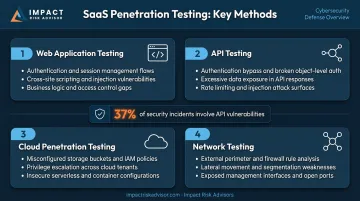
SaaS buyers typically encounter four testing types:
- Web application testing: logic flaws, injection attacks, session management issues
- API testing: broken object-level authorization, authentication gaps, the OWASP API Security Top 10 2023 risks (37% of organizations experienced an API security incident in the past 12 months, per Salt Security's 2024 report)
- Cloud penetration testing: misconfigured IAM policies, storage exposure, privilege escalation paths
- Network testing: internal and external infrastructure, segmentation weaknesses
Most SaaS engagements use a gray box approach: testers have partial knowledge of the environment (architecture diagrams, credentials), which more closely mirrors a realistic attacker who's done reconnaissance. Black box testing (zero knowledge) works well for testing external detection capabilities.
Manual vs. Automated: Why the Distinction Matters
OWASP's Web Security Testing Guide is direct on this point: business logic vulnerabilities cannot be detected by a vulnerability scanner. They require tester skill and creativity. Automated tooling handles broad reconnaissance and known-CVE scanning efficiently. Manual expertise is what turns a list of potential issues into a chain of exploits that demonstrates actual business risk.
Key Factors to Consider When Choosing a Penetration Testing Provider
Most pentest vendors look identical on paper: certified testers, manual methodology, comprehensive reporting. The factors below cut through that noise by connecting provider selection to outcomes you can measure (compliance readiness, reduced breach risk, and customer trust) rather than a PDF that sits in a folder.
Tester Qualifications and Certifications
Certifications signal that a tester can execute real-world exploitation, not just run tools. When evaluating providers, ask specifically which certifications are held by the testers who will conduct your engagement, not the firm's general headcount.
Certifications worth requiring:
| Certification | Issuing Body | What It Demonstrates |
|---|---|---|
| OSCP / OSCP+ | OffSec | Hands-on exploitation, practical attack methodology |
| OSWE | OffSec | White-box web application exploitation |
| GPEN | GIAC | Penetration testing techniques and methodology |
| GWAPT | GIAC | Web application exploits and testing methodology |
| CRT | CREST | Intermediate-level, government-recognized pen testing |
| CCT INF / CCT APP | CREST | Advanced network and application layer assessment |
Require providers to name the specific certifications held by testers assigned to your project. Domain expertise matters just as much; a tester with deep API security experience is more valuable for a SaaS engagement than a generalist who covers everything shallowly.
Manual Testing vs. Automated-Only Approach
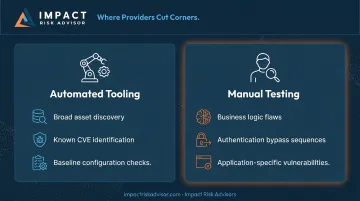
Some vendors disguise automated vulnerability scans as penetration tests, typically at a much lower price. SANS defines penetration testing as using tools combined with manual testing techniques to assess security posture. The "combined with" is where providers cut corners.
Automated tooling is useful for:
- Broad asset discovery and enumeration
- Known CVE identification at scale
- Baseline configuration checks
Manual testing is required for:
- Business logic flaws and multi-step exploit chains
- Authentication bypass sequences
- Application-specific vulnerabilities that scanners don't recognize
Ask any provider directly: what percentage of the engagement is human-driven, and how do testers validate findings before they appear in the report? A provider who can't answer specifically, with a methodology, not a marketing phrase, is likely leaning heavily on automated tooling.
Coverage Scope: Full-Stack vs. Surface-Level
Many providers test internet-facing assets only (the login page, the primary web app) and call it done. For SaaS companies, the real attack surface extends further:
- Internal and external APIs
- Cloud infrastructure (IAM roles, storage permissions, serverless functions)
- CI/CD pipelines and build tooling
- Third-party integrations and OAuth/SSO configurations
- Multi-tenant data isolation
Limited scope produces incomplete findings, which produces false confidence. Push providers to confirm whether their scope explicitly covers APIs, cloud environments, and internal network segments, and get it in writing before signing.
Report Quality and Actionability
The pentest report is the primary deliverable. A quality report includes:
- Executive summary: business risk framing for leadership, not just a vulnerability list
- Technical findings: reproduction steps, screenshots, affected components
- Severity ratings: CVSS scores or equivalent risk ratings
- Prioritized remediation guidance: specific, actionable fixes ordered by impact
Before signing a contract, ask for a sample redacted report. If the provider won't share one, that's a red flag. Also confirm how they handle false positives; credible providers manually validate every finding before it reaches the final report, rather than passing raw scanner output directly to the client.
Compliance Framework Alignment
SaaS companies pursuing SOC 2, PCI DSS, or HIPAA often need penetration testing as part of their compliance program. PCI DSS v4.0 Requirement 11.4 explicitly states that external and internal penetration testing must be regularly performed and exploitable vulnerabilities corrected, with testing required at least once every 12 months and after significant infrastructure changes.
A provider who understands these frameworks scopes the engagement to satisfy auditor requirements, not just generic security goals. The practical benefits:
- Accelerates SOC 2 audit readiness
- Shortens enterprise sales cycles (security questionnaires answered faster)
- Supports cyber insurance applications with documented risk management evidence
Verify that the provider tests regularly against your specific frameworks and that their report format is structured for auditor review, not just internal use.
Remediation Support and Retest Options
The engagement shouldn't end when the report lands in your inbox. After your team remediates findings, a structured retest confirms that fixes actually resolved the vulnerabilities, not just closed the ticket. Without a retest, a "fixed" vulnerability is an assumption, not a verified result.
For SaaS teams operating in rapid release cycles, embedded support during remediation is particularly valuable. Look for providers who offer:
- Developer guidance on ambiguous or complex findings
- Clarification calls during the remediation sprint
- Defined retest turnaround timelines before the engagement starts
Confirm upfront whether retesting is included in the engagement fee or billed separately; the answer affects both your budget and your remediation timeline.
SaaS-Specific Red Flags and Must-Haves
SaaS products have a unique attack surface that generic testers frequently underestimate. A provider unfamiliar with these environments will miss what matters most. Before engaging anyone, confirm they have hands-on experience with:
- Multi-tenant architectures and tenant isolation failures
- Publicly exposed APIs (OWASP API Security Top 10)
- OAuth and SSO integration vulnerabilities
- Serverless functions and cloud-native deployments on AWS, Azure, or GCP
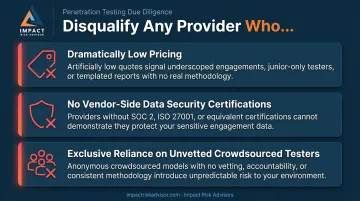
Three Concrete Disqualifiers
1. Dramatically low pricing Research from Cybersecurity Ventures puts the average penetration test cost at $18,300. Engagements priced well below this range almost always indicate automated scanning without manual validation. You're buying a scanner report with a pentest label.
2. No vendor-side data security certifications A provider who isn't SOC 2 or ISO 27001 compliant themselves cannot reliably protect the sensitive findings they generate about your systems. Pentest reports contain detailed exploitation paths, credential information, and architectural weaknesses; the provider holding that data needs their own security controls.
3. Exclusive reliance on crowdsourced or freelance testers without background verification CREST's 2022 guidance on disruptive penetration testing delivery models identifies governance, tester qualification, consistency, confidentiality, and accountability as key assurance factors. Rotating freelancers without vetting introduce insider risk and accountability gaps, a particular concern for regulated SaaS companies, where auditors and enterprise buyers will ask who conducted the test and under what oversight.
What Good Looks Like: In-House vs. Contractor Testers
In-house testers bring qualities that freelancer pools structurally can't replicate:
- Consistency: The same team builds institutional knowledge of your environment over time
- Accountability: Employees of the testing firm are directly liable; freelancers often aren't
- Domain depth: Full-time testers stay current on SaaS-specific attack techniques as their core job
- Audit defensibility: SOC 2 auditors and enterprise security questionnaires increasingly ask whether testing was performed by employees of the provider's firm, not anonymous contractors
How Impact Risk Advisors Can Help
Impact Risk Advisors is a cybersecurity compliance partner with a track record spanning 150+ audits across SOC 2, HIPAA, and ISO 27001. That compliance depth shapes how the team approaches penetration testing, as part of an ongoing security posture, not a standalone annual checkbox.
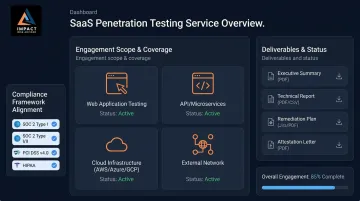
Testing services are built specifically for SaaS and cloud-technology companies. Engagements are scoped to the systems that matter, mapped to compliance frameworks, and delivered with risk-prioritized reporting that development and security teams can act on immediately. Coverage includes:
- Web applications and APIs
- Cloud environments (AWS, Azure, and GCP)
- Network infrastructure
- Social engineering scenarios
What separates the engagement from a typical vendor relationship:
- Guidance before, during, and after testing, not just a report handoff
- Scoping decisions driven by your actual threat landscape and compliance obligations
- Optional vCISO access for organizations that need strategic security direction alongside testing
- Findings mapped to SOC 2 Trust Services Criteria, PCI DSS requirements, and HIPAA risk analysis obligations, formatted for auditor review
- Practical outcomes: stronger audit readiness, increased customer trust, and faster enterprise sales cycles
Conclusion
Choosing a pen testing provider isn't a procurement decision made on price alone. It's a choice about who you trust to understand your architecture, your compliance obligations, and your customers' data. The best provider for a SaaS company speaks the language of cloud-native risk and frames findings in the context of your specific business, not a generic attack surface.
That fit doesn't stay fixed, either. As your product evolves (new features, new integrations, new cloud services) your exposure changes with it. Build a testing cadence into your security program, reassess scope after significant releases, and expect your provider to grow alongside your risk profile. The right partner isn't a vendor you call once a year. They're part of how you stay ahead.
Frequently Asked Questions
How do you choose the best penetration testing service?
Prioritize manual testing capability, relevant certifications (OSCP, CREST CRT, GPEN), and full-stack coverage for your SaaS environment. Compliance alignment and report quality matter too; the right provider matches their expertise to your specific tech stack and regulatory requirements, not just your industry category.
What are the top penetration testing techniques?
The most commonly used include network scanning and enumeration, manual vulnerability exploitation and chaining, social engineering simulations, web application attacks (SQL injection, XSS, IDOR), and privilege escalation. Skilled providers combine these techniques to simulate realistic, multi-step attack paths rather than testing each vector in isolation.
What are the standard phases of a penetration test?
Most frameworks follow four to seven stages; NIST SP 800-115 defines Planning, Discovery, Attack, and Reporting, while PTES adds threat modeling and post-exploitation. Reputable providers also include a retest phase to confirm identified vulnerabilities have been remediated.
How often should a SaaS company conduct penetration testing?
PCI DSS v4.0 Requirement 11.4 requires testing at least every 12 months and after any significant infrastructure or application change. SaaS companies handling sensitive data or running frequent release cycles may benefit from more continuous or quarterly testing to keep pace with their evolving attack surface.
What's the difference between a vulnerability scan and a penetration test?
A vulnerability scan uses automated tools to identify known weaknesses based on known signatures. A penetration test involves human-led exploitation to demonstrate real-world impact; it uncovers chained exploits, business logic flaws, and context-specific vulnerabilities that scanners miss, and eliminates false positives through manual validation.
What certifications should I look for in a penetration tester?
Focus on certifications with practical, hands-on assessments: OSCP, OSWE, GPEN, GWAPT, and CREST CRT or CCT. Ask providers to name the specific certifications held by the testers assigned to your engagement, not just what the firm holds across its team in aggregate.