Many SaaS companies understand that SOC 2 exists. Fewer understand why Type II specifically matters, and what it actually delivers beyond a compliance checkbox. This article breaks down the business case: what Type II is, how it creates measurable advantages, and what companies lose by deferring it.
Key Takeaways
- SOC 2 Type II is an independent CPA audit confirming your security controls operated effectively over 6–12 months, not just that they were designed correctly
- Enterprise buyers in finance, healthcare, and government commonly require it before approving SaaS vendors
- Core advantages: faster deal cycles, stronger customer trust, and reduced risk exposure
- Without it, expect manual security questionnaires, stalled deals, and a reactive security posture
- Maximum value comes from treating it as a continuous program, not a one-time audit sprint
What Is SOC 2 Type II?
SOC 2 is an examination framework developed by the AICPA for service organizations (SaaS providers, cloud platforms, and data processors) that store or handle customer data. A SOC 2 report assesses controls against up to five Trust Services Criteria: Security, Availability, Processing Integrity, Confidentiality, and Privacy.
The distinction between Type I and Type II is where the real difference lies.
- Type I evaluates whether controls were designed correctly as of a specific date, as a snapshot
- Type II evaluates whether those controls operated effectively over a defined review period, typically 6 to 12 months
According to the AICPA's Trust Services Criteria, SOC reports give users the information they need to assess risks from outsourced services. Buyers aren't asking whether you documented a policy; they're asking whether your controls held up under real operating conditions.
Type II answers that question directly. For SaaS companies, it's how you translate internal security work into a credible signal that enterprise procurement teams and security-conscious buyers can act on.
Key Advantages of SOC 2 Type II for SaaS Companies
The advantages below are operational and measurable. They affect revenue, risk exposure, and customer relationships, not vague security posture scores.
Accelerated Enterprise Sales and Shorter Deal Cycles
Enterprise buyers routinely require a current SOC 2 Type II report before completing vendor onboarding. When a SaaS company has one ready, procurement teams can accept it in place of conducting their own security review. Without one, the process defaults to custom vendor questionnaires and extended back-and-forth.
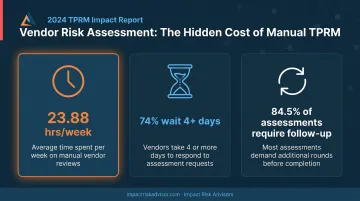
The friction cost is real. The 2024 Third-Party Risk Management Impact Report found that assessment teams spend 23.88 hours per week on vendor reviews, 74% wait more than four days for vendor responses, and 84.5% of assessments require follow-up clarification. A SOC 2 Type II report short-circuits much of that cycle.
A reusable, third-party assurance artifact eliminates repetitive evidence gathering. Instead of answering the same security questions for each new enterprise prospect, your team shares the report and moves on.
KPIs this affects:
- Sales cycle length
- Vendor approval rate
- Enterprise win rate
- Time-to-revenue for new accounts
When it matters most: Selling into finance, healthcare, or government, and any mid-market or enterprise deal where procurement and legal run formal vendor risk reviews.
Impact Risk Advisors works with SaaS companies in exactly this position: a deal is active, the enterprise prospect has asked for a SOC 2 report, and the absence of one is putting the opportunity at risk. Getting ahead of that request, before it surfaces in a sales call, is where Type II creates its clearest commercial value.
Verified Customer Trust Through Sustained, Operational Controls
A Type II report shows buyers something a Type I cannot: consistent evidence that access management, monitoring, incident response, and data handling worked correctly over months of actual operations, not just at a point in time.
That sustained verification matters because the risk buyers are managing is concrete. Verizon's 2025 Data Breach Investigations Report found third parties were involved in 30% of breaches. SecurityScorecard's research found 35.5% of 2024 breaches were linked to third-party access. Enterprise customers know their SaaS vendors sit directly in their risk path.
When a customer signs with a SaaS provider, they inherit that provider's security posture. A breach at the vendor level can expose the customer to legal liability, regulatory penalties, and operational disruption.
Type II doesn't eliminate that risk. It provides documented evidence that the provider has been managing it, consistently, over time.
KPIs this affects:
- Customer retention and renewal rates
- Net revenue retention
- Volume of manual security questionnaire responses required
When it matters most: Any SaaS company handling PII, financial data, or health records, and especially when customers are themselves subject to HIPAA, PCI DSS, or GDPR requirements.
SaaS companies that pursue multi-framework alignment, combining SOC 2 with HIPAA or ISO 27001, amplify this trust signal. Impact Risk Advisors structures these programs using unified control design, mapping evidence once across applicable frameworks rather than running separate compliance tracks. Customers see a coherent, mature security program rather than disconnected audits.
Reduced Risk Exposure and Stronger Insurance Positioning
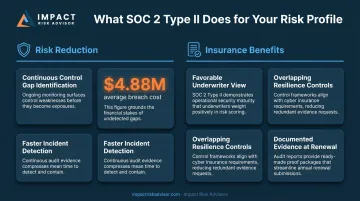
SOC 2 Type II does two things for an organization's risk profile. First, maintaining it forces continuous identification and closure of control gaps: issues surface during review cycles, not after incidents. Second, the resulting report documents control effectiveness in a format underwriters and enterprise risk managers recognize.
The financial case for getting this right is grounded in breach economics. IBM's 2024 Cost of a Data Breach report put the global average breach cost at $4.88M, up 10% year over year. That figure represents the upper-end exposure for organizations without mature controls. Type II compliance works to reduce it.
On the insurance side, Marsh's Q4 2024 cyber insurance market update noted that underwriters view cybersecurity control investments favorably, and their framework of key resilience controls overlaps substantially with what a SOC 2 Type II program requires: identity and access management, incident response, data classification, and continuous monitoring. A Type II report gives a SaaS company documented evidence for underwriters at policy renewal.
KPIs this affects:
- Cyber insurance premium costs
- Mean time to detect and respond to incidents
- Control gaps identified in annual audits
- Breach-related cost exposure
When it matters most: As cyber insurance scrutiny tightens, and during M&A due diligence, fundraising, or expansion into regulated verticals where financial and operational resilience are directly evaluated.
What Happens When SOC 2 Type II Is Missing or Ignored
Deferring Type II doesn't keep things neutral. The costs accumulate across sales, operations, security posture, and long-term finances, and they compound the longer the gap stays open.
- Deals stall or close quietly to a competitor: enterprise procurement teams reject vendors without a current Type II report, and sales teams often never learn the specific reason.
- Every new enterprise prospect sends its own vendor risk questionnaire, forcing engineering and security teams to answer the same questions from scratch, repeatedly, for each new deal.
- Without audit-driven review cycles, control gaps build up undetected. Issues surface through incidents rather than through controlled assessments where they could have been caught first.
- Starting compliance later costs more: breach remediation, customer churn from eroded trust, and higher insurance premiums all add up, alongside greater exposure during the delay.
How to Get the Most Value from SOC 2 Type II
Earning the report is step one. Sustaining the security posture behind it, consistently, year-round, is what separates companies that benefit from SOC 2 Type II and those that just hold the certificate.
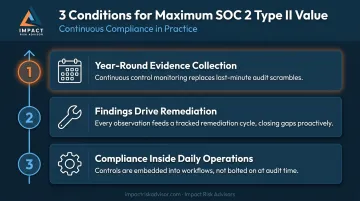
Conditions that determine whether Type II delivers its full value:
Evidence is collected year-round, not in the weeks before the audit. Controls monitored throughout the year produce cleaner audits and fewer surprises. Scrambling to assemble evidence right before the audit window is the most common way companies undermine their own compliance investment.
Audit findings drive remediation, not just paperwork. Gaps identified during the audit cycle should reset priorities, not get filed away until the next review. Each cycle should leave the program measurably stronger.
Compliance lives inside daily operations, not beside them. Access reviews, change management, incident response drills: these happen routinely, not as pre-audit exercises. When controls are woven into how the team operates, the audit becomes a confirmation rather than a last-minute scramble.
For SaaS teams without dedicated security leadership, this continuity is difficult to sustain. Impact Risk Advisors' embedded compliance model is built for exactly this problem, with a vCISO who owns the compliance calendar, manages auditor communications, maintains the policy library, and tracks control effectiveness throughout the year.
The model runs continuously: readiness, the audit window, remediation, and renewal. Not just the months before the report date.
When an enterprise buyer asks for your current SOC 2 report, it's already ready: no scramble, no coverage gap, no deal hanging in the balance.
Conclusion
SOC 2 Type II matters because it converts your internal security work into a verifiable signal that enterprise buyers, procurement teams, and insurers can act on. Done right, it removes friction in deals, builds lasting customer confidence, and strengthens your position when cyber insurers or enterprise procurement teams start asking hard questions.
The second and third annual reports carry more weight than the first. They demonstrate a sustained security culture, and enterprise buyers can tell the difference between a company that audited once and one that has been running controls consistently for two or three years.
Key signals that accumulate with each renewal cycle:
- Fewer exceptions and control failures year-over-year
- Evidence of proactive risk remediation, not reactive patching
- Updated scope that reflects how your product and infrastructure have grown
- A security narrative that matches what's in the report
Treat SOC 2 Type II as an ongoing practice that evolves alongside your company. The compliance program that looks most credible to a $500K enterprise prospect in year three is the one you started building seriously in year one.
Frequently Asked Questions
What is SOC 2 Type 2 compliance?
SOC 2 Type 2 is an independent CPA attestation report confirming that a service organization's security controls were properly designed and consistently operating over a defined review period, typically 6 to 12 months, against the AICPA's Trust Services Criteria. Enterprise buyers require it because it demonstrates real-world control effectiveness, not just documented intent.
Who needs SOC 2 Type 2 compliance?
Any SaaS company, cloud service provider, or data processing organization that stores or handles customer data should pursue SOC 2 Type 2. It's especially critical for vendors selling into enterprise accounts or regulated industries (finance, healthcare, and government contracting) where formal vendor risk assessments are standard.
Is SOC 2 compliance required?
SOC 2 is not legally mandated in the US, but enterprise vendor contracts and procurement processes frequently require it. In practice, most SaaS companies selling to mid-market or enterprise customers treat it as a business requirement, one that shows up as a deal condition rather than a regulatory penalty.
How often is a SOC 2 audit required?
SOC 2 Type 2 reports cover a 12-month period and need to be renewed annually. Most enterprise buyers only accept a report dated within the past year, so letting a report lapse can disqualify a vendor during procurement.
Which is better, SOC 2 or ISO 27001?
Neither is universally superior. SOC 2 is the dominant standard for SaaS companies selling to US-based enterprise customers; ISO 27001 is more common in international markets and non-SaaS industries. Companies expanding globally often pursue both, and the control overlap between frameworks makes dual certification more efficient than it appears.
What are the 5 pillars of SOC 2?
The five Trust Services Criteria are: Security (mandatory for all audits), Availability, Processing Integrity, Confidentiality, and Privacy. Most SaaS audits cover Security at minimum; organizations add additional criteria based on the data types they handle and what enterprise customers require.