
HHS OCR received 30,968 new HIPAA complaints in 2023, and large breaches affecting 113 million individuals were reported that same year. Meanwhile, enterprise healthcare buyers increasingly use SOC 2 reports as a vendor qualification filter, treating a missing attestation as a disqualifying condition, not a minor gap.
This article identifies which company types face dual obligations, which gain meaningful competitive advantage from pursuing both, and how a unified compliance program makes the effort manageable.
Key Takeaways
- Healthcare SaaS, EHR vendors, and telehealth platforms face HIPAA as a legal mandate and SOC 2 as an enterprise sales requirement
- RCM firms, healthcare BPOs, and managed IT providers serving hospitals are HIPAA business associates now required to hold SOC 2 attestations
- Health analytics platforms, wellness tech vendors, and fintech companies entering health data markets gain measurable deal velocity from dual compliance
- HIPAA and SOC 2 share controls across access management, encryption, audit logging, and incident response, making a unified compliance program far more efficient than two parallel tracks
When One Framework Isn't Enough
HIPAA and SOC 2 serve different masters. Understanding that distinction is the starting point for any combined program.
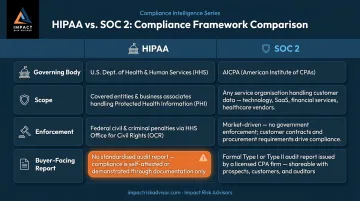
The two frameworks differ in both origin and output:
| HIPAA | SOC 2 | |
|---|---|---|
| Governing Body | HHS OCR (federal regulation) | AICPA (voluntary attestation) |
| Scope | PHI safeguards: administrative, physical, technical | Five Trust Services Criteria: Security, Availability, Processing Integrity, Confidentiality, Privacy |
| Enforcement | Civil and criminal penalties for covered entities and BAs | Market-driven; required by many enterprise buyers |
| Buyer-Facing Report | None; no formal third-party audit report | Yes; SOC 2 Type II report reviewable by customers |
The HIPAA Security Rule is prescriptive on what must be protected, but it produces no deliverable a procurement team can review. SOC 2 fills that gap, as it's technically voluntary, but HIMSS guidance on third-party risk management notes that healthcare organizations managing hundreds of third-party suppliers increasingly require SOC 2 audits as a procurement condition.
That gap matters. A healthcare vendor that is HIPAA-compliant but lacks a SOC 2 report can still fail a hospital's vendor security review.
The SOC 2 + HIPAA Combined Engagement
AICPA guidance allows SOC 2 engagements to include additional subject matter and suitable criteria beyond the standard Trust Services Criteria. This means a licensed CPA auditor can evaluate both SOC 2 controls and HIPAA safeguards within a single audit engagement, producing one combined attestation report. Not every audit firm offers this structure; confirming combined-engagement scope with your audit partner before fieldwork begins prevents costly gaps in coverage.
Companies Effectively Required to Have Both
Any organization that qualifies as a HIPAA covered entity or business associate and sells technology or services to enterprise healthcare clients faces both obligations simultaneously. The HIPAA obligation is legal. The SOC 2 obligation is contractual and market-driven.
Healthcare SaaS Platforms and EHR/EMR Vendors
EHR, EMR, and clinical workflow platforms store and transmit electronic PHI (ePHI) by definition, and HIPAA compliance is non-negotiable from day one. But that's only half the equation.
Hospital systems and large health networks use vendor onboarding processes that function as security filters. HIMSS notes that procurement teams require third-party security assessments before contracts are signed, and some specifically require SOC 2 audits from new suppliers. Failing a vendor security review costs a contract, not just a score on a compliance checklist.
Healthcare SaaS companies that only maintain HIPAA documentation still face disqualification from enterprise deals where buyers want an independent, auditor-issued attestation, which only SOC 2 provides.
Telehealth and Remote Patient Monitoring Companies
Telehealth occupies a uniquely high-risk compliance position. These platforms transmit PHI across third-party networks, integrate with wearables and patient-reported data, and serve both individual consumers and enterprise health systems, often through the same infrastructure.
The scale of adoption makes compliance positioning urgent:
- AMA data shows 71.4% of physicians used telehealth weekly in 2024, up from 25.1% in 2018
- The American Hospital Association reports 12.6% of Medicare beneficiaries received a telehealth service in Q4 2023 alone
For telehealth and remote patient monitoring vendors, HIPAA governs the data; SOC 2 covers the cloud infrastructure in a way that satisfies enterprise security reviews from health system partners. At this market scale, dual compliance functions as access infrastructure, not a competitive extra.
Revenue Cycle Management and Healthcare BPOs
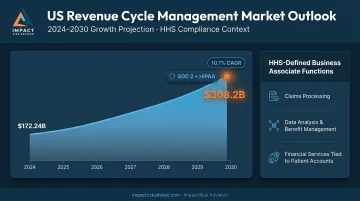
RCM firms, medical billing companies, and healthcare business process outsourcers are classified as HIPAA business associates under HHS definitions. HHS explicitly lists the following as business associate functions when PHI is involved:
- Claims processing and medical billing
- Data analysis and benefit management
- Financial services tied to patient accounts
Grand View Research estimated the US RCM market at $172.24B in 2024, projected to reach $308.2B by 2030 at a 10.1% CAGR. These organizations process enormous volumes of sensitive financial and health data for hospital networks and insurers, clients who routinely require SOC 2 attestation as part of their vendor qualification process. Without both certifications, RCM vendors are frequently disqualified before a sales conversation can begin.
Medical Transcription, Coding, and Clinical Documentation Services
Clinical documentation and medical coding vendors handle verbatim PHI, making them HIPAA business associates by function. Their enterprise clients, increasingly large hospital systems, include SOC 2 report requirements in vendor due diligence cycles. A missing SOC 2 attestation doesn't just weaken a proposal; it removes the vendor from consideration entirely.
Companies That Gain a Competitive Edge from Both
This group differs from the previous one: the dual obligation may not be absolute, but market dynamics make combined compliance a clear differentiator. It accelerates deal cycles, builds customer trust, and opens upmarket opportunities that single-framework companies can't access.
Cloud and Managed IT Providers Serving Healthcare
MSPs, cloud hosting companies, and IT infrastructure vendors that serve hospitals or clinics are typically classified as HIPAA business associates. Many also serve non-healthcare clients and already hold SOC 2 attestations.
For these providers, adding HIPAA compliance to an existing SOC 2 program is highly efficient, as overlapping control areas include access management, encryption, audit logging, incident response, and risk assessments.
That overlap means less duplicated work. The combined posture qualifies them for regulated healthcare clients who would otherwise require a separate, HIPAA-specific vendor, directly expanding addressable market without building a new compliance program from scratch.
Healthcare Analytics, AI, and Population Health Companies
Health data analytics platforms, AI-powered clinical decision support tools, and population health management companies frequently access de-identified or aggregated PHI. Even when data has been de-identified under HIPAA's Safe Harbor or Expert Determination standards, enterprise healthcare clients often require HIPAA business associate agreements and SOC 2 reports as standard procurement conditions.
The market scale makes early compliance positioning a real business decision:
- US healthcare analytics market: $21.21B in 2024, projected to reach $67.48B by 2033
- US AI in healthcare: $8.65B in 2025, projected at $43.30B by 2030 at 38.0% CAGR
Vendors in this space who establish dual compliance early avoid playing catch-up when enterprise clients start asking for documentation at scale.
Employer Benefits and Wellness Technology Vendors
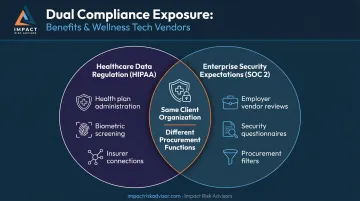
HR tech and employee wellness platforms that administer health benefits, collect biometric screening data, or connect to health insurance providers often sit unnoticed in compliance discussions.
These platforms can handle PHI under HIPAA as business associates to employer health plans, while simultaneously serving large enterprise employers who require SOC 2 as part of their vendor security review.
The dual exposure (healthcare data regulation plus enterprise security expectations) makes combined compliance directly valuable for deal velocity. Employers asking for SOC 2 and insurers asking for HIPAA documentation are frequently the same client organization, viewed from different procurement functions.
Fintech and Insurance Tech Companies Handling Health Data
Financial services companies entering the health insurance, supplemental benefits, or healthcare payments space face both frameworks simultaneously: HIPAA for health data and SOC 2 for the broader security expectations of enterprise financial and healthcare partners.
Establishing dual compliance early avoids costly retrofitting later. As health-data-adjacent fintech products scale, the cost of retrofitting a compliance program grows significantly, both in internal effort and in the compliance infrastructure needed to satisfy enterprise security reviews that weren't anticipated at product launch.
What Dual Compliance Unlocks
Enterprise Sales Access
Enterprise healthcare clients and large hospital networks maintain approved vendor lists that require current SOC 2 Type II reports. Organizations with both HIPAA compliance documentation and an active SOC 2 report can provide independent evidence of controls directly to buyer security teams, reducing reliance on lengthy questionnaire cycles and moving faster through procurement.
HIMSS notes that third-party security questionnaires are a necessary part of healthcare procurement. A SOC 2 report doesn't eliminate that review, but it gives security teams reusable, auditor-verified evidence rather than self-reported answers, which meaningfully cuts friction for vendors who've already done the work.
Cyber Insurance Positioning
Faster enterprise access isn't the only commercial benefit. Dual compliance also affects what you pay for cyber insurance.
Marsh reported that US cyber insurance rates declined 5% on average in Q4 2024, while carriers identified 12 cyber hygiene controls as essential to underwriting. The 2024 Health-ISAC/KLAS/AHA Healthcare Cybersecurity Benchmarking Study found that organizations using a documented primary cybersecurity framework averaged 6% premium increases, compared to 18% for those without one.
Holding both HIPAA compliance documentation and a SOC 2 report signals a layered security posture. Underwriters reviewing healthcare-adjacent organizations want auditor-verified evidence of mature controls, not just self-reported claims. That distinction shows up in your renewal conversations.
Shared Controls Efficiency
Beyond the external benefits, there's a strong internal case for unifying the two programs. Running HIPAA and SOC 2 separately means duplicating effort across controls that substantially overlap:
- Access management: HIPAA requires workforce access controls; SOC 2 Security criteria require the same
- Encryption: HIPAA's technical safeguards and SOC 2's confidentiality criteria both address data in transit and at rest
- Audit logging: Required under HIPAA's audit controls and SOC 2's monitoring requirements
- Incident response: HIPAA Breach Notification Rule and SOC 2 availability criteria both require documented response procedures
- Risk assessments: Foundational to both frameworks
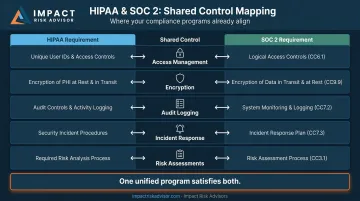
A unified program produces a single policy set, a shared evidence library, and one control framework that satisfies both. For teams already stretched thin, that consolidation typically cuts compliance overhead by 30–40% compared to running two separate tracks.
How to Build a Combined HIPAA and SOC 2 Compliance Program
Start with a Crosswalk
Map existing HIPAA safeguards (administrative, physical, and technical) against SOC 2 Trust Services Criteria. Organizations already achieving HIPAA compliance have a head start. Existing controls like risk assessments, workforce training, and access controls directly satisfy SOC 2 requirements in many cases.
The gap analysis identifies what SOC 2 adds on top: formal change management procedures, system availability monitoring, service level documentation, and evidence-collection infrastructure for an external auditor. These gaps are manageable, but identifying them early prevents surprises during audit preparation.
Consider an Advisor-Led Program
Self-managed dual compliance programs typically require significant internal hours and a 9–12 month timeline. Organizations working with an embedded compliance advisor familiar with both frameworks can compress that timeline and avoid the common mistake of building controls for one framework that don't satisfy the other.
One approach is embedding a security leader directly into the organization through a vCISO engagement. Impact Risk Advisors structures this to own the compliance roadmap across both frameworks: designing controls once and mapping them across HIPAA and SOC 2 requirements instead of running parallel programs. For healthcare SaaS, telehealth, and RCM clients with ongoing compliance maintenance needs, that continuous embedded model delivers more lasting value than point-in-time consulting.
Explore the Combined Audit Engagement
Organizations that need formal third-party attestation of both frameworks should ask their audit partner whether they offer a combined SOC 2 + HIPAA engagement. AICPA guidance allows additional criteria to be included in a SOC 2 engagement, and a single audit covering both sets of requirements produces one report.
Key advantages of a combined engagement include:
- Eliminates duplicate evidence collection across two separate assessments
- Cuts the total hours spent responding to separate auditor requests
- Produces a single report covering both frameworks for customer and partner review
- Shortens the overall audit timeline by coordinating fieldwork into one engagement
Frequently Asked Questions
Which companies need SOC 2 compliance?
SOC 2 applies to service organizations that store or process customer data in the cloud, such as SaaS companies, cloud providers, and data processors. Enterprise clients in healthcare, financial services, and technology routinely require SOC 2 attestation as a vendor qualification standard, making it effectively mandatory in practice.
What companies must comply with HIPAA?
HIPAA applies to covered entities (healthcare providers, health plans, and clearinghouses) and their business associates, any third party that creates, receives, maintains, or transmits PHI on their behalf. This extends to technology vendors, billing companies, and other service providers that may not consider themselves traditional healthcare organizations.
Does HIPAA require SOC 2 compliance?
HIPAA does not require SOC 2; the two frameworks are independent. However, many enterprise healthcare clients contractually require SOC 2 attestation from HIPAA-covered business associates as part of vendor due diligence, making it a practical requirement even without a legal one.
Does SOC 2 cover privacy?
SOC 2 includes a Privacy Trust Services Criterion, but it is optional and applies to general personal data rather than PHI under HIPAA. Organizations handling PHI should not assume the Privacy criterion satisfies their HIPAA Privacy Rule obligations; SOC 2 Privacy and HIPAA Privacy Rule cover different data types and impose distinct requirements.
Can a company get a combined SOC 2 and HIPAA audit report?
Yes. AICPA guidance allows a licensed CPA auditor to evaluate SOC 2 Trust Services Criteria and HIPAA safeguards within a single engagement. This reduces total audit effort and is increasingly standard for healthcare technology vendors.