The real story isn't about passing an audit. It's about what happens to your sales pipeline, your insurance costs, and your customer relationships once you have (or don't have) a current SOC 2 Type 2 report in hand.
This article breaks down what SOC 2 certification actually delivers for cloud-native businesses: the outcomes that show up in your pipeline, on your balance sheet, and in how you operate day to day.
Key Takeaways
- SOC 2 has five Trust Service Criteria; Security is mandatory, but enterprise buyers routinely expect coverage beyond that baseline
- A current SOC 2 Type 2 report removes procurement blockers and shortens enterprise sales cycles. 64% of organizations cite winning new business as a primary audit driver
- SOC 2 signals a documented, audited security program to cyber insurance underwriters, improving coverage terms and reducing friction at renewal
- Continuous compliance, not a one-time audit sprint, is where the compounding business value actually comes from
What Is SOC 2 Certification?
SOC 2 (System and Organization Controls 2) is a voluntary auditing standard developed by the AICPA. It evaluates how service organizations protect customer data across five Trust Service Criteria:
| Criterion | Required? |
|---|---|
| Security | ✅ Yes, mandatory in every SOC 2 |
| Availability | Optional |
| Processing Integrity | Optional |
| Confidentiality | Optional |
| Privacy | Optional |
SOC 2 is specifically designed for technology and cloud service providers that store, process, or transmit customer data. It applies directly to SaaS platforms, cloud infrastructure providers, and any cloud-native company in a B2B relationship where customers need evidence that their data is handled responsibly.
When enterprise buyers evaluate vendors, one distinction shapes their decision: Type 1 vs. Type 2. A Type 1 report confirms controls were designed correctly at a single point in time. A Type 2 report confirms those controls operated effectively over a sustained period, typically six to twelve months. Security teams and procurement officers know the difference, and they ask for Type 2.
Key Benefits of SOC 2 Certification for Cloud-Native Companies
Cloud-native companies feel these benefits more acutely than traditional on-premise businesses. Shared-responsibility architecture, dynamic workloads, and multi-tenant customer environments amplify both the security risk and the trust signal that SOC 2 directly addresses.
Benefit 1: Accelerated Enterprise Sales and Removal of Procurement Blockers
Enterprise procurement, especially in financial services, healthcare, and government contracting, routinely requires a SOC 2 report before any contract is signed. Without one, deals don't just slow down. They disappear into security review queues.
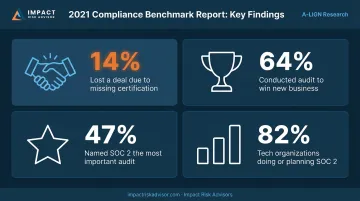
According to A-LIGN's 2021 Compliance Benchmark Report:
- 14% of respondents lost a business deal because they lacked a compliance certification or report
- 64% conducted an audit specifically to win new business
- 47% called SOC 2 the most important audit
- 82% of technology organizations were doing or planning a SOC 2 audit
A current SOC 2 Type 2 report answers the majority of vendor security questionnaires upfront. Without that reusable evidence, your team handles each questionnaire manually, an average of 12 to 18 hours per review, according to HyperComply. Multiply that across a growing pipeline of enterprise prospects, and the time cost compounds fast.
The GSA's Low Impact SaaS authorization process explicitly lists a SOC 2/SSAE audit report as a baseline requirement for government vendors. FFIEC guidance for financial services firms directs management to leverage SOC reports when overseeing cloud service providers. These are procurement gates, not soft preferences.
KPIs most affected:
- Average sales cycle length
- Win rate on enterprise deals
- Number of security questionnaires requiring manual responses
- Time-to-close for regulated-industry accounts
Benefit 2: Reduced Cyber Insurance Premiums and Improved Risk Economics
Cyber insurance underwriters assess your security controls and compliance posture when setting premiums and coverage terms. SOC 2 certification is one of the strongest available signals that your security program is documented, tested, and operational, not theoretical.
The audit process forces you to implement and maintain controls around:
- Access management and least-privilege enforcement
- Incident response planning and testing
- Change management documentation
- Continuous monitoring and alerting
These are exactly the controls insurers evaluate. A certified company presents as a measurably lower-risk applicant than one relying on self-attestation.
IBM's 2024 Cost of a Data Breach Report puts the global average breach cost at $4.88 million, up 10% from 2023. For healthcare, that average reaches $9.77 million. Against those exposure figures, the investment in SOC 2 certification (which vendor estimates generally place between $12,000 and $100,000 depending on scope and complexity) represents clear risk economics.
Beyond premiums, certified companies may also qualify for broader coverage, higher limits, and faster claims processing because documented controls demonstrate due diligence before an incident occurs.
KPIs most affected:
- Cyber insurance premium as a percentage of IT security spend
- Coverage limit achieved per dollar of premium
- Claim approval rate and friction at renewal
For fintech and health tech companies especially, where underwriters apply the highest scrutiny, this is often the benefit with the fastest measurable ROI.
Benefit 3: Verifiable Customer Trust and Competitive Differentiation
Every vendor claims to take security seriously. SOC 2 converts that claim into a third-party verified statement, backed by an independent auditor's assessment of how your controls actually performed over time, not just how they were designed.
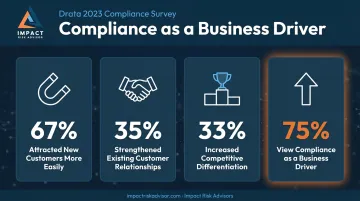
The business impact is well-documented. In Drata's 2023 compliance survey of 300 organizations:
- 67% of continuously compliant organizations said compliance helped them attract new customers more easily
- 35% reported strengthened relationships with existing customers
- 33% reported increased ability to differentiate from key competitors
- 75% of organizations with continuous compliance programs view compliance as a business driver
For cloud-native B2B companies, the Type 2 report serves a dual function: it removes a sales blocker for new prospects, and it provides ongoing assurance to existing clients, reducing churn risk in regulated industries where your customers have their own compliance obligations to satisfy.
Displaying SOC 2 compliance in sales materials and on your website also signals technical maturity and corporate governance. In competitive RFP processes, that signal matters, particularly when you're going up against larger, better-resourced incumbents.
KPIs most affected:
- Customer retention and renewal rates in regulated industries
- RFP win rate
- Time spent responding to vendor security questionnaires
- Net Promoter Score among security-conscious buyers
What Happens When Cloud-Native Companies Skip SOC 2
The pattern is predictable:
- Deals stall in procurement review
- Enterprise prospects send individual security questionnaires that pull engineering and security teams into manual, time-consuming responses
- Certified competitors close the accounts you were working on
The Drata data puts numbers behind this: 41% of organizations using reactive or point-in-time compliance reported slowed new-customer acquisition. Low compliance maturity produced negative outcomes for 87% of organizations surveyed, with 33% reporting loss of a business relationship as a direct result.
Lost deals are only part of the exposure. Without the controls discipline that SOC 2 enforces, cloud-native environments accumulate configuration drift, access management gaps, and undocumented processes.
Unit 42 research consistently flags IAM misconfigurations as one of the primary vectors making cloud environments susceptible to attack. Scaling while onboarding more sensitive customer data, without a structured controls program, increases breach exposure at exactly the wrong time.
In sectors like fintech and health tech, client contracts may eventually require SOC 2 as a condition of renewal. Companies that haven't built the compliance infrastructure face a reactive, high-cost scramble, one that typically takes 12–18 months to resolve under audit pressure, rather than a structured program built on their own timeline.
How to Get the Most Value from SOC 2 Certification
SOC 2 yields the highest return when treated as a continuous security program, not a periodic audit event. Controls monitored year-round produce better audit outcomes and stronger actual security posture than controls assembled in the weeks before a scheduled review.
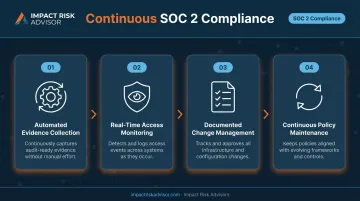
For cloud-native companies specifically, that means:
- Automated evidence collection aligned to your deployment velocity, not manual snapshots taken every six months
- Real-time access monitoring that keeps pace with dynamic infrastructure changes
- Documented change management processes that auditors can follow and verify
- Continuous policy maintenance so documentation reflects your actual environment, not a point-in-time picture
The difference between a compliance program that compounds in value and one that degrades between audits is whether controls are maintained as an operational function or patched together before each audit window.
That operational continuity is what separates a practitioner-led engagement from a one-time audit prep project. Impact Risk Advisors structures SOC 2 work as a six-phase program, spanning scoping, gap assessment, program design, testing, audit support, and continuous monitoring, so each annual review builds on the last rather than starting from scratch. The embedded vCISO model keeps controls active between audits, not just during them.
Conclusion
For cloud-native companies, SOC 2 certification is one of the few investments that simultaneously strengthens security posture, unlocks enterprise revenue, and reduces operating costs. The benefits aren't theoretical; they show up in closed deals, renewal rates, insurance terms, and the operational capacity your team doesn't spend on manual questionnaire responses.
Those benefits build year over year. Each annual Type 2 report deepens the evidence trail of operational control effectiveness, strengthening enterprise client trust, improving insurance economics, and positioning the business to expand into more regulated markets.
The companies that extract the full value of SOC 2 treat it as an ongoing operational discipline. When compliance is embedded into security operations year-round, rather than assembled in the weeks before each audit, the controls become stronger, the audits become faster, and the business case becomes self-sustaining.
Frequently Asked Questions
What are the benefits of SOC 2 certification for cloud-native companies?
SOC 2 certification drives faster enterprise sales cycles, lower cyber insurance premiums, and stronger customer trust. These outcomes compound over time, as each year of Type 2 evidence adds credibility with enterprise buyers and insurers that a one-time audit simply can't match.
What is SOC 2 in cloud computing?
SOC 2 is a voluntary AICPA auditing standard for service organizations that handle customer data in cloud environments. It covers five Trust Service Criteria (Security, Availability, Processing Integrity, Confidentiality, and Privacy), making it a natural fit for SaaS and cloud-native businesses.
What are the 4 C's of cloud-native security?
The 4 C's (Code, Container, Cluster, and Cloud) represent the layered security model for cloud-native environments. SOC 2 controls around access management, system monitoring, and change management map directly to securing each of these layers, making SOC 2 a natural fit for cloud-native security programs.
How long does SOC 2 certification take for a SaaS company?
SOC 2 Type 1 typically takes 3–6 months from engagement to report issuance. Type 2 requires a minimum 6-month observation window, putting total timelines at 9–15 months, though companies with an existing compliance program or advisory support often move through readiness faster.
Does SOC 2 certification help reduce cyber insurance premiums?
SOC 2 signals a documented, audited security program to underwriters, which can lower premiums, improve coverage terms, and reduce friction at renewal. This is most impactful for cloud-native companies in high-risk sectors like fintech and health tech, where insurers apply more scrutiny to security controls and compliance posture.