Choose the wrong approach and you risk one of two outcomes: broad security coverage with no documented evidence trail for auditors, or a tightly scoped test that misses systemic threats hiding outside its boundaries. Verizon's 2024 Payment Security Report found PCI DSS Requirement 11, which governs security testing, had only 47.6% full compliance in 2023, representing the largest control gap across the entire standard.
This guide explains what each method actually is, where they diverge, and which one your organization needs based on your compliance obligations and security program maturity.
Key Takeaways
- Ethical hacking is broad and ongoing with no fixed scope, timeline, or guaranteed documentation
- Penetration testing is scoped, time-bound, and produces a formal report for compliance evidence
- Both find vulnerabilities; the difference is scope, duration, and deliverables, not intent
- PCI DSS, FedRAMP, and CMMC Level 3 require penetration testing; HIPAA and SOC 2 treat it as supporting evidence
- For most regulated businesses: start with penetration testing for compliance, then layer in ethical hacking as your program matures
Ethical Hacking vs. Penetration Testing: At a Glance
| Dimension | Ethical Hacking | Penetration Testing |
|---|---|---|
| Scope | Entire environment, no fixed limits | Defined targets only |
| Duration | Ongoing, continuous | Time-bound (days to weeks) |
| Deliverables | Informal findings | Formal report with risk ratings |
| Compliance use | General security improvement | Audit evidence |
| Who performs it | In-house staff or vCISO programs | Contracted team with rules of engagement |
| Cost structure | Continuous investment | Per-engagement fee |
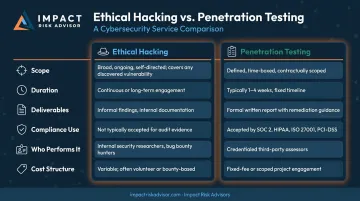
The right choice depends on your situation:
- Audit deadline approaching? A penetration test provides the formal documentation trail compliance requires.
- Building long-term security resilience? Organizations in regulated industries often combine both approaches.
What Is Ethical Hacking?
EC-Council defines ethical hacking as an authorized attempt to gain unauthorized access to a computer system, application, or data, using the same tools and mindset as a malicious attacker, but with explicit permission. The practitioners, commonly called "white hat hackers," operate without a fixed scope document.
Unlike a narrowly scoped test, an ethical hacker can follow a vulnerability wherever it leads, across systems, networks, applications, and even people through social engineering. There are no artificial boundaries.
Key benefits:
- Broader threat visibility across the full environment
- Ability to uncover vulnerabilities a narrowly scoped test would never reach
- Capacity to build and validate baseline security controls, not just identify gaps
- Supports continuous security improvement between formal compliance assessments
Use Cases for Ethical Hacking
Ethical hacking fits best in specific scenarios:
- Organizations building a security program from scratch that need holistic visibility before formalizing controls
- Internal security teams running continuous red team exercises
- Companies with vCISO-led programs where ongoing threat awareness is embedded into security operations
One caveat: ethical hacking is rarely the right standalone choice for compliance purposes. It doesn't guarantee a formal report, and without structured documentation, it can't satisfy auditors.
Impact Risk Advisors embeds ethical hacking capabilities within penetration testing engagements and broader vCISO programs, rather than offering it as a standalone compliance solution.
What Is Penetration Testing?
NIST SP 800-115 defines penetration testing as "security testing in which assessors mimic real-world attacks to identify methods for circumventing the security features of an application, system, or network." The key structural difference from ethical hacking: everything is defined upfront, including scope, methodology, timeline, and rules of engagement.
The Five Common Test Types
| Test Type | What It Assesses |
|---|---|
| External Infrastructure | Perimeter-facing assets and internet-exposed systems |
| Internal Infrastructure | Insider threat simulation, lateral movement paths |
| Web Application | OWASP-aligned application vulnerabilities |
| Cloud Security | Misconfiguration and access control in AWS/Azure/GCP |
| Social Engineering | Human layer vulnerabilities, phishing susceptibility |
Each test type maps to a different threat model. How the test is configured, the knowledge level given to the tester, determines how realistic the simulation will be.
Testing Perspectives: Black, Gray, and White Box
OWASP distinguishes three testing perspectives, each suited to different compliance and threat modeling needs:
- Black Box: No prior system knowledge; simulates an external attacker with no inside access. Best for realistic perimeter testing.
- Gray Box: Partial knowledge; simulates a privileged insider or third-party partner. Balances realism with efficiency.
- White Box: Full system knowledge, including code and architecture. Deepest coverage for validating internal controls.
Why the Formal Report Matters
Penetration testing concludes with a structured deliverable: executive summary, classified vulnerability findings, CVSS scores (0.0–10.0 scale per FIRST CVSS v4.0), evidence of exploitation, and remediation guidance. This documentation is what auditors actually need.
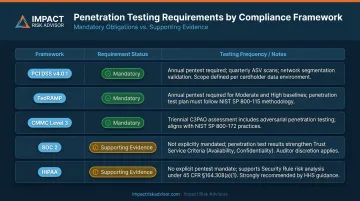
Framework-specific requirements:
- PCI DSS v4.0.1 (Requirement 11.4): Internal and external penetration testing required at least every 12 months and after significant changes
- FedRAMP: Requires an announced penetration test by a recognized 3PAO for Moderate and High systems, plus annual continuous-monitoring testing
- CMMC Level 3: Annual penetration testing or testing after significant security changes, explicitly mandated
- SOC 2: Penetration tests appear as a point of focus under CC7.1; not a standalone mandate but routinely expected
- HIPAA: Not named explicitly in regulation text; supports the risk analysis requirement under 45 CFR 164.308
Use Cases for Penetration Testing
Penetration testing is non-negotiable when:
- A compliance audit deadline is approaching (SOC 2, PCI DSS, FedRAMP, CMMC)
- The organization handles regulated data (PHI, PII, or cardholder data)
- Enterprise customers are demanding proof of security posture before signing contracts
- A security investment needs formal validation
For SaaS companies, this last point matters more than most buyers expect. Impact Risk Advisors structures penetration testing engagements around the specific questionnaires enterprise procurement teams send, so findings translate directly into signed contracts, not just a report that sits in a folder.
Key Differences: Ethical Hacking vs. Penetration Testing
Scope and Boundaries
This is the most fundamental distinction. Penetration testers operate within a defined rules-of-engagement document; they test only what the client explicitly authorizes. Ethical hackers pursue vulnerabilities wherever they lead, without predefined limits.
For businesses, the practical implication is clear: pen tests produce predictable, auditable coverage; ethical hacking produces comprehensive but less standardized findings. When an auditor asks "what was tested and what was found," only a penetration test gives you a defensible answer.
Duration and Engagement Model
- Penetration testing: Time-bound, typically days to a few weeks per engagement
- Ethical hacking: Ongoing and continuous, embedded in security operations
Most organizations commission penetration tests annually or before specific compliance milestones. Ethical hacking principles operate in the background continuously, which is why they're most naturally housed within a vCISO-led security program rather than a one-time vendor engagement.
Reporting and Documentation
This distinction is the one that determines compliance outcomes.
Penetration tests always produce a formal report. Ethical hacking does not. If your auditor, assessor, or enterprise customer asks for documentation, the informal findings from an ethical hacking exercise won't satisfy the requirement.
What a formal pen test report contains:
- Executive summary (business-readable risk overview)
- Vulnerability classifications with CVSS scores
- Evidence of exploitation (screenshots, proof-of-concept)
- Risk ratings by severity
- Remediation guidance mapped to applicable frameworks
Methodology and Techniques
Ethical hackers apply a wider toolkit: system hacking, wireless attacks, social engineering, red/blue team exercises, and policy review. The approach is often improvised based on what they discover mid-engagement.
Penetration testers follow structured, named methodologies within the agreed scope:
- PTES (Penetration Testing Execution Standard): 7 defined phases from pre-engagement through reporting
- OWASP Testing Guide: current stable version v4.2 for web application assessments
- NIST SP 800-115: technical guide to information security testing and assessment
That structure is a feature, not a limitation. It makes pen test results reproducible, comparable across engagements, and acceptable as compliance evidence.
Responsibility and Remediation
Penetration testers identify, document, and hand off. Remediation is the client's responsibility, though firms like Impact Risk Advisors provide prioritized, actionable remediation guidance as part of the deliverable.
Ethical hackers embedded as in-house staff or within a vCISO engagement often play a more active role: remediation, policy development, and security control design. That ongoing involvement means security posture improves continuously, not just at the close of an engagement.
Which Does Your Business Need?
The decision comes down to four variables:
- Compliance obligations: Do you have a framework mandate or audit deadline?
- Security program maturity: Do you have defined controls to validate, or are you still building them?
- Budget and timeline: One-time engagement or ongoing investment?
- Threat surface: What specific systems carry the most risk?
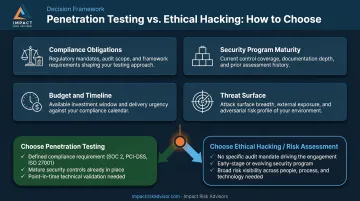
Choose Penetration Testing If You:
- Have a compliance audit approaching (SOC 2, PCI DSS, HIPAA assessment, FedRAMP, CMMC)
- Handle cardholder data, PHI, or controlled unclassified information
- Need documented evidence for enterprise customers or procurement questionnaires
- Want to validate specific controls after a security investment
Choose a Broader Risk Assessment or Ethical Hacking Approach If You:
- Are building your security program from scratch and lack visibility into your full attack surface
- Don't yet have defined controls to scope a formal penetration test against
- Need to prioritize where to invest before committing to point-in-time testing
For most regulated businesses, these two approaches work in sequence rather than in isolation. Penetration testing addresses point-in-time compliance needs, while ethical hacking principles, embedded through ongoing vCISO support or red team exercises, build resilience between formal tests.
Impact Risk Advisors supports both sides of this equation: standalone penetration testing engagements for compliance validation, and vCISO leadership for the continuous compliance strategy that surrounds them.
If you're unsure which engagement fits your obligations or security maturity, connect with Impact Risk Advisors for a risk-based assessment that maps your framework requirements to the right testing approach.
Conclusion
Ethical hacking and penetration testing serve different functions at different stages of a security program. The right choice depends on whether you need structured audit evidence, holistic threat visibility, or both.
For Impact Risk Advisors' clients (SaaS companies closing enterprise deals, healthcare organizations managing PHI, fintechs under PCI DSS obligations, and government contractors navigating FedRAMP), penetration testing typically comes first. It reduces audit friction, generates the documentation that enterprise procurement demands, and validates that security investments are actually working.
From there, the continuous principles of ethical hacking, embedded through vCISO oversight, close the gaps that annual assessments miss. That combination of structured compliance evidence and ongoing security intelligence is what makes a security posture genuinely defensible, not just audit-ready on paper.
Frequently Asked Questions
What is the difference between pen testing and ethical hacking?
Penetration testing is a scoped, time-bound engagement that concludes with a formal report, making it the standard for compliance evidence. Ethical hacking is a broader, ongoing practice covering the full environment without fixed scope or guaranteed documentation. The intent is identical; the structure and outputs are not.
What are the five types of hackers?
EC-Council identifies five categories: white hat (ethical hackers), black hat (malicious), gray hat (unauthorized but not malicious), script kiddies (low-skill attackers using existing tools), and hacktivists (ideology-driven). Legitimate security engagements involve only white hat practitioners.
Is penetration testing required for compliance?
It depends on the framework. PCI DSS v4.0.1 (Requirement 11.4), FedRAMP (for Moderate and High systems), and CMMC Level 3 explicitly require it. HIPAA and SOC 2 don't name it as a standalone mandate, but penetration testing commonly supports the risk analysis and monitoring criteria both frameworks require.
How often should a business conduct penetration testing?
PCI DSS, FedRAMP, and CMMC Level 3 all require annual testing, with PCI DSS and CMMC also mandating tests after significant infrastructure or security changes. High-risk industries like fintech and healthcare often run engagements more frequently than these minimums.
Can ethical hacking and penetration testing be used together?
They work well together. Penetration testing handles structured compliance validation at defined intervals, while ethical hacking principles, embedded through red team programs or vCISO oversight, maintain continuous threat awareness between those formal tests.
How do I know if my business needs a penetration test or a broader assessment?
If you have a compliance deadline, audit requirement, or specific system to validate, start with a penetration test. If you're building your security program from scratch or lack visibility into your full attack surface, start with a risk assessment or vCISO engagement.