Introduction
If you're budgeting for a HIPAA risk assessment, the price range alone can be disorienting. The Security Rule at 45 CFR §164.308(a)(1) requires every covered entity and business associate to conduct an accurate and thorough Security Risk Analysis, and OCR is actively enforcing it. Its ongoing Risk Analysis Initiative has produced multiple settlements in 2025 alone, with fines ranging from $103,000 to $227,816 for organizations that simply skipped the process.
The cost of getting this right varies dramatically; a small practice using a guided tool might spend $2,000–$5,000, while a large health system or SaaS platform with broad PHI exposure can face $75,000–$100,000+. This guide breaks down what drives that gap, what each approach actually delivers, and how to match your spend to your risk profile.
Key Takeaways
- HIPAA SRA costs range from $2,000–$5,000 for small organizations to $30,000–$100,000+ for enterprise environments
- The biggest cost drivers: organization size, PHI volume and sensitivity, security maturity, and delivery model
- Solo practices and early-stage health tech companies pay less; multi-location groups, hospitals, and SaaS vendors pay significantly more
- Skipping the SRA to save money routinely backfires: a single OCR fine can exceed the cost of a thorough assessment many times over
How Much Does a HIPAA Risk Assessment Cost?
Before looking at numbers, one clarification matters. A HIPAA "risk assessment" refers specifically to the Security Risk Analysis (SRA) required under 45 CFR §164.308(a)(1), not a full compliance audit, not a risk management plan, and not a policy gap analysis. These are related but distinct.
Conflating them is one of the most common budgeting mistakes organizations make. Some underbudget and receive a shallow, checkbox-style SRA that won't hold up under OCR scrutiny. Others pay for full-program consulting when only the SRA is what's actually required.
Typical Cost Ranges by Organization Size
| Tier | Organization Type | Typical SRA Cost |
|---|---|---|
| Small | Solo practices, startups under 25 employees, limited PHI systems | $2,000–$12,000 |
| Mid-size | 25–200 employees, multiple PHI systems, moderate complexity | $12,000–$30,000 |
| Enterprise | Large health systems, multi-location practices, SaaS platforms with broad PHI exposure | $30,000–$100,000+ |
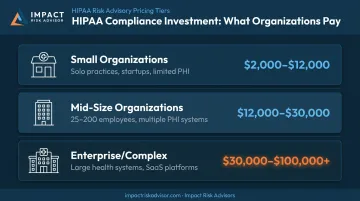
These ranges reflect current market data from sources including Accountable HQ and Compliancy Group, and align with community health center benchmarks of approximately $7,000 per site for structured SRA programs.
Small Organization Tier ($2,000–$12,000)
What's typically included:
- Document review and basic asset identification
- Threat and vulnerability identification across administrative, physical, and technical categories
- Risk rating matrix with likelihood and impact scores
- Written SRA report meeting OCR documentation requirements
- Usually conducted remotely with minimal on-site time
Best for: Solo or small practices, early-stage health tech companies, business associates with limited PHI touchpoints.
The limitation at this tier is scope depth. Assessors may not have time to identify every system or workflow touching ePHI, which can leave gaps if OCR investigates.
Mid-Size Organization Tier ($12,000–$30,000)
What's typically included:
- Scoping interviews across departments and system owners
- Technical control review and policy gap analysis
- Prioritized risk register with remediation roadmap
- One round of follow-up or clarification after report delivery
Best for: Growing medical groups, behavioral health networks, digital health SaaS vendors, and healthcare staffing firms with moderate PHI exposure. At this tier, you're paying for thoroughness; the assessor has enough time to map data flows accurately and produce findings that hold up under OCR review.
Enterprise/Complex Tier ($30,000–$100,000+)
What's typically included:
- Multi-site scoping and infrastructure/system inventory
- Integration with penetration testing findings
- HIPAA Security Rule control mapping
- Executive-level risk report and board-ready findings summary
- Ongoing advisory support and annual update structure
Best for: Hospital systems, large health plans, SaaS platforms processing PHI for multiple clients, and organizations pursuing HITRUST certification.
Key Factors That Affect the Cost of a HIPAA Risk Assessment
The spread between a $2,000 assessment and a $75,000+ engagement comes down to four core variables.
Organization Size and Scope
Headcount, number of locations, and the number of systems that create, receive, maintain, or transmit ePHI all expand assessment scope. Each touchpoint requires documentation, analysis, and a risk rating.
The difference is significant: a three-person practice with one EHR and a secure messaging app has far less scope than a 200-person behavioral health network running across five sites with multiple vendor integrations. Every additional system, site, and integration adds to the assessment workload.
Volume and Sensitivity of PHI Handled
Organizations handling sensitive PHI categories face more complex control requirements and deeper assessor scrutiny. This includes:
- Substance use disorder records (subject to additional protections under 42 CFR Part 2)
- Mental health data
- Reproductive health information
SaaS platforms or clearinghouses processing PHI on behalf of multiple clients multiply this effect, since every downstream data flow needs to be mapped and assessed.
Current Security Maturity and Documentation State
Starting from a low baseline (no prior SRA, undocumented systems, limited policies) requires the assessor to build the entire evidence base from scratch. That takes time, and time costs money.
Organizations that already have:
- A prior SRA with documented findings
- An up-to-date asset inventory
- Existing security policies and procedures
- Documented remediation history
...can complete reassessments faster and at lower cost. Strong documentation isn't just a compliance obligation; it's a direct cost lever.
Delivery Model: DIY Tool vs. Consultant vs. Managed Assessment
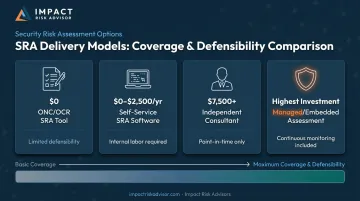
The delivery model is often the single largest cost variable:
- ONC/OCR SRA Tool: A no-cost, software-guided tool intended for small and medium providers. Useful for structuring the process, but ONC explicitly notes that use of the tool neither guarantees compliance nor replaces expert judgment for a defensible assessment.
- Self-service SRA software: Typically $0–$2,500 annually, plus significant internal labor. Accelerates documentation but produces findings that may not withstand OCR review without independent review.
- Independent consultant: Project fees starting around $7,500, scaling with complexity. Provides external expertise and more defensible documentation, but delivers a point-in-time report with no ongoing support.
- Managed/embedded assessment: Annual program fees that bundle the SRA with continuous monitoring, policy management, and expert support. Higher direct cost in some cases, but reduces internal burden and keeps documentation current between cycles, closing the gap where most point-in-time assessments fall short.
What's Included in a HIPAA Risk Assessment Engagement
A legitimate, OCR-defensible SRA has nine distinct activities per HHS guidance. Here's what each phase delivers, and where cheaper options tend to cut corners.
A thorough engagement covers four core activities:
- Scoping and asset inventory: Every system, application, device, and workflow that touches ePHI must be identified and documented. Omitting systems from scope is a common failure point; if OCR investigates a breach involving an unscoped system, the entire assessment may be considered inadequate.
- Threat and vulnerability identification: The assessor documents reasonably anticipated threats (technical, including malware, ransomware, and unauthorized access, and non-technical, including insider risk, physical theft, and vendor failure) then maps vulnerabilities across administrative, physical, and technical safeguard categories. This is the analytical core of the SRA and the component most frequently shortchanged at the low-cost tier.
- Risk rating and prioritization: Each identified risk gets a likelihood score and an impact score, producing a risk register. This is what OCR reviews when a breach or complaint triggers an investigation. Generic, templated ratings that don't reflect your actual environment won't hold up to that scrutiny.
- Written SRA report and remediation roadmap: The final deliverable must be documented, retained for a minimum of six years per 45 CFR §164.316, and detailed enough to demonstrate good-faith analysis. The remediation roadmap prioritizes findings by risk level so your team knows where to act first.
Impact Risk Advisors structures each engagement to produce a risk register and remediation roadmap your team can act on, not a compliance checkbox that collects dust. Every deliverable is built to hold up under OCR review.
How to Budget for a HIPAA Risk Assessment
Choose for Fit, Not Price
Organizations that select a vendor solely on lowest quote frequently end up with incomplete scoping, generic risk ratings, or reports that won't meet OCR documentation standards. Before committing, ask prospective vendors:
- How do you scope which systems are included in the SRA?
- How do you handle systems we haven't fully documented?
- What does the final report look like, and will it satisfy OCR documentation requirements?
- Do you update the SRA when we make significant operational changes?
Common Budgeting Mistakes to Avoid
- Pricing only the assessment fee: ignoring remediation costs that will follow from findings. Most SRAs surface gaps that require investment to close.
- Assuming last year's assessment is sufficient: HIPAA requires updates whenever significant operational or environmental changes occur. Annual reassessment is what OCR expects.
- Treating the SRA as a one-time project: it's a recurring compliance obligation, not a deliverable you complete once.
- Underestimating internal staff time: even with a consultant, your team will need to support interviews, evidence gathering, and system documentation. That time has a cost.
Estimating Total Annual HIPAA Compliance Cost
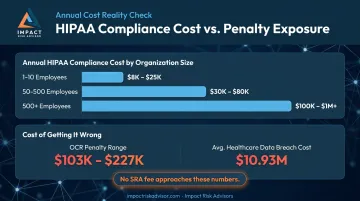
The SRA fee is just the starting point. According to ComplyAssistant, total annual HIPAA compliance costs by organization size look like this:
| Organization Size | Total Annual HIPAA Compliance Cost |
|---|---|
| 1–10 employees | $8,000–$25,000+ |
| 50–500 employees | $30,000–$80,000+ |
| 500+ employees | $100,000–$1,000,000+ |
These figures include the SRA plus remediation, policy development, training, security software, and ongoing monitoring. These numbers also put the cost of skipping or cutting corners in perspective: the average healthcare data breach cost $10.93 million in 2023, per IBM research. OCR's Risk Analysis Initiative has already produced 10+ enforcement actions, with penalties ranging from $103,000 to $227,816 per violation. No SRA fee approaches those numbers.
Conclusion
HIPAA risk assessment costs vary based on organization size, PHI complexity, security maturity, and the delivery model you choose. What matters most is that the assessment is thorough enough to identify real risks, satisfy OCR documentation requirements, and produce a remediation roadmap your team can act on.
A weak or missing SRA costs far more than a thorough one, in OCR penalties, breach exposure, and remediation work that could have been caught earlier. Impact Risk Advisors works with healthcare and health tech organizations to conduct practitioner-led, risk-based HIPAA risk assessments that hold up under audit and give your team a clear path forward. If you're scoping an assessment or evaluating options, reach out for a scoping conversation.
Frequently Asked Questions
Does HIPAA require a security risk assessment?
Yes. The HIPAA Security Rule at 45 CFR §164.308(a)(1)(ii)(A) explicitly requires covered entities and business associates to conduct an accurate and thorough assessment of potential risks and vulnerabilities to ePHI. It is not optional, and OCR's ongoing Risk Analysis Initiative demonstrates active enforcement against organizations that skip it.
How often is a HIPAA risk assessment required?
HIPAA doesn't mandate a fixed schedule, but the SRA must be reviewed whenever significant operational, system, or environmental changes affect ePHI security. Annual reassessment is the accepted standard, explicitly required in both the Health Fitness and Deer Oaks OCR corrective action plans.
What is a HIPAA security assessment?
A HIPAA Security Risk Analysis is a structured evaluation of every system and control involved in handling ePHI. It identifies threats, vulnerabilities, and gaps across administrative, physical, and technical safeguards, producing a documented risk register and remediation roadmap.
How much does a HIPAA risk assessment cost?
Costs generally range from $2,000–$12,000 for small organizations to $30,000–$100,000+ for large health systems or complex SaaS platforms. The final cost depends on organization size, PHI complexity, current security maturity, and the delivery model selected.
How much does a HIPAA audit cost?
A risk assessment (the required SRA) and a formal third-party HIPAA compliance audit are distinct engagements. Risk assessments typically run $2,000–$100,000+ depending on size. Third-party HIPAA compliance audits typically start at $15,000 for small organizations and can reach $200,000+ for larger enterprises, per Thoropass.
How much does HIPAA compliance cost overall?
Total HIPAA compliance costs go well beyond the SRA fee: small organizations typically spend $8,000–$25,000 annually, mid-size organizations $30,000–$80,000+, and large enterprises $100,000–$1,000,000+. These figures cover remediation, policy development, training, penetration testing, and ongoing monitoring, with the SRA as the required foundation.