OCR enforcement activity reinforces this. In 2023, the agency received nearly 31,000 new HIPAA complaints, completed 1,388 complaint investigations, and closed 14 resolution agreements totaling $7.7 million in penalties. One February 2024 settlement reached $4.75 million for a single cybersecurity investigation.
So what does it actually cost to make a healthcare app HIPAA compliant? There's no flat answer. Costs vary by app complexity, PHI sensitivity, integration depth, and whether compliance is built in from day one or added later. This article breaks down realistic cost ranges by tier, maps the key drivers, and separates one-time from recurring spend, so app teams can budget with accuracy instead of guesswork.
Key Takeaways
- HIPAA compliance adds roughly $40,000–$200,000+ to healthcare app costs, depending on app complexity and scope (market estimate, not a regulatory benchmark)
- The biggest cost drivers: PHI sensitivity, number of integrations, user role complexity, and build approach
- Ongoing annual costs for monitoring, pen testing, training, and audits often rival or exceed initial setup costs over 3–5 years
- Retrofitting compliance onto an existing app is materially more expensive than building security in from the start
- Current OCR penalty caps reach $2,190,294 per violation category, making deferred compliance a high-stakes gamble
How Much Does HIPAA Compliance Cost for a Healthcare App?
There is no universal HIPAA compliance fee. The cost depends on what your app does, where PHI flows, how many vendors touch that data, and whether you're starting fresh or reworking an existing product.
A few common mistakes inflate costs unnecessarily or leave teams exposed:
- Underbudgeting security infrastructure by treating compliance as a documentation exercise
- Treating compliance as a one-time project rather than an ongoing program with annual obligations
- Ignoring vendor BAA management: every cloud provider, messaging API, analytics tool, and support platform that touches PHI needs a signed Business Associate Agreement
These gaps don't just create budget surprises; they're the same factors that determine which cost tier your app actually lands in.
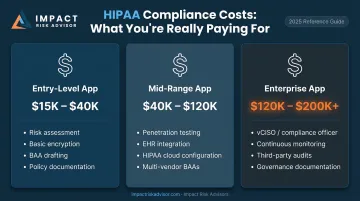
Typical Cost Ranges by Tier
Entry-Level / Basic App (single platform, limited PHI handling, minimal third-party integrations)
$15,000–$40,000 covers formal risk assessment, basic encryption implementation, policy documentation, BAA drafting with primary vendors, and foundational security configuration. Appointment scheduling apps and simple patient communication tools typically fall here.
Mid-Range App (multi-platform, EHR integration, multiple user roles, dedicated security layer)
Estimated cost: $40,000–$120,000. According to HIPAA Journal, mid-range programs typically cluster around $80,000–$120,000. This tier adds comprehensive risk analysis, penetration testing, HIPAA-eligible cloud configuration, audit logging infrastructure, and BAA management across multiple vendors.
Enterprise / Advanced App (multi-tenant architecture, AI/ML features, complex EHR integrations, full compliance program)
Estimated cost: $120,000–$200,000+. This tier includes dedicated compliance oversight (in-house officer or vCISO engagement), annual third-party audits, continuous monitoring, staff training programs, and governance documentation. Compliancy Group estimates larger multi-location organizations spend $78,000+ on compliance programs alone, and apps at this tier with continuous obligations consistently push well beyond that figure.
What These Ranges Include vs. Exclude
| Typically Included | Typically Excluded |
|---|---|
| Technical safeguards implementation | App development costs |
| Compliance consulting and risk analysis | Legal counsel for contracts |
| Penetration testing | Breach remediation |
| BAA drafting and management | Regulatory fines and penalties |
| Staff training | HIPAA-required legal filings |
Key Factors That Affect HIPAA Compliance Costs
No two apps face identical compliance costs. The combination of technical architecture, operational scope, and PHI sensitivity determines where your budget actually goes.
App Complexity and PHI Scope
An appointment scheduling app that stores minimal PHI has a narrower compliance surface than a platform handling clinical records, diagnostics, lab results, or billing data. More sensitive PHI means:
- Deeper encryption requirements (field-level encryption for high-sensitivity data)
- More granular access control logic
- Broader audit logging scope
- Higher penetration testing complexity
The simpler and more defined your PHI scope, the lower your compliance costs.
Number of User Roles and Access Tiers
Every user role (clinician, nurse, admin, patient, billing staff) requires its own permission layer, role-based access control (RBAC) logic, and testing. More roles means more development time, more compliance surface area, and more audit complexity. A five-role system can cost significantly more to validate than a two-role one, especially when combined with EHR access.
EHR and Third-Party Integrations
Connecting to Epic, Cerner, or other EHR systems via HL7 FHIR adds both development cost and compliance overhead. While Epic's developer tooling itself carries no licensing fee for app developers, the integration work (testing, security validation, compliance evidence, and workflow mapping) is the real cost center. Third-party estimates for EHR integration implementation range from $18,000 to $80,000 depending on scope.
Beyond EHRs, every vendor that touches PHI creates a BAA obligation: cloud platforms, messaging APIs, analytics tools, support systems, and logging services all require review and signed agreements. Managing this vendor portfolio is an ongoing compliance cost that grows with each integration added.
Build Approach: Compliance-First vs. Retrofitted
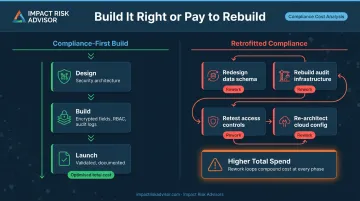
Build approach shapes compliance costs more than almost any other variable. NIST's Secure Software Development Framework explicitly supports building security in early, noting that shifting left minimizes technical debt from remediating security flaws late in development or after production.
For HIPAA apps, retrofitting compliance isn't just patching policies. It means:
- Redesigning encrypted fields in an existing data schema
- Rebuilding audit trail infrastructure after the fact
- Retesting entire codebases for access control gaps
- Re-architecting cloud configurations that weren't set up for HIPAA-eligible services
Retrofits consistently cost more than compliance-first builds. The architectural rework alone, before factoring in documentation and retesting, often exceeds what a proper initial build would have required.
Cloud Infrastructure and HIPAA-Eligible Services
AWS, Azure, and Google Cloud all support HIPAA workloads through BAA pathways. Google Cloud explicitly states that HIPAA-regulated customers receive the same products at the same pricing as other customers, so there's typically no special HIPAA cloud tier driving up costs.
The actual cost driver is configuration and ongoing operations. That work includes:
- Using only HIPAA-eligible services within each platform
- Implementing and maintaining audit logging
- Configuring access controls and encryption
- Producing and preserving compliance evidence
Signing a BAA is a separate action from using the platform. The BAA alone doesn't make your architecture compliant.
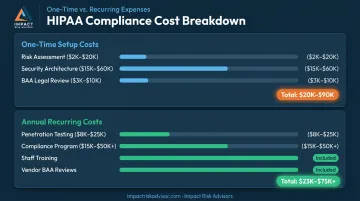
HIPAA Compliance Cost Breakdown: One-Time vs. Recurring
Teams that budget only for initial setup consistently underestimate total compliance spend. Here's how the cost splits across time.
One-Time Costs (Initial Setup)
Risk Assessment and Gap Analysis
A formal HIPAA risk analysis covers PHI data flows, threat and vulnerability identification, and gap analysis against the Security Rule. This is the foundational document that OCR will ask for in any investigation.
Cost range: $2,000–$20,000 depending on organization size, per Compliancy Group. A gap assessment scoped to include controls identification, testing, and a remediation roadmap runs around $10,000.
Impact Risk Advisors starts every HIPAA engagement with a Security Risk Analysis, defining what compliance actually requires for your specific app and PHI exposure, not applying generic controls that may not fit.
Security Architecture and Technical Safeguards
Initial build-out covers the core technical safeguard layer:
- AES-256 encryption at rest and TLS 1.2+ in transit
- Role-based access control (RBAC) design
- Audit logging infrastructure
- MFA integration
- HIPAA-eligible cloud configuration
Expect to budget $15,000–$60,000 depending on app complexity and existing infrastructure.
BAA Legal Review and Drafting
Initial legal setup covers BAA templates and privacy policy review. Marketplace data from ContractsCounsel shows average flat-fee proposals around $890, with individual drafting and review ranging from $240–$2,000 per agreement. A comprehensive BAA portfolio typically runs $3,000–$10,000 to set up properly.
Recurring Annual Costs
Penetration Testing
Professional pen testing is a HIPAA best practice and required by enterprise healthcare buyers before procurement approval. Annual testing is the minimum expectation.
Cost range: $8,000–$25,000 for a standard HIPAA penetration test, per Blaze InfoSec. Focused web app or API tests may start near $5,000; full mobile, API, and infrastructure combinations run higher.
Ongoing Compliance Program
Year two is where compliance budgets most often fall short. A maintained annual program covers:
- Continuous security monitoring and log review
- Vulnerability scanning and remediation
- Staff HIPAA training with documentation
- Policy updates for regulatory changes
- Annual risk reassessment
- Third-party compliance audits
- BAA portfolio reviews for new vendors
Annual recurring cost range: $15,000–$50,000+ depending on program depth, app complexity, and whether oversight is handled internally or through a vCISO engagement.
Low-Investment vs. High-Investment HIPAA Compliance
Not every compliance approach carries the same risk profile.
What "Checkbox" Compliance Looks Like
- Generic policy templates downloaded from the internet
- Internal self-audits only, no third-party validation
- No professional penetration testing
- Free or unvalidated monitoring tools
- BAA signing without verifying vendor capabilities
The real-world consequences are: undetected vulnerabilities that persist until a breach occurs, audit trails that won't hold up in an OCR investigation, and immediate disqualification from enterprise healthcare procurement reviews. Health systems run detailed security questionnaires before signing vendor contracts; a thin compliance program fails those reviews before negotiations even begin.
What a Properly Resourced Program Includes
- Professional risk assessment from a qualified firm
- Third-party penetration testing with remediation validation
- Dedicated compliance oversight: in-house officer or vCISO engagement
- Continuous monitoring with documented evidence
- Annual training with completion records
- Regular BAA audits as integrations change
This level of investment is what enterprise health system buyers and cyber insurance underwriters expect. It also directly lowers breach probability, and given the $10.93M average healthcare breach cost, that reduction is where the financial case for proper investment becomes undeniable.
Impact Risk Advisors' vCISO service addresses this directly, providing embedded compliance leadership for organizations that need ongoing HIPAA program governance, vendor oversight, and continuous monitoring without the overhead of a full-time hire.
How to Estimate the Right HIPAA Compliance Budget
The right compliance budget isn't the smallest number that avoids a fine. It's the investment level that matches your app's PHI risk, target market, and growth trajectory.
Key Inputs for Sizing Your Budget
- App complexity and PHI sensitivity: what data you handle determines encryption depth, logging scope, and testing requirements
- Current baseline: greenfield apps cost less than retrofitting existing products
- Integration count and type: each EHR and vendor connection adds development, BAA, and audit overhead
- Target customer segment: a consumer wellness app faces different expectations than a platform selling to enterprise health systems
- Growth milestones: major feature releases, new EHR integrations, and expanded user roles all trigger reassessment requirements
Working with a compliance advisor during the scoping phase helps you avoid two costly mistakes: over-engineering controls that don't match your actual risk profile, and under-investing in areas that leave serious exposure.
Common Budgeting Mistakes
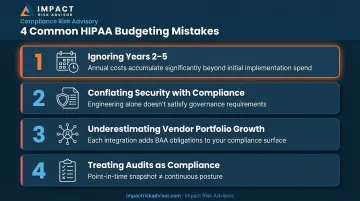
- Ignoring years 2–5: annual monitoring, pen testing, and training costs add up fast
- Conflating security with compliance: security engineering addresses vulnerabilities; compliance requires documentation, governance, and testing layers that development teams don't own
- Underestimating vendor portfolio growth: every new integration is a new BAA obligation; vendor portfolios grow faster than compliance programs typically account for
- Treating a point-in-time audit as a compliance program: a single audit snapshot doesn't maintain your posture; OCR expects continuous compliance, not an annual scramble
Frequently Asked Questions
How much does it cost to build a HIPAA compliant app?
HIPAA compliance overhead typically runs $40,000–$200,000+ depending on app complexity, separate from baseline development costs. Compliance commonly adds 15–25% to total development spend, though this varies widely by app type and PHI scope.
How do you get HIPAA compliance for an app?
Start with a formal risk analysis to map PHI flows, then implement technical safeguards: encryption, RBAC, audit logging, and MFA. Execute signed BAAs with all vendors, document policies, and establish ongoing monitoring and training to maintain compliance over time.
Are health apps covered by HIPAA?
Apps are covered by HIPAA if they handle PHI on behalf of a covered entity or business associate. General wellness apps with no provider connection typically fall outside scope, though many apps operate in gray areas. HHS's Mobile Health App resources provide guidance on where your app may fall.
Is SaaS HIPAA compliant?
SaaS platforms can be HIPAA compliant if they implement required safeguards and have a signed BAA in place. The platform's technical capability alone isn't enough; the BAA must be formally executed before any PHI touches the system. AWS, Azure, and GCP all offer HIPAA BAA pathways, but the customer remains responsible for proper configuration.
What are the new HIPAA regulations for 2025?
HHS published a proposed HIPAA Security Rule update on January 6, 2025, with the comment period closing March 7, 2025. The proposal would strengthen cybersecurity requirements for electronic PHI. Check the HHS Office for Civil Rights regulatory initiatives page for current status, and consult a compliance advisor to assess the concrete impact on your app architecture.
What is the compliance deadline for HIPAA?
HIPAA has no one-time deadline; it's a continuous obligation from the moment your app handles real PHI. Specific timelines do apply: breach notification to OCR must occur within 60 days of discovery, and patient access requests must be fulfilled within 30 calendar days (with one possible 30-day extension).